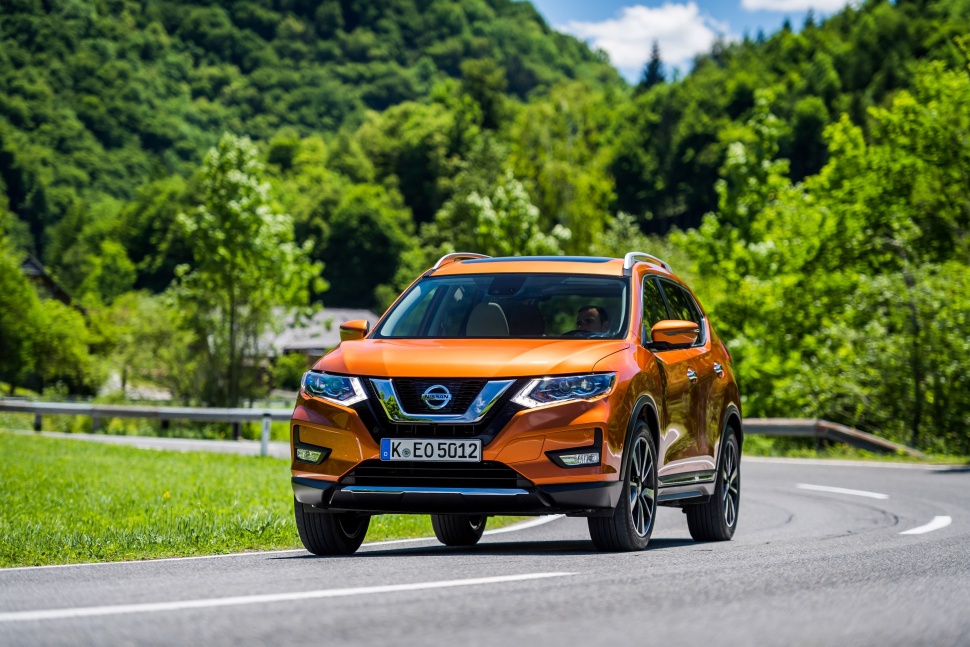
The Nissan X-Trail III (T32 series), particularly the facelifted version introduced in 2017, represents Nissan’s entry into the compact SUV segment. Marketed globally, the X-Trail holds a significant position in the European market as a practical and versatile family vehicle, competing with models like the Kia Sportage, Hyundai Tucson, and Volkswagen Tiguan. While not initially a major seller in the United States (Nissan offered the Rogue as its primary compact SUV), the X-Trail’s blend of space, efficiency, and available all-wheel drive made it a popular choice for buyers needing a capable and comfortable crossover. This article focuses on the 1.7 dCi (150 HP) 4x4i 7-seat variant produced between 2019 and 2020.
Nissan X-Trail III (T32) 1.7 dCi: An Overview
The T32 generation X-Trail, launched in 2014 and facelifted in 2017, brought a more refined and modern aesthetic to the X-Trail lineup. The facelift included updates to the front fascia, interior materials, and technology features. The 1.7 dCi engine option, paired with all-wheel drive and offering seven-seat configuration, was particularly popular in European markets where diesel engines and larger families are common. This model aimed to provide a balance between fuel economy, practicality, and passenger capacity.
Engine & Performance
The heart of the X-Trail 1.7 dCi is a 1.7-liter inline-four cylinder diesel engine, designated the R9N. This engine produces 150 horsepower at 3500 rpm and 340 Nm (250.77 lb-ft) of torque at 1750 rpm. The turbocharger and intercooler contribute to both power output and efficiency. The engine’s relatively high torque output at low engine speeds provides good responsiveness for everyday driving and towing. Power is delivered to all four wheels via a six-speed manual transmission, offering drivers a direct connection to the drivetrain. Acceleration from 0 to 100 km/h (0-62 mph) takes 10.7 seconds, while 0-60 mph is achieved in 10.2 seconds. The X-Trail 1.7 dCi reaches a maximum speed of 194 km/h (120.55 mph). Fuel economy is a strong point, with combined cycle figures ranging from 5.7 to 5.9 liters per 100 kilometers (41.3 to 39.9 US mpg), and CO2 emissions between 151 and 154 g/km, meeting Euro 6d-TEMP emission standards.
Design & Features
The Nissan X-Trail III is a five-door SUV offering seating for up to seven passengers, although the third-row seats are best suited for children or shorter journeys. The body style is a traditional SUV shape, prioritizing practicality and interior space. The 2017 facelift brought a more prominent V-motion grille, redesigned headlights, and updated taillights, giving the X-Trail a more contemporary look. Inside, the X-Trail offers a comfortable and well-equipped cabin. Key features include a touchscreen infotainment system, navigation, Bluetooth connectivity, and climate control. Safety features are comprehensive, including ABS (Anti-lock Braking System), electronic stability control, and multiple airbags. The available all-wheel-drive system enhances traction and stability in various driving conditions. The X-Trail’s interior is designed with family use in mind, offering flexible seating configurations and ample storage compartments. Trunk space ranges from 135 liters (4.77 cu. ft.) with all seats in use to a substantial 1877 liters (66.29 cu. ft.) with the rear seats folded down.
Technical Specifications
| Brand | Nissan |
| Model | X-Trail |
| Generation | X-Trail III (T32, facelift 2017) |
| Type (Engine) | 1.7 dCi (150 Hp) 4x4i 7 Seat |
| Start of production | January, 2019 |
| End of production | December, 2020 |
| Powertrain Architecture | Internal Combustion engine |
| Body type | SUV |
| Seats | 7 |
| Doors | 5 |
| Fuel consumption (urban) | 6.4-6.6 l/100 km (36.8 – 35.6 US mpg) |
| Fuel consumption (extra urban) | 5.3-5.4 l/100 km (44.4 – 43.6 US mpg) |
| Fuel consumption (combined) | 5.7-5.9 l/100 km (41.3 – 39.9 US mpg) |
| CO2 emissions | 151-154 g/km |
| Fuel Type | Diesel |
| Acceleration 0 – 100 km/h | 10.7 sec |
| Acceleration 0 – 62 mph | 10.7 sec |
| Acceleration 0 – 60 mph | 10.2 sec |
| Maximum speed | 194 km/h (120.55 mph) |
| Emission standard | Euro 6d-TEMP |
| Weight-to-power ratio | 11.9 kg/Hp |
| Weight-to-torque ratio | 5.3 kg/Nm |
| Power | 150 Hp @ 3500 rpm |
| Torque | 340 Nm @ 1750 rpm (250.77 lb.-ft. @ 1750 rpm) |
| Engine layout | Front, Transverse |
| Engine Model/Code | R9N |
| Engine displacement | 1749 cm3 (106.73 cu. in.) |
| Number of cylinders | 4 |
| Engine configuration | Inline |
| Cylinder Bore | 80 mm (3.15 in.) |
| Piston Stroke | 87 mm (3.43 in.) |
| Number of valves per cylinder | 4 |
| Fuel injection system | Diesel Commonrail |
| Engine aspiration | Turbocharger, Intercooler |
| Engine oil capacity | 5.9 l (6.23 US qt | 5.19 UK qt) |
| Coolant | 8.7 l (9.19 US qt | 7.65 UK qt) |
| Kerb Weight | 1790-1829 kg (3946.27 – 4032.25 lbs.) |
| Max. weight | 2360 kg (5202.91 lbs.) |
| Max load | 531-570 kg (1170.65 – 1256.63 lbs.) |
| Trunk (boot) space – minimum | 135 l (4.77 cu. ft.) |
| Trunk (boot) space – maximum | 1877 l (66.29 cu. ft.) |
| Fuel tank capacity | 60 l (15.85 US gal | 13.2 UK gal) |
| AdBlue tank | 17 l (4.49 US gal | 3.74 UK gal) |
| Max. roof load | 100 kg (220.46 lbs.) |
| Permitted trailer load with brakes (12%) | 2000 kg (4409.25 lbs.) |
| Permitted trailer load without brakes | 750 kg (1653.47 lbs.) |
| Permitted towbar download | 100 kg (220.46 lbs.) |
| Length | 4690 mm (184.65 in.) |
| Width | 1820-1830 mm (71.65 – 72.05 in.) |
| Height | 1700-1730 mm (66.93 – 68.11 in.) |
| Wheelbase | 2705 mm (106.5 in.) |
| Front track | 1575-1585 mm (62.01 – 62.4 in.) |
| Rear (Back) track | 1575-1585 mm (62.01 – 62.4 in.) |
| Ride height (ground clearance) | 210 mm (8.27 in.) |
| Minimum turning circle (turning diameter) | 11.2 m (36.75 ft.) |
| Drive wheel | All wheel drive (4×4) |
| Number of gears and type of gearbox | 6 gears, manual transmission |
| Front suspension | Independent type McPherson |
| Rear suspension | Independent multi-link suspension |
| Steering type | Steering rack and pinion |
| Power steering | Electric Steering |
| Tires size | 225/65 R17; 225/60 R18; 225/55 R19 |
| Wheel rims size | 7.0J x 17; 7.0J x 18; 7.0J x 19 |