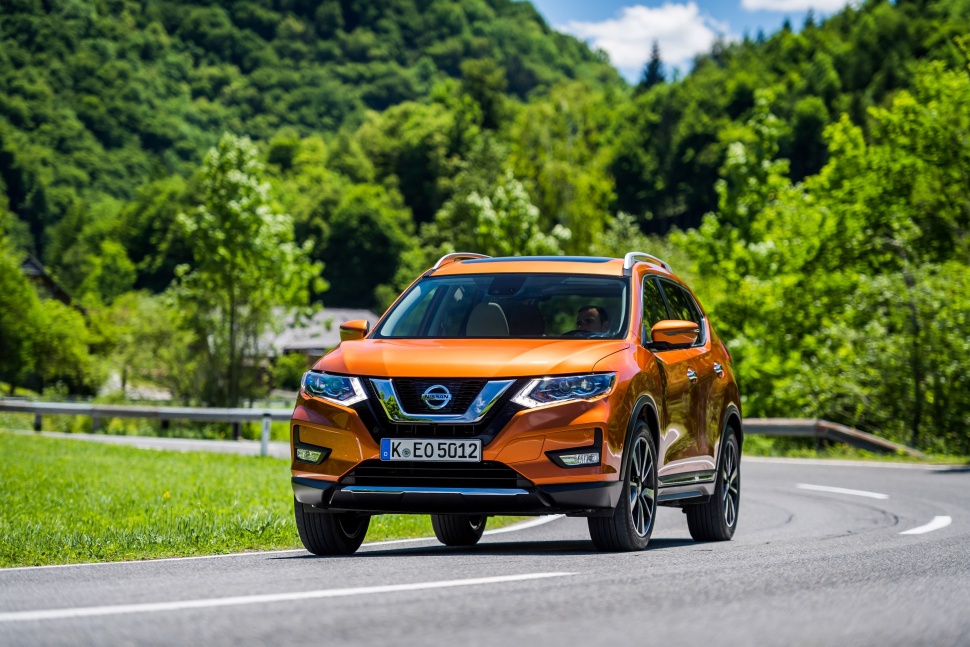
The Nissan X-Trail III (T32 series), particularly the facelifted version introduced in 2017, represents Nissan’s offering in the compact SUV segment. While not initially a major seller in the United States (Nissan discontinued X-Trail sales in the US in 2015), the X-Trail is a significant vehicle in European, Asian, and Australian markets, competing with models like the Kia Sportage, Hyundai Tucson, and Volkswagen Tiguan. The 2017 facelift brought styling updates, improved technology, and refinements to the powertrain, aiming to enhance the X-Trail’s appeal and competitiveness. This version, specifically the 2.0 dCi 177 Hp 4x4i, focused on providing a balance of fuel efficiency, practicality, and all-weather capability.
Nissan X-Trail III (T32, facelift 2017) 2.0 dCi 4x4i Overview
The T32 generation X-Trail, launched in 2014, marked a shift towards a more crossover-oriented design compared to its predecessor. The 2017 facelift further refined this aesthetic, with a more prominent V-motion grille, revised headlights, and updated interior materials. The 2.0 dCi engine, a mainstay in European Nissan offerings, provided a diesel-powered option for buyers prioritizing fuel economy and torque. The “4x4i” designation indicates Nissan’s intelligent all-wheel-drive system, offering enhanced traction and stability in various driving conditions. This model year was produced from 2017 until August 2018.
Engine & Performance
The heart of the 2017 Nissan X-Trail 2.0 dCi 4x4i is the M9R 2.0-liter inline-four cylinder diesel engine. This engine produces 177 horsepower at 3750 rpm and 380 Nm (280.27 lb.-ft.) of torque at 2000 rpm. The engine utilizes a diesel commonrail fuel injection system and a turbocharger with an intercooler to optimize performance and efficiency. The engine’s transverse mounting and all-wheel-drive configuration contribute to its balanced handling characteristics. Acceleration from 0 to 100 km/h (0-62 mph) takes 9.4 seconds, while 0-60 mph is achieved in 8.9 seconds. The X-Trail’s top speed is electronically limited to 204 km/h (126.76 mph). The engine meets Euro 6b emission standards, incorporating a particulate filter to reduce harmful emissions. The power-to-weight ratio is 9.2 kg/Hp, and the torque-to-weight ratio is 4.3 kg/Nm.
Design & Features
The Nissan X-Trail III is a five-door, five-seat SUV characterized by its robust styling and practical interior. The 2017 facelift brought a more refined appearance, with chrome accents and updated lighting elements. Inside, the X-Trail offers a spacious cabin with a focus on family-friendly usability. Key features include a comfortable seating arrangement, a user-friendly infotainment system (depending on trim level), and ample storage compartments. The rear seats can be folded down to expand cargo capacity from a minimum of 550 liters (19.42 cu. ft.) to a maximum of 1982 liters (69.99 cu. ft.). Safety features, crucial for a modern SUV, include ABS (Anti-lock Braking System), and a comprehensive airbag system. The vehicle’s ride height of 210 mm (8.27 in) provides good ground clearance for navigating varied terrain. The X-Trail’s approach, departure, and ramp-over angles (18°, 27°, and 20° respectively) further enhance its off-road capability.
Technical Specifications
| Brand | Nissan |
| Model | X-Trail |
| Generation | X-Trail III (T32, facelift 2017) |
| Type (Engine) | 2.0 dCi (177 Hp) 4x4i |
| Start of production | 2017 |
| End of production | August, 2018 |
| Powertrain Architecture | Internal Combustion engine |
| Body type | SUV |
| Seats | 5 |
| Doors | 5 |
| Fuel consumption (urban) | 6.3-6.7 l/100 km (37.3 – 35.1 US mpg, 44.8 – 42.2 UK mpg, 15.9 – 14.9 km/l) |
| Fuel consumption (extra urban) | 5.2-5.3 l/100 km (45.2 – 44.4 US mpg, 54.3 – 53.3 UK mpg, 19.2 – 18.9 km/l) |
| Fuel consumption (combined) | 5.6-5.8 l/100 km (42 – 40.6 US mpg, 50.4 – 48.7 UK mpg, 17.9 – 17.2 km/l) |
| CO2 emissions | 149-153 g/km |
| Fuel Type | Diesel |
| Acceleration 0 – 100 km/h | 9.4 sec |
| Acceleration 0 – 62 mph | 9.4 sec |
| Acceleration 0 – 60 mph | 8.9 sec |
| Maximum speed | 204 km/h (126.76 mph) |
| Emission standard | Euro 6 b |
| Weight-to-power ratio | 9.2 kg/Hp |
| Weight-to-torque ratio | 4.3 kg/Nm |
| Power | 177 Hp @ 3750 rpm |
| Torque | 380 Nm @ 2000 rpm (280.27 lb.-ft. @ 2000 rpm) |
| Engine layout | Front, Transverse |
| Engine Model/Code | M9R |
| Engine displacement | 1995 cm3 (121.74 cu. in.) |
| Number of cylinders | 4 |
| Engine configuration | Inline |
| Cylinder Bore | 84 mm (3.31 in.) |
| Piston Stroke | 90 mm (3.54 in.) |
| Number of valves per cylinder | 4 |
| Fuel injection system | Diesel Commonrail |
| Engine aspiration | Turbocharger, Intercooler |
| Engine oil capacity | 7.4 l (7.82 US qt | 6.51 UK qt) |
| Coolant | 7.7 l (8.14 US qt | 6.78 UK qt) |
| Kerb Weight | 1625-1713 kg (3582.51 – 3776.52 lbs.) |
| Max. weight | 2190 kg (4828.12 lbs.) |
| Max load | 477-565 kg (1051.6 – 1245.61 lbs.) |
| Trunk (boot) space – minimum | 550 l (19.42 cu. ft.) |
| Trunk (boot) space – maximum | 1982 l (69.99 cu. ft.) |
| Fuel tank capacity | 60 l (15.85 US gal | 13.2 UK gal) |
| Max. roof load | 100 kg (220.46 lbs.) |
| Permitted trailer load with brakes (12%) | 2000 kg (4409.25 lbs.) |
| Permitted trailer load without brakes | 750 kg (1653.47 lbs.) |
| Permitted towbar download | 100 kg (220.46 lbs.) |
| Length | 4690 mm (184.65 in.) |
| Width | 1820-1830 mm (71.65 – 72.05 in.) |
| Height | 1700-1730 mm (66.93 – 68.11 in.) |
| Wheelbase | 2705 mm (106.5 in.) |
| Front track | 1575-1585 mm (62.01 – 62.4 in.) |
| Rear (Back) track | 1575-1585 mm (62.01 – 62.4 in.) |
| Ride height (ground clearance) | 210 mm (8.27 in.) |
| Minimum turning circle (turning diameter) | 11.2 m (36.75 ft.) |
| Drive wheel | All wheel drive (4×4) |
| Number of gears and type of gearbox | 6 gears, manual transmission |
| Front suspension | Independent, type McPherson with coil spring and anti-roll bar |
| Rear suspension | Independent multi-link suspension |
| Front brakes | Ventilated discs |
| Rear brakes | Ventilated discs |
| Steering type | Steering rack and pinion |
| Power steering | Electric Steering |
| Tires size | 225/65 R17; 225/60 R18; 225/55 R19 |
| Wheel rims size | 17; 18; 19 |