The Nissan X-Trail III (T32), particularly the facelifted version introduced in 2017, represents a significant iteration of Nissan’s popular compact SUV. Sold globally, the X-Trail occupies a crucial position in Nissan’s lineup, offering a blend of practicality, comfort, and technology aimed at families and individuals seeking a versatile vehicle. The 2.0 dCi variant, equipped with the Xtronic continuously variable transmission and seven-seat configuration, was a key offering in European markets, where diesel engines remained highly prevalent. This model aimed to provide efficient performance and ample space for passengers and cargo.
Nissan X-Trail III (T32, 2017 Facelift) 2.0 dCi Xtronic
The T32 generation X-Trail, launched initially in 2014, received a substantial facelift in 2017, bringing revised styling, updated technology, and refinements to the powertrain. The 2.0 dCi model, powered by the Renault-Nissan Alliance’s M9R engine, was a mainstay of the X-Trail range, particularly in Europe. It catered to buyers prioritizing fuel economy and torque for towing or navigating varied terrain. The Xtronic transmission offered smooth, stepless gear changes, enhancing the driving experience and contributing to improved fuel efficiency. The availability of a seven-seat option further broadened the X-Trail’s appeal, making it a viable choice for larger families.
Engine & Performance
The heart of the 2017 Nissan X-Trail 2.0 dCi is the M9R 2.0-liter inline-four cylinder diesel engine. This engine produces 177 horsepower at 3750 rpm and 380 Nm (280.27 lb.-ft.) of torque at 2000 rpm. The turbocharger and intercooler work in concert to optimize power delivery and efficiency. The engine’s transverse mounting and the use of a diesel common rail fuel injection system contribute to its responsiveness and refined operation. Paired with the Xtronic continuously variable transmission (CVT), the X-Trail delivers smooth acceleration and efficient cruising. Acceleration from 0 to 100 km/h (0-62 mph) takes 9.6 seconds, while 0-60 mph is achieved in 9.1 seconds. The vehicle boasts a maximum speed of 199 km/h (123.65 mph). Fuel economy is rated at 5.6-5.8 l/100 km (42-40.6 US mpg) combined, with CO2 emissions ranging from 148-152 g/km, meeting Euro 6b emission standards.
Design & Features
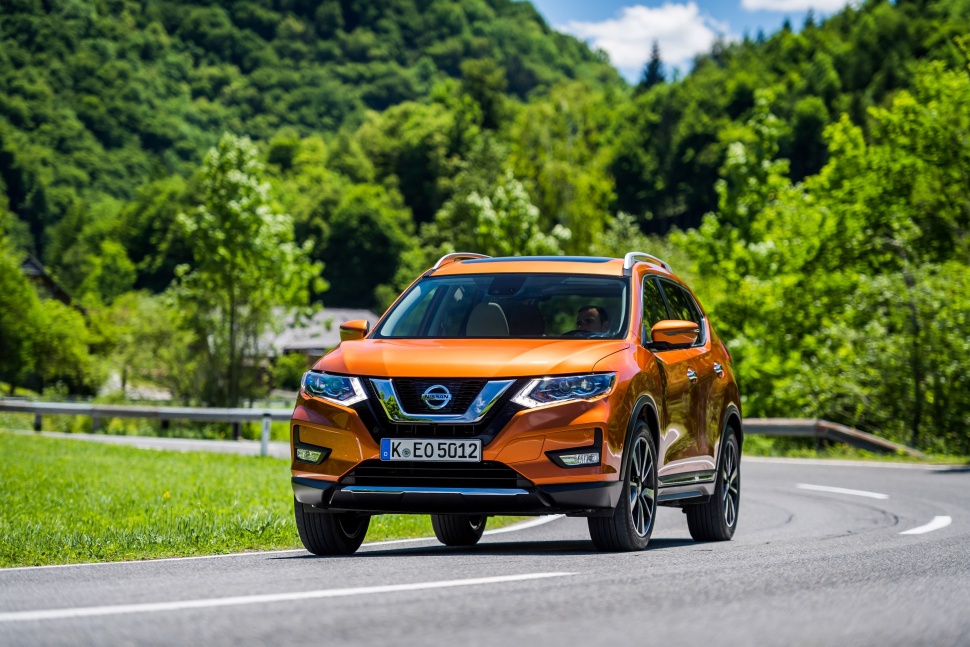
The 2017 facelift brought a more modern and aggressive aesthetic to the X-Trail. The SUV features a prominent V-motion grille, redesigned headlights, and revised bumpers. The body style is a classic five-door SUV, with the option of a seven-seat configuration. The interior focuses on practicality and comfort, with a spacious cabin and flexible seating arrangements. Key features include a user-friendly infotainment system, climate control, and a range of safety technologies. The seven-seat option provides additional versatility, although the third-row seats are best suited for children or occasional use. The X-Trail’s generous trunk space, ranging from 135 liters (4.77 cu. ft.) with all seats up to 1877 liters (66.29 cu. ft.) with the rear seats folded down, enhances its practicality. Ground clearance of 210 mm (8.27 in) provides reasonable off-road capability for light trails and uneven surfaces.
Technical Specifications
| Brand | Nissan |
| Model | X-Trail |
| Generation | X-Trail III (T32, facelift 2017) |
| Type (Engine) | 2.0 dCi (177 Hp) Xtronic 7 Seat |
| Start of production | 2017 |
| End of production | August, 2018 |
| Powertrain Architecture | Internal Combustion engine |
| Body type | SUV |
| Seats | 7 |
| Doors | 5 |
| Fuel consumption (urban) | 6.2-6.4 l/100 km (37.9 – 36.8 US mpg) |
| Fuel consumption (extra urban) | 5.3-5.4 l/100 km (44.4 – 43.6 US mpg) |
| Fuel consumption (combined) | 5.6-5.8 l/100 km (42 – 40.6 US mpg) |
| CO2 emissions | 148-152 g/km |
| Fuel Type | Diesel |
| Acceleration 0 – 100 km/h | 9.6 sec |
| Acceleration 0 – 62 mph | 9.6 sec |
| Acceleration 0 – 60 mph | 9.1 sec |
| Maximum speed | 199 km/h (123.65 mph) |
| Emission standard | Euro 6 b |
| Weight-to-power ratio | 9.4 kg/Hp |
| Weight-to-torque ratio | 4.4 kg/Nm |
| Power | 177 Hp @ 3750 rpm |
| Torque | 380 Nm @ 2000 rpm (280.27 lb.-ft. @ 2000 rpm) |
| Engine layout | Front, Transverse |
| Engine Model/Code | M9R |
| Engine displacement | 1995 cm3 (121.74 cu. in.) |
| Number of cylinders | 4 |
| Engine configuration | Inline |
| Cylinder Bore | 84 mm (3.31 in.) |
| Piston Stroke | 90 mm (3.54 in.) |
| Number of valves per cylinder | 4 |
| Fuel injection system | Diesel Commonrail |
| Engine aspiration | Turbocharger, Intercooler |
| Engine oil capacity | 7.4 l (7.82 US qt | 6.51 UK qt) |
| Coolant | 7.9 l (8.35 US qt | 6.95 UK qt) |
| Kerb Weight | 1655-1748 kg (3648.65 – 3853.68 lbs.) |
| Max. weight | 2170 kg (4784.03 lbs.) |
| Max load | 422-515 kg (930.35 – 1135.38 lbs.) |
| Trunk (boot) space – minimum | 135 l (4.77 cu. ft.) |
| Trunk (boot) space – maximum | 1877 l (66.29 cu. ft.) |
| Fuel tank capacity | 60 l (15.85 US gal | 13.2 UK gal) |
| Max. roof load | 100 kg (220.46 lbs.) |
| Permitted trailer load with brakes (12%) | 1650 kg (3637.63 lbs.) |
| Permitted trailer load without brakes | 750 kg (1653.47 lbs.) |
| Permitted towbar download | 75 kg (165.35 lbs.) |
| Length | 4690 mm (184.65 in.) |
| Width | 1820-1830 mm (71.65 – 72.05 in.) |
| Height | 1700-1730 mm (66.93 – 68.11 in.) |
| Wheelbase | 2705 mm (106.5 in.) |
| Front track | 1575-1585 mm (62.01 – 62.4 in.) |
| Rear (Back) track | 1575-1585 mm (62.01 – 62.4 in.) |
| Ride height (ground clearance) | 210 mm (8.27 in.) |
| Minimum turning circle (turning diameter) | 11.2 m (36.75 ft.) |