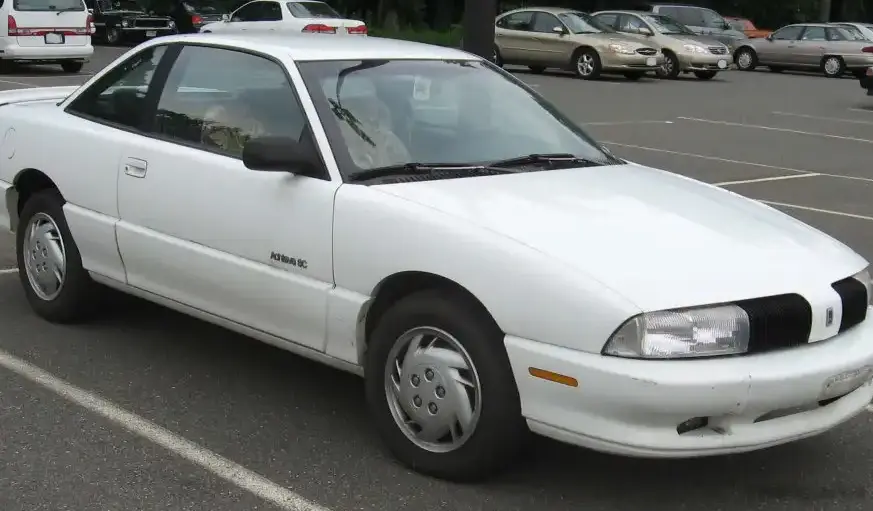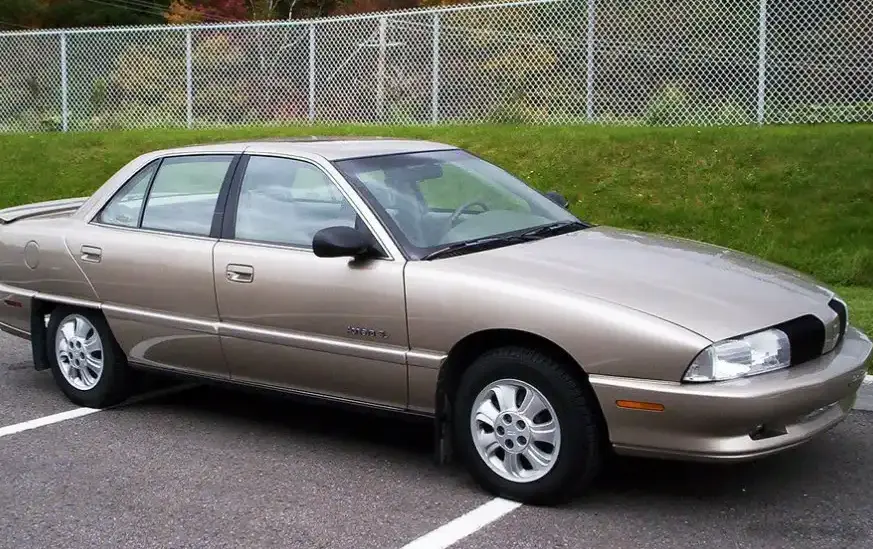
The Oldsmobile Achieva 2.3 16V, produced from 1991 to 1998, represented a significant entry in the compact sedan market for General Motors. Positioned as a mainstream offering within the Achieva lineup, the 2.3-liter, 16-valve engine paired with a 3-speed automatic transmission aimed to provide a balance of affordability, fuel efficiency, and acceptable performance for the average commuter. It was part of the first generation of the Achieva (1992-1998), built on the GM N-body platform, which was also shared with the Buick Skylark and Pontiac Grand Am. This model sought to modernize Oldsmobile’s image and compete with increasingly popular Japanese imports.
Technical Specifications
| Brand | Oldsmobile |
| Model | Achieva |
| Generation | Achieva |
| Type (Engine) | 2.3 16V (150 Hp) |
| Start of production | 1991 year |
| End of production | 1998 year |
| Powertrain Architecture | Internal Combustion engine |
| Body type | Sedan |
| Seats | 5 |
| Doors | 4 |
| Fuel consumption (economy) – combined | 9.4 l/100 km |
| Fuel consumption (economy) – combined | 25 US mpg |
| Fuel consumption (economy) – combined | 30.1 UK mpg |
| Fuel consumption (economy) – combined | 10.6 km/l |
| Fuel Type | Petrol (Gasoline) |
| Weight-to-power ratio | 8.5 kg/Hp |
| Weight-to-power ratio | 117.8 Hp/tonne |
| Weight-to-torque ratio | 6.3 kg/Nm |
| Weight-to-torque ratio | 159.5 Nm/tonne |
| Power | 150 Hp @ 6000 rpm |
| Power per litre | 66.4 Hp/l |
| Torque | 203 Nm @ 4800 rpm |
| Torque | 149.73 lb.-ft. @ 4800 rpm |
| Engine layout | Front, Transverse |
| Engine Model/Code | LD2 |
| Engine displacement | 2260 cm3 |
| Engine displacement | 137.91 cu. in. |
| Number of cylinders | 4 |
| Engine configuration | Inline |
| Cylinder Bore | 92 mm |
| Cylinder Bore | 3.62 in. |
| Piston Stroke | 85 mm |
| Piston Stroke | 3.35 in. |
| Compression ratio | 9.5:1 |
| Number of valves per cylinder | 4 |
| Fuel injection system | Multi-port manifold injection |
| Engine aspiration | Naturally aspirated engine |
| Valvetrain | DOHC |
| Engine oil capacity | 4.3 l |
| Engine oil capacity | 4.54 US qt |
| Engine oil capacity | 3.78 UK qt |
| Coolant | 9.8 l |
| Coolant | 10.36 US qt |
| Coolant | 8.62 UK qt |
| Kerb Weight | 1273 kg |
| Kerb Weight | 2806.48 lbs |
| Trunk (boot) space – minimum | 396 l |
| Trunk (boot) space – minimum | 13.98 cu. ft. |
| Fuel tank capacity | 58 l |
| Fuel tank capacity | 15.32 US gal |
| Fuel tank capacity | 12.76 UK gal |
| Length | 4772 mm |
| Length | 187.87 in. |
| Width | 1715 mm |
| Width | 67.52 in. |
| Height | 1357 mm |
| Height | 53.43 in. |
| Wheelbase | 2627 mm |
| Wheelbase | 103.43 in. |
| Front track | 1419 mm |
| Front track | 55.87 in. |
| Rear (Back) track | 1407 mm |
| Rear (Back) track | 55.39 in. |
| Drivetrain Architecture | The Internal combustion engine (ICE) drives the front wheels of the vehicle. |
| Drive wheel | Front wheel drive |
| Number of gears and type of gearbox | 3 gears, automatic transmission |
| Front suspension | Coil spring |
| Rear suspension | Coil spring |
| Front brakes | Ventilated discs |
| Rear brakes | Drum |
| Assisting systems | ABS (Anti-lock braking system) |
| Steering type | Steering rack and pinion |
| Power steering | Hydraulic Steering |
| Tires size | 185/75 R14 S |
Powertrain & Engine Architecture
The heart of the Achieva 2.3 was the LD2 engine, a 2.3-liter inline-four cylinder powerplant. This engine featured a dual overhead camshaft (DOHC) valvetrain operating 16 valves (four per cylinder), contributing to improved breathing and higher-end power compared to older pushrod designs. The LD2 utilized multi-port fuel injection, delivering fuel directly to each intake port for precise fuel metering and efficient combustion. The 3-speed automatic transmission, a common GM unit of the era (likely the 3T45), was chosen for its simplicity and cost-effectiveness. While not known for its sporty responsiveness, it provided smooth, if somewhat leisurely, shifts. The engine’s design prioritized reliability and fuel economy over outright performance.
Driving Characteristics
The 150 horsepower and 203 Nm (149.73 lb-ft) of torque delivered by the 2.3-liter engine and automatic transmission resulted in adequate, but not exhilarating, performance. Acceleration from 0 to 60 mph was estimated to be around 10-11 seconds. The automatic transmission’s gear ratios were geared towards fuel efficiency, meaning the engine often felt strained during quick acceleration or when climbing hills. Compared to the available 3.1-liter V6 engine option, the 2.3 automatic was noticeably slower. However, it offered a smoother and more relaxed driving experience than the 5-speed manual version of the 2.3, which required more frequent shifting to maintain momentum. The automatic was favored by drivers prioritizing comfort and ease of use.
Equipment & Trim Levels
The Achieva 2.3 with the automatic transmission typically came standard with features considered essential for the time, including air conditioning, power steering, an AM/FM stereo, and cloth upholstery. Higher trim levels, such as the SL or S, added features like upgraded sound systems, power windows and locks, cruise control, and alloy wheels. Interior color options were generally limited to shades of gray, blue, and beige. Optional extras included a sunroof, upgraded seating materials, and a CD player. The base model was fairly spartan, while the higher trims offered a more comfortable and refined experience.
Chassis & Braking
The Achieva’s chassis employed a front-engine, front-wheel-drive layout. Suspension consisted of coil springs at all four corners, providing a reasonably comfortable ride. The front suspension utilized MacPherson struts, while the rear employed a semi-independent twist-beam setup. Braking duties were handled by ventilated discs at the front and drum brakes at the rear. Anti-lock braking system (ABS) was available, particularly on higher trim levels, enhancing safety. The Achieva’s suspension tuning prioritized ride comfort over sporty handling, making it a suitable choice for everyday commuting.
Market Reception & Comparison
The Achieva 2.3 automatic was generally well-received as a practical and affordable family sedan. Critics praised its fuel efficiency and comfortable ride, but noted its lack of sporty performance. Compared to the V6-powered Achieva, the 2.3 automatic offered significantly better fuel economy (around 25 mpg combined) but considerably less power. Against competitors like the Honda Accord and Toyota Camry, the Achieva offered a lower price point but lacked the same level of refinement and brand prestige. Reliability was generally considered average for the era, with some reports of minor issues with the automatic transmission and fuel injection system.
Legacy
The Oldsmobile Achieva, while not a groundbreaking vehicle, played a role in Oldsmobile’s attempt to modernize its image in the 1990s. The 2.3-liter LD2 engine proved to be a relatively durable and reliable powerplant, and many examples remain on the road today. However, the Achieva’s association with a brand that ultimately disappeared in 2004 has limited its collectibility. In the used car market, Achieva 2.3 automatics are typically found at very affordable prices, making them a budget-friendly option for those seeking basic transportation. Parts availability is generally good, as many components were shared with other GM vehicles of the same era. The Achieva 2.3 automatic represents a snapshot of American automotive engineering in the 1990s – a focus on practicality, affordability, and fuel efficiency.