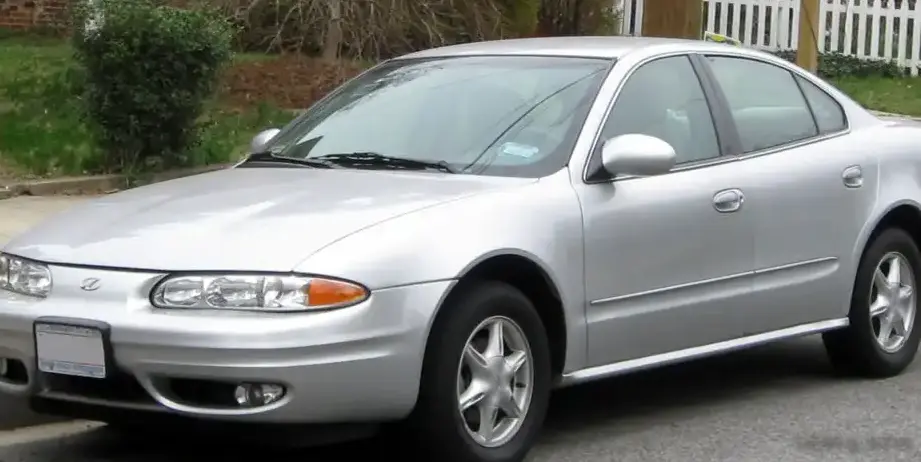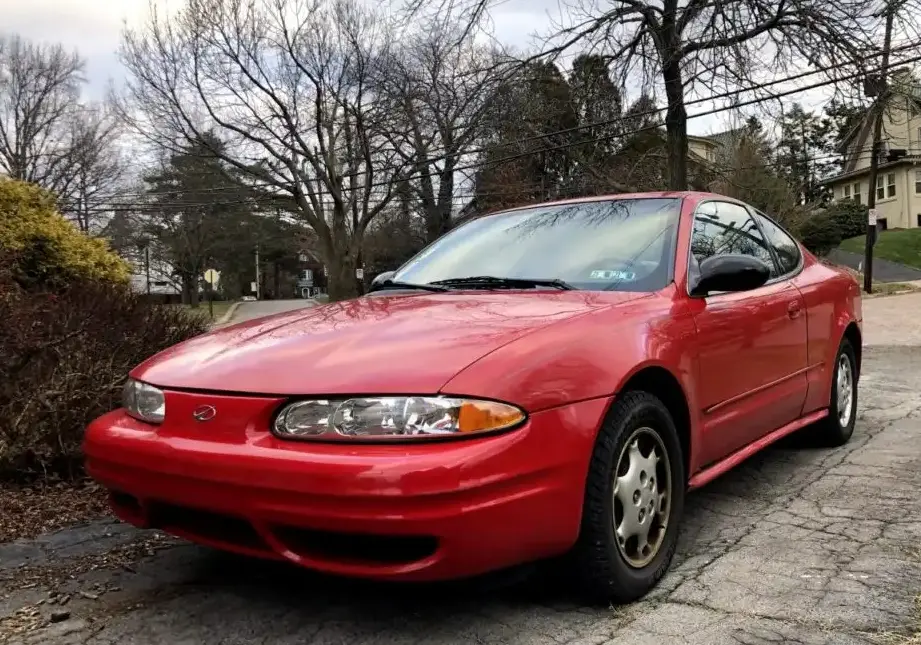
The Oldsmobile Alero Coupe 2.4 16V, producing 152 horsepower, was a front-wheel drive coupe manufactured by General Motors from 1998 to 2001. It represented Oldsmobile’s entry into the increasingly popular coupe market, aiming to provide a stylish and relatively affordable option for buyers. This variant occupied a mid-range position within the Alero lineup, slotting between the base 2.2L engine and the more powerful supercharged 3.4L versions. The Alero, as a whole, was built on GM’s N-body platform, shared with other vehicles like the Buick Cutlass and Pontiac Grand Am, but the coupe distinguished itself with a more sporty aesthetic.
Technical Specifications
| Brand | Oldsmobile |
| Model | Alero |
| Generation | Alero Coupe |
| Type (Engine) | 2.4 16V (152 Hp) |
| Start of production | April, 1998 |
| End of production | 2001 |
| Powertrain Architecture | Internal Combustion engine |
| Body type | Coupe |
| Seats | 5 |
| Doors | 2 |
| Fuel consumption (urban) | 10.7 l/100 km (22 US mpg) |
| Fuel consumption (extra urban) | 7.4 l/100 km (31.8 US mpg) |
| Fuel Type | Petrol (Gasoline) |
| Acceleration 0 – 100 km/h | 10.8 sec |
| Acceleration 0 – 62 mph | 10.8 sec |
| Acceleration 0 – 60 mph | 10.3 sec |
| Maximum speed | 180 km/h (111.85 mph) |
| Weight-to-power ratio | 8.8 kg/Hp |
| Weight-to-torque ratio | 6.6 kg/Nm |
| Power | 152 Hp @ 5600 rpm |
| Torque | 203 Nm @ 4400 rpm (149.73 lb.-ft. @ 4400 rpm) |
| Engine layout | Front, Transverse |
| Engine Model/Code | LD9 |
| Engine displacement | 2392 cm3 (145.97 cu. in.) |
| Number of cylinders | 4 |
| Engine configuration | Inline |
| Cylinder Bore | 90 mm (3.54 in.) |
| Piston Stroke | 94 mm (3.7 in.) |
| Compression ratio | 9.5:1 |
| Number of valves per cylinder | 4 |
| Fuel injection system | Multi-port manifold injection |
| Engine aspiration | Naturally aspirated |
| Engine oil capacity | 3.8 l (4.02 US qt | 3.34 UK qt) |
| Coolant capacity | 9.5 l (10.04 US qt | 8.36 UK qt) |
| Kerb Weight | 1340 kg (2954.19 lbs.) |
| Trunk (boot) space | 435 l (15.36 cu. ft.) |
| Fuel tank capacity | 57 l (15.06 US gal | 12.54 UK gal) |
| Length | 4740 mm (186.61 in.) |
| Width | 1780 mm (70.08 in.) |
| Height | 1390 mm (54.72 in.) |
| Wheelbase | 2720 mm (107.09 in.) |
| Front track | 1500 mm (59.06 in.) |
| Rear track | 1505 mm (59.25 in.) |
| Drivetrain Architecture | Front wheel drive |
| Number of gears | 4 |
| Gearbox type | Automatic transmission |
| Front suspension | Spring Strut |
| Rear suspension | Double wishbone |
| Front brakes | Ventilated discs |
| Rear brakes | Disc |
| Assisting systems | ABS (Anti-lock braking system) |
| Steering type | Steering rack and pinion |
| Power steering | Hydraulic |
| Tires size | 215/60 R15 |
Powertrain & Engine Architecture
The heart of the Alero Coupe 2.4 was the LD9 engine, a 2.4-liter inline-four cylinder powerplant. This engine utilized a cast iron block with an aluminum cylinder head, a common configuration for GM’s four-cylinder engines of the era. The LD9 featured multi-port fuel injection, delivering fuel directly into each intake port for improved combustion efficiency. The engine employed a double overhead camshaft (DOHC) valvetrain with four valves per cylinder, enhancing breathing and contributing to its 152 horsepower output. The automatic transmission paired with this engine was a 4-speed 4T45-E unit. This transmission was known for its smooth operation but wasn’t particularly sporty or fuel-efficient compared to later designs. The 4T45-E featured electronically controlled shifting, adapting to driving conditions and throttle input.
Driving Characteristics
The 152-horsepower 2.4L engine, coupled with the 4-speed automatic, provided adequate, but not exhilarating, performance. Acceleration from 0-60 mph took around 10.3 seconds, making it competitive with other mid-size coupes of the time. The automatic transmission’s gear ratios were geared more towards comfort and fuel economy than outright speed. Compared to the available supercharged 3.4L V6, the 2.4L felt noticeably less powerful, especially during highway passing maneuvers. The manual transmission versions of the 2.4L offered a more engaging driving experience, but the automatic was favored by buyers prioritizing convenience. The front-wheel drive configuration provided predictable handling, but lacked the dynamic capabilities of rear-wheel drive alternatives.
Equipment & Trim Levels
The Alero Coupe 2.4 typically came standard with features like air conditioning, power windows and locks, an AM/FM stereo, and cloth upholstery. Optional extras included a CD player, upgraded sound system, power sunroof, and leather upholstery. The trim levels varied slightly over the production run, but generally, the 2.4L model was positioned as the base or mid-level offering. Higher trims, like the GL, added more convenience features and cosmetic enhancements. Interior materials were generally of average quality for the price point, with a focus on durability rather than luxury.
Chassis & Braking
The Alero Coupe utilized a front-wheel drive chassis with independent front suspension featuring coil springs and a strut design. The rear suspension employed a semi-independent double wishbone setup. Braking duties were handled by ventilated discs up front and solid discs in the rear. Anti-lock brakes (ABS) were standard, enhancing safety and control during emergency braking situations. The suspension tuning was geared towards a comfortable ride, prioritizing smoothness over sporty handling. Stabilizer bars were included at both the front and rear to reduce body roll during cornering, but the overall handling characteristics were considered somewhat soft.
Market Reception & Comparison
The Alero Coupe 2.4 received mixed reviews from automotive critics. While praised for its styling and comfortable ride, it was often criticized for its lack of performance and somewhat bland interior. Compared to the supercharged 3.4L Alero, the 2.4L offered significantly lower fuel consumption, achieving around 22 mpg in the city and 32 mpg on the highway. However, the 3.4L provided a much more engaging driving experience. The Alero also faced competition from other coupes in its class, such as the Honda Civic Coupe and the Nissan Sentra Coupe, which often offered better handling and fuel economy.
Legacy
The Oldsmobile Alero, and specifically the 2.4L automatic variant, has become a relatively affordable and accessible used car. The LD9 engine is generally considered reliable, although regular maintenance is crucial to prevent issues like oil leaks and timing chain wear. The 4T45-E automatic transmission is also reasonably durable, but can experience problems with the torque converter or valve body over time. Today, the Alero Coupe 2.4 is often sought after by those looking for a budget-friendly coupe with decent fuel economy and a comfortable ride. While it may not be a performance icon, it represents a significant chapter in Oldsmobile’s history and offers a glimpse into the automotive landscape of the late 1990s and early 2000s.