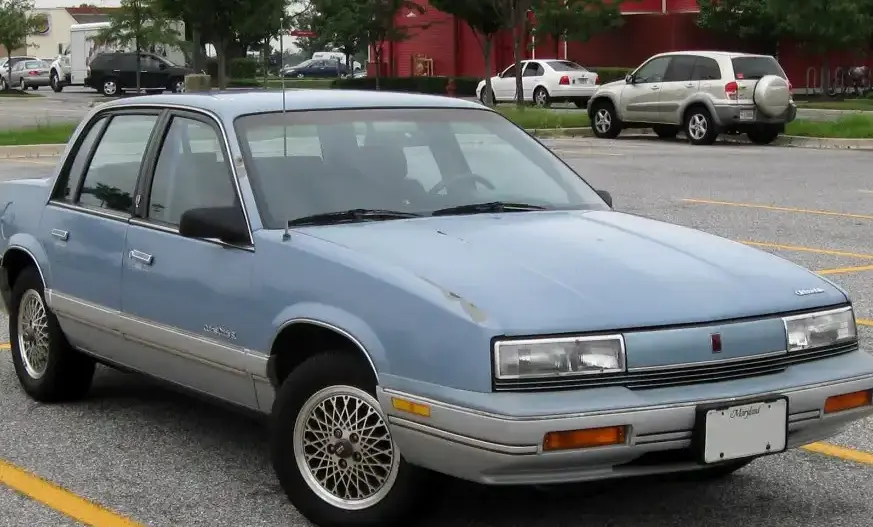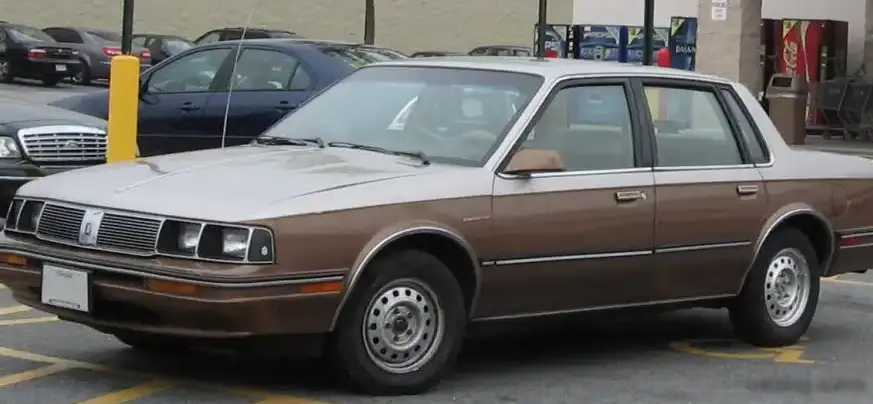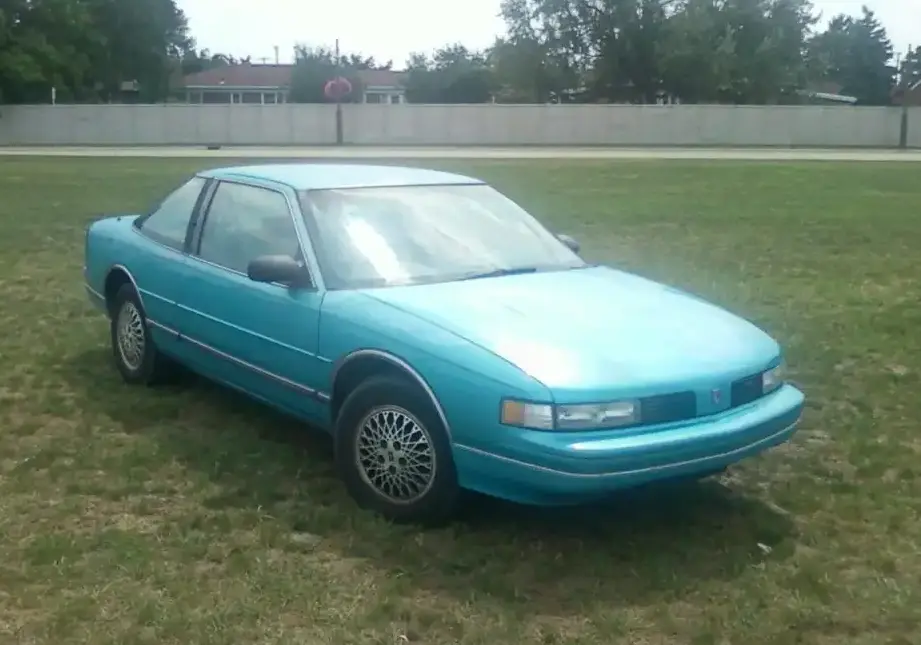
The Oldsmobile Cutlass Supreme Coupe with the 2.3-liter 16-valve (162 hp) engine was a mainstay of the American automotive landscape from 1987 through 1997. Representing the fifth generation of the Cutlass Supreme, this variant occupied a crucial position in Oldsmobile’s lineup as an entry-level offering, aimed at buyers seeking a comfortable, stylish coupe without the expense of the larger engines or more luxurious trim packages. It was part of the broader GM A-body platform, shared with models like the Buick Century and Pontiac 6000, and represented a shift towards more fuel-efficient and compact personal coupes.
Technical Specifications
| Brand | Oldsmobile |
| Model | Cutlass |
| Generation | Cutlass Supreme Coupe |
| Type (Engine) | 2.3 16 (162 Hp) |
| Start of production | 1987 |
| End of production | 1997 |
| Powertrain Architecture | Internal Combustion engine |
| Body type | Coupe |
| Seats | 5 |
| Doors | 2 |
| Fuel consumption (urban) | 16 l/100 km (14.7 US mpg) |
| Fuel consumption (extra urban) | 9 l/100 km (26.1 US mpg) |
| Fuel Type | Petrol (Gasoline) |
| Maximum speed | 190 km/h (118.06 mph) |
| Weight-to-power ratio | 8.9 kg/Hp |
| Weight-to-torque ratio | 6.9 kg/Nm |
| Power | 162 Hp @ 6200 rpm |
| Power per litre | 71.7 Hp/l |
| Torque | 210 Nm @ 5200 rpm (154.89 lb.-ft. @ 5200 rpm) |
| Engine layout | Front, Transverse |
| Engine Model/Code | LD2 |
| Engine displacement | 2260 cm3 (137.91 cu. in.) |
| Number of cylinders | 4 |
| Engine configuration | Inline |
| Cylinder Bore | 92 mm (3.62 in.) |
| Piston Stroke | 85 mm (3.35 in.) |
| Compression ratio | 9.5:1 |
| Number of valves per cylinder | 4 |
| Fuel injection system | Multi-port manifold injection |
| Engine aspiration | Naturally aspirated engine |
| Valvetrain | DOHC |
| Engine oil capacity | 4.3 l (4.54 US qt | 3.78 UK qt) |
| Coolant | 10.5 l (11.1 US qt | 9.24 UK qt) |
| Kerb Weight | 1445 kg (3185.68 lbs.) |
| Trunk (boot) space – minimum | 490 l (17.3 cu. ft.) |
| Fuel tank capacity | 63 l (16.64 US gal | 13.86 UK gal) |
| Length | 4900 mm (192.91 in.) |
| Width | 1805 mm (71.06 in.) |
| Height | 1350 mm (53.15 in.) |
| Wheelbase | 2730 mm (107.48 in.) |
| Front track | 1510 mm (59.45 in.) |
| Rear (Back) track | 1470 mm (57.87 in.) |
| Drivetrain Architecture | Front wheel drive |
| Drive wheel | Front wheel drive |
| Number of gears and type of gearbox | 3 gears, automatic transmission |
| Front suspension | Coil spring |
| Rear suspension | Leaf spring |
| Front brakes | Ventilated discs |
| Rear brakes | Disc |
| Assisting systems | ABS (Anti-lock braking system) |
| Steering type | Steering rack and pinion |
| Power steering | Hydraulic Steering |
| Tires size | 195/75 R14 S |
Powertrain & Engine Architecture
The heart of this Cutlass Supreme was the LD2 2.3-liter inline-four engine. This engine was a member of Oldsmobile’s “Quad 4” family, though it differed from the more performance-oriented versions. It featured a dual overhead camshaft (DOHC) valvetrain with four valves per cylinder, contributing to its relatively high output for its displacement. The engine utilized multi-port fuel injection, a significant advancement over earlier carburetor-based systems, improving fuel efficiency and responsiveness. The 3-speed automatic transmission, a TH125C, was a common unit in GM vehicles of the era. It was chosen for its smoothness and affordability, prioritizing comfort over outright performance. The transmission’s gear ratios were optimized for fuel economy and relaxed cruising, rather than aggressive acceleration.
Driving Characteristics
The 162-horsepower, 3-speed automatic combination delivered adequate, but not exhilarating, performance. Acceleration from 0 to 60 mph typically took around 10-11 seconds. The automatic transmission, while smooth, did detract from the engine’s potential, resulting in a noticeable delay in response compared to the available 5-speed manual transmission. The gear ratios were spaced to favor fuel economy, meaning the engine often felt strained during quick overtaking maneuvers. Compared to the more powerful V6 options, this 2.3L version prioritized fuel efficiency and a comfortable ride over sporty handling. The front-wheel-drive configuration provided predictable handling, but lacked the dynamic feel of rear-wheel-drive counterparts.
Equipment & Trim Levels
The 2.3L Cutlass Supreme Coupe typically came standard with features like air conditioning, power steering, a basic AM/FM radio, and cloth upholstery. Optional extras included upgraded sound systems, power windows and locks, cruise control, and a sunroof. Interior trim was generally conservative, with a focus on durability rather than luxury. The dashboard layout was typical of GM vehicles of the period, featuring analog gauges and a straightforward control layout. The base model offered a relatively spartan interior, while higher trim levels added features like upgraded seat fabrics and woodgrain accents.
Chassis & Braking
The Cutlass Supreme Coupe utilized a front-wheel-drive chassis with an independent coil spring suspension in the front and a solid axle with leaf springs in the rear. This suspension setup prioritized ride comfort over handling precision. The front brakes were ventilated discs, providing adequate stopping power, while the rear brakes were solid discs. An anti-lock braking system (ABS) was available as an option, enhancing safety. The steering was a rack-and-pinion system with hydraulic power assist, offering light and easy steering feel. Tire size was typically 195/75R14, chosen for a balance of ride comfort and fuel efficiency.
Market Reception & Comparison
Critics generally viewed the 2.3L Cutlass Supreme Coupe as a sensible and affordable option, but not a particularly exciting one. It was praised for its fuel economy and comfortable ride, but criticized for its lack of power and somewhat bland styling. Compared to the V6-powered Cutlass Supreme models, the 2.3L version offered significantly lower performance, but at a lower price point. Fuel economy was a key selling point, with the 2.3L engine achieving around 17 mpg in the city and 26 mpg on the highway. Reliability was generally good, although the automatic transmission could be prone to issues if not properly maintained.
Legacy
The Oldsmobile Cutlass Supreme Coupe 2.3L 16V, while not a performance icon, remains a relatively common sight on used car lots today. The LD2 engine, when properly maintained, proved to be reasonably durable. However, age and mileage have taken their toll on many examples, and finding a well-preserved model can be challenging. Parts availability is generally good, as many components were shared with other GM vehicles. The car represents a specific era of American automotive design – a time when comfort, affordability, and fuel efficiency were prioritized over outright performance. It serves as a reminder of Oldsmobile’s long history and its role in shaping the American automotive landscape.