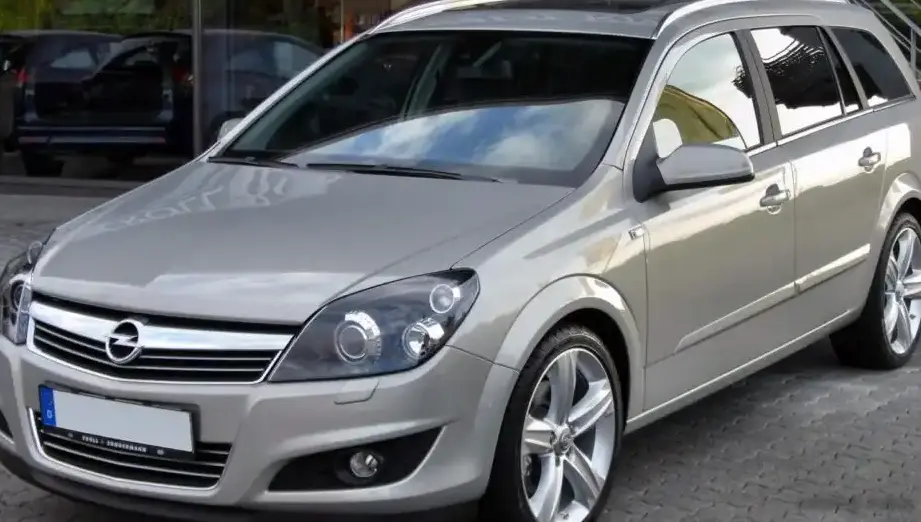
The Opel Astra H Caravan (facelift, produced 2007-2010) 1.4 Twinport ECOTEC 90 hp variant represented an entry-level offering within the broader Astra H range. Positioned as a fuel-efficient and practical family vehicle, it catered to buyers prioritizing affordability and space over outright performance. This version of the Astra, a station wagon (estate) body style, was primarily sold in European markets, where the demand for such vehicles remained strong. It sat below the more powerful 1.6L, 1.8L, and diesel variants in the lineup, offering a more economical alternative.
Technical Specifications
| Brand | Opel |
| Model | Astra |
| Generation | Astra H Caravan (facelift 2007) |
| Type (Engine) | 1.4 Twinport ECOTEC (90 Hp) |
| Start of production | 2007 |
| End of production | 2010 |
| Powertrain Architecture | Internal Combustion engine |
| Body type | Station wagon (estate) |
| Seats | 5 |
| Doors | 5 |
| Fuel consumption (urban) | 8 l/100 km (29.4 US mpg, 35.3 UK mpg, 12.5 km/l) |
| Fuel consumption (extra urban) | 5 l/100 km (47 US mpg, 56.5 UK mpg, 20 km/l) |
| Fuel consumption (combined) | 6.1 l/100 km (38.6 US mpg, 46.3 UK mpg, 16.4 km/l) |
| CO2 emissions | 146 g/km |
| Fuel Type | Petrol (Gasoline) |
| Acceleration 0 – 100 km/h | 14.1 sec |
| Acceleration 0 – 62 mph | 14.1 sec |
| Acceleration 0 – 60 mph | 13.4 sec |
| Maximum speed | 178 km/h (110.6 mph) |
| Emission standard | Euro 4 |
| Weight-to-power ratio | 13.4 kg/Hp, 74.8 Hp/tonne |
| Weight-to-torque ratio | 9.6 kg/Nm, 103.9 Nm/tonne |
| Power | 90 Hp @ 5600 rpm |
| Power per litre | 66 Hp/l |
| Torque | 125 Nm @ 4000 rpm (92.2 lb.-ft. @ 4000 rpm) |
| Engine layout | Front, Transverse |
| Engine Model/Code | Z14XEP |
| Engine displacement | 1364 cm3 (83.24 cu. in.) |
| Number of cylinders | 4 |
| Engine configuration | Inline |
| Cylinder Bore | 73.4 mm (2.89 in.) |
| Piston Stroke | 80.6 mm (3.17 in.) |
| Compression ratio | 10.5:1 |
| Number of valves per cylinder | 4 |
| Fuel injection system | Multi-port manifold injection |
| Engine aspiration | Naturally aspirated engine |
| Valvetrain | DOHC |
| Engine oil capacity | 3.5 l (3.7 US qt | 3.08 UK qt) |
| Coolant capacity | 5.6 l (5.92 US qt | 4.93 UK qt) |
| Kerb Weight | 1203 kg (2652.16 lbs.) |
| Max. weight | 1810 kg (3990.37 lbs.) |
| Max load | 607 kg (1338.21 lbs.) |
| Trunk (boot) space – minimum | 500 l (17.66 cu. ft.) |
| Trunk (boot) space – maximum | 1590 l (56.15 cu. ft.) |
| Fuel tank capacity | 52 l (13.74 US gal | 11.44 UK gal) |
| Max. roof load | 100 kg (220.46 lbs.) |
| Permitted trailer load with brakes (12%) | 900 kg (1984.16 lbs.) |
| Permitted trailer load without brakes | 640 kg (1410.96 lbs.) |
| Length | 4515 mm (177.76 in.) |
| Width | 1753 mm (69.02 in.) |
| Width with mirrors folded | 1804 mm (71.02 in.) |
| Width including mirrors | 2033 mm (80.04 in.) |
| Height | 1500 mm (59.06 in.) |
| Wheelbase | 2703 mm (106.42 in.) |
| Front track | 1488 mm (58.58 in.) |
| Rear track | 1488 mm (58.58 in.) |
| Front overhang | 871 mm (34.29 in.) |
| Rear overhang | 941 mm (37.05 in.) |
| Drag coefficient (Cd) | 0.31 |
| Minimum turning circle | 11.5 m (37.73 ft.) |
| Drivetrain | Front wheel drive |
| Number of gears | 5 |
| Gearbox type | Manual transmission |
| Front suspension | Independent, type McPherson with coil spring and anti-roll bar |
| Rear suspension | Torsion |
| Front brakes | Ventilated discs |
| Rear brakes | Disc |
| Assisting systems | ABS (Anti-lock braking system) |
| Steering type | Steering rack and pinion |
| Power steering | Electric Steering |
| Tires size | 195/65 R15; 205/55 R16; 225/45 R17; 225/40 R18 |
| Wheel rims size | 6.5J x 15; 6.5J x 16; 7J x 17; 7.5J x 18 |
INTRODUCTION
The Opel Astra H Caravan, particularly the facelifted version introduced in 2007, was a significant model for Opel (and its Vauxhall counterpart in the UK). Built on the GM Delta platform (1HX0/A3), the Astra H aimed to provide a more refined and modern experience compared to its predecessor. The 1.4 Twinport ECOTEC 90 hp variant, offered from 2007 to 2010, was designed to appeal to budget-conscious buyers seeking a practical and economical station wagon. It served as the entry point into the Astra H Caravan range, prioritizing fuel efficiency and affordability over performance.
Powertrain & Engine Architecture
The heart of this Astra variant is the Z14XEP engine, a 1.4-liter inline-four cylinder petrol engine. This engine belongs to Opel’s ECOTEC family, known for its focus on efficiency and reduced emissions. The Z14XEP utilizes a multi-port fuel injection system, delivering fuel directly into the intake ports. It features a double overhead camshaft (DOHC) valvetrain with four valves per cylinder, optimizing airflow for improved combustion. The engine produces 90 horsepower at 5600 rpm and 125 Nm (92.2 lb-ft) of torque at 4000 rpm. The engine’s 10.5:1 compression ratio contributes to its efficiency. Paired with this engine was a five-speed manual transmission, which was the standard offering. The transmission’s gear ratios were tuned for fuel economy, prioritizing smooth operation over sporty acceleration.
Driving Characteristics
The 1.4 Twinport ECOTEC 90 hp Astra Caravan offered a comfortable, but unhurried, driving experience. Acceleration from 0-100 km/h (0-62 mph) took approximately 14.1 seconds, and top speed was limited to 178 km/h (110.6 mph). The engine’s torque delivery was relatively flat, meaning there wasn’t a significant surge of power at any particular point in the rev range. This made it predictable and easy to drive in everyday situations, but it lacked the punch of the higher-powered variants. Compared to the 1.6L or 1.8L models, the 1.4 felt noticeably slower, especially when fully loaded or tackling inclines. The five-speed manual transmission was well-matched to the engine, but frequent downshifts were often required to maintain momentum.
Equipment & Trim Levels
The 1.4 Twinport ECOTEC variant typically came with a basic level of equipment. Standard features generally included power steering, ABS brakes, front airbags, and a basic audio system. Interior upholstery was typically cloth, and the dashboard featured a functional, if somewhat plain, design. Optional extras included air conditioning, alloy wheels, electric windows, and a more advanced audio system. Trim levels varied slightly depending on the market, but the 1.4 generally represented the entry-level specification.
Chassis & Braking
The Astra H Caravan featured an independent McPherson strut suspension at the front, providing a comfortable ride and decent handling. The rear suspension utilized a torsion beam setup, which was a cost-effective solution for maintaining ride quality while minimizing complexity. Braking duties were handled by ventilated discs at the front and solid discs at the rear. ABS (Anti-lock Braking System) was standard, enhancing safety during emergency braking situations. The suspension setup was tuned for comfort rather than sporty handling, prioritizing a smooth ride over sharp cornering.
Market Reception & Comparison
The 1.4 Twinport ECOTEC Astra Caravan was generally well-received as a practical and affordable family vehicle. Critics praised its fuel efficiency and spacious interior, but noted its lack of outright performance. Compared to the 1.6L and 1.8L variants, the 1.4 offered significantly lower running costs but at the expense of driving enjoyment. The 1.9 CDTi diesel models provided even better fuel economy and more torque, but came with a higher purchase price. The 1.4 was often seen as a sensible choice for drivers who primarily used their cars for commuting and family transportation.
Legacy
The Z14XEP engine, while not known for its exceptional performance, proved to be relatively reliable. Common issues included occasional oil leaks and sensor failures, but these were generally not major concerns. Today, the 1.4 Twinport ECOTEC Astra Caravan can be found on the used car market at very affordable prices. Its simplicity and relatively low maintenance costs make it an attractive option for budget-conscious buyers. However, potential buyers should be aware of its limited performance and the age-related wear and tear that is common with older vehicles. The Astra H Caravan 1.4 Twinport ECOTEC remains a testament to Opel’s commitment to providing practical and economical transportation for the masses.