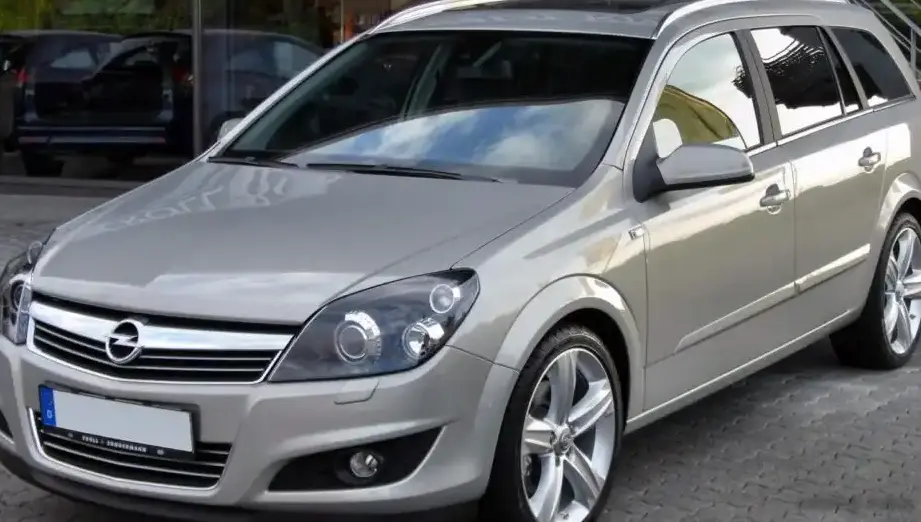
The Opel Astra H Caravan (facelift, produced 2007-2010) 1.6 Turbo ECOTEC, generating 180 horsepower, represented a significant offering within the Astra H range. Positioned as a mid-to-upper trim level, it bridged the gap between the more economical base engines and the performance-oriented OPC (Vauxhall/Opel Performance Centre) models. This variant aimed to provide a balance of practicality, fuel efficiency, and respectable performance for family-oriented buyers in the European market. The facelift brought styling updates and refinements to the already popular Astra H, solidifying its position as a competitive station wagon.
Technical Specifications
| Brand | Opel |
| Model | Astra |
| Generation | Astra H Caravan (facelift 2007) |
| Type (Engine) | 1.6 Turbo ECOTEC (180 Hp) |
| Start of production | 2007 |
| End of production | 2010 |
| Powertrain Architecture | Internal Combustion engine |
| Body type | Station wagon (estate) |
| Seats | 5 |
| Doors | 5 |
| Fuel consumption (urban) | 10.3 l/100 km (22.8 US mpg, 27.4 UK mpg, 9.7 km/l) |
| Fuel consumption (extra urban) | 6.2 l/100 km (37.9 US mpg, 45.6 UK mpg, 16.1 km/l) |
| Fuel consumption (combined) | 7.7 l/100 km (30.5 US mpg, 36.7 UK mpg, 13 km/l) |
| CO2 emissions | 185 g/km |
| Fuel Type | Petrol (Gasoline) |
| Acceleration 0 – 100 km/h | 8.5 sec |
| Acceleration 0 – 62 mph | 8.5 sec |
| Acceleration 0 – 60 mph | 8.1 sec |
| Maximum speed | 221 km/h (137.32 mph) |
| Emission standard | Euro 4 |
| Weight-to-power ratio | 7.3 kg/Hp, 136.4 Hp/tonne |
| Weight-to-torque ratio | 5.7 kg/Nm, 174.2 Nm/tonne |
| Power | 180 Hp @ 5500 rpm |
| Power per litre | 112.6 Hp/l |
| Torque | 230 Nm @ 1980-5500 rpm (169.64 lb.-ft. @ 1980-5500 rpm) |
| Engine layout | Front, Transverse |
| Engine Model/Code | Z16LET |
| Engine displacement | 1598 cm3 (97.52 cu. in.) |
| Number of cylinders | 4 |
| Engine configuration | Inline |
| Cylinder Bore | 79 mm (3.11 in.) |
| Piston Stroke | 81.5 mm (3.21 in.) |
| Compression ratio | 8.8:1 |
| Number of valves per cylinder | 4 |
| Fuel injection system | Multi-port manifold injection |
| Engine aspiration | Turbocharger, Intercooler |
| Valvetrain | DOHC |
| Engine oil capacity | 4.5 l (4.76 US qt | 3.96 UK qt) |
| Coolant capacity | 5.9 l (6.23 US qt | 5.19 UK qt) |
| Kerb Weight | 1320 kg (2910.1 lbs.) |
| Max. weight | 1920 kg (4232.88 lbs.) |
| Max load | 600 kg (1322.77 lbs.) |
| Trunk (boot) space – minimum | 500 l (17.66 cu. ft.) |
| Trunk (boot) space – maximum | 1590 l (56.15 cu. ft.) |
| Fuel tank capacity | 52 l (13.74 US gal | 11.44 UK gal) |
| Max. roof load | 100 kg (220.46 lbs.) |
| Permitted trailer load with brakes (12%) | 1400 kg (3086.47 lbs.) |
| Permitted trailer load without brakes | 690 kg (1521.19 lbs.) |
| Length | 4515 mm (177.76 in.) |
| Width | 1753 mm (69.02 in.) |
| Width with mirrors folded | 1804 mm (71.02 in.) |
| Width including mirrors | 2033 mm (80.04 in.) |
| Height | 1500 mm (59.06 in.) |
| Wheelbase | 2703 mm (106.42 in.) |
| Front track | 1488 mm (58.58 in.) |
| Rear track | 1488 mm (58.58 in.) |
| Front overhang | 871 mm (34.29 in.) |
| Rear overhang | 941 mm (37.05 in.) |
| Minimum turning circle | 11.5 m (37.73 ft.) |
| Drivetrain | Front wheel drive |
| Number of gears | 6 |
| Gearbox type | Manual transmission |
| Front suspension | Independent, McPherson with coil spring and anti-roll bar |
| Rear suspension | Torsion |
| Front brakes | Ventilated discs |
| Rear brakes | Disc |
| Assisting systems | ABS (Anti-lock braking system) |
| Steering type | Steering rack and pinion |
| Power steering | Electric |
| Tires size | 205/55 R16; 225/45 R17; 225/40 R18 |
| Wheel rims size | 6.5J x 16; 7J x 17; 7.5J x 18 |
Powertrain & Engine Architecture
The heart of this Astra variant is the Z16LET, a 1.6-liter turbocharged inline-four cylinder engine. This engine belongs to Opel/Vauxhall’s Ecotec family, known for its focus on efficiency and refinement. The Z16LET utilizes a single overhead camshaft (SOHC) design with four valves per cylinder, and a multi-point fuel injection system. The turbocharger, coupled with an intercooler, significantly boosts power output. The engine’s turbocharger is a wastegate turbo, providing a balance between responsiveness and peak power. The 6-speed manual transmission was the standard offering, providing precise gear changes and contributing to the car’s overall driving experience. The engine’s design prioritized low-end torque, making it suitable for everyday driving conditions.
Driving Characteristics
The 180 hp output, combined with the 230 Nm of torque, provided the Astra H Caravan 1.6 Turbo ECOTEC with brisk acceleration. The 0-60 mph time of around 8.1 seconds was respectable for a family station wagon of its era. The turbocharger did exhibit some lag at lower RPMs, but once spooled up, it delivered a noticeable surge of power. The 6-speed manual transmission allowed drivers to keep the engine in its optimal power band. Compared to the naturally aspirated 1.4-liter and 1.6-liter engines, the turbo variant offered a significantly more engaging driving experience. While not as sporty as the OPC models, it provided a good balance of performance and practicality. The front-wheel-drive configuration ensured predictable handling, although traction could be limited in wet conditions.
Equipment & Trim Levels
The 1.6 Turbo ECOTEC trim typically included features such as air conditioning, electric front windows, a CD/radio system, and alloy wheels. Higher trim levels added options like automatic climate control, rain-sensing wipers, a trip computer, and upgraded upholstery. Safety features included ABS, front and side airbags, and seatbelt pretensioners. The interior was generally well-appointed, with a focus on ergonomics and practicality. The Caravan body style offered a spacious interior and a large cargo area, making it ideal for families and those needing to transport bulky items.
Chassis & Braking
The Astra H Caravan featured an independent McPherson strut suspension at the front and a torsion beam suspension at the rear. This setup provided a comfortable ride while maintaining reasonable handling characteristics. The front brakes were ventilated discs, while the rear brakes were solid discs. ABS (Anti-lock Braking System) was standard, enhancing braking performance and safety. The steering was electrically assisted, providing light and precise control. The suspension was tuned to prioritize comfort, but it also offered decent body control during cornering.
Market Reception & Comparison
The Astra H Caravan 1.6 Turbo ECOTEC was generally well-received by automotive critics. It was praised for its blend of performance, fuel efficiency, and practicality. Compared to the base engines, the turbo variant offered a significant improvement in performance without sacrificing fuel economy. It was also considered a more attractive alternative to some of its competitors, such as the Ford Focus Estate and the Volkswagen Passat Variant. Fuel economy figures of around 30.5 US mpg combined were competitive for its class. Reliability was generally good, although some owners reported minor issues with the turbocharger and fuel injection system.
Legacy
The Opel Astra H Caravan 1.6 Turbo ECOTEC remains a popular choice in the used car market. Its combination of practicality, performance, and affordability makes it an attractive option for buyers seeking a reliable and versatile station wagon. The Z16LET engine, while not without its quirks, has proven to be relatively durable when properly maintained. Parts availability is generally good, and maintenance costs are reasonable. The Astra H Caravan continues to be appreciated for its spacious interior, comfortable ride, and overall value.