Technical Specifications
| Brand | Opel |
| Model | Astra |
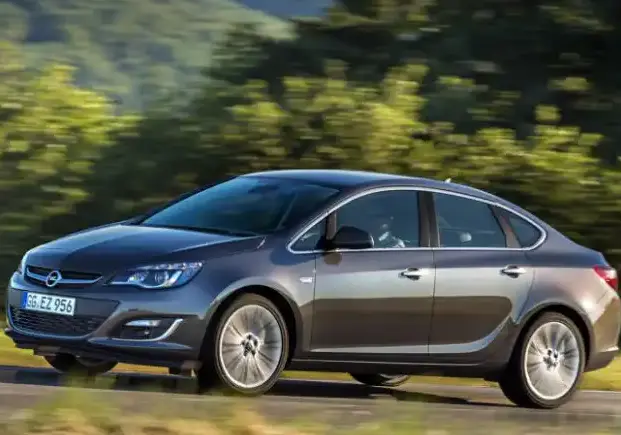
| Generation | Astra J Sedan |
| Type (Engine) | 2.0 CDTI (195 Hp) BiTurbo Ecotec start/stop |
| Start of production | 2012 |
| End of production | 2015 |
| Powertrain Architecture | Internal Combustion engine |
| Body type | Sedan |
| Seats | 5 |
| Doors | 4 |
| Fuel consumption (urban) | 6.2 l/100 km (37.9 US mpg) |
| Fuel consumption (extra urban) | 4.4 l/100 km (53.5 US mpg) |
| Fuel consumption (combined) | 5.1 l/100 km (46.1 US mpg) |
| CO2 emissions | 135 g/km |
| Fuel Type | Diesel |
| Acceleration 0 – 100 km/h | 7.8 sec |
| Acceleration 0 – 62 mph | 7.8 sec |
| Acceleration 0 – 60 mph | 7.4 sec |
| Maximum speed | 226 km/h (140.43 mph) |
| Emission standard | Euro 5 |
| Power | 195 Hp @ 4000 rpm |
| Torque | 400 Nm @ 1750-2500 rpm (295.02 lb.-ft.) |
| Engine layout | Front, Transverse |
| Engine Model/Code | A20DTR |
| Engine displacement | 1956 cm3 (119.36 cu. in.) |
| Number of cylinders | 4 |
| Engine configuration | Inline |
| Cylinder Bore | 83 mm (3.27 in.) |
| Piston Stroke | 90.4 mm (3.56 in.) |
| Number of valves per cylinder | 4 |
| Fuel injection system | Diesel Commonrail |
| Engine aspiration | BiTurbo, Intercooler |
| Engine oil capacity | 4.5 l (4.76 US qt | 3.96 UK qt) |
| Coolant capacity | 6.9 l (7.29 US qt | 6.07 UK qt) |
| Trunk (boot) space – minimum | 460 l (16.24 cu. ft.) |
| Trunk (boot) space – maximum | 1010 l (35.67 cu. ft.) |
| Fuel tank capacity | 56 l (14.79 US gal | 12.32 UK gal) |
| Length | 4658 mm (183.39 in.) |
| Width | 1814 mm (71.42 in.) |
| Width including mirrors | 2013 mm (79.25 in.) |
| Height | 1500 mm (59.06 in.) |
| Wheelbase | 2685 mm (105.71 in.) |
| Front track | 1541 mm (60.67 in.) |
| Rear track | 1551 mm (61.06 in.) |
| Front overhang | 974 mm (38.35 in.) |
| Rear overhang | 999 mm (39.33 in.) |
| Minimum turning circle | 11.5 m (37.73 ft.) |
| Drivetrain Architecture | Front wheel drive |
| Number of gears | 6 |
| Gearbox type | Manual transmission |
| Front brakes | Ventilated discs |
| Assisting systems | ABS (Anti-lock braking system) |
| Steering type | Steering rack and pinion |
| Power steering | Electric Steering |
The Opel Astra J Sedan 2.0 CDTI BiTurbo, launched in 2012, was a significant addition to the Astra J range. It aimed to provide a more engaging driving experience than the lower-powered diesel options, while still maintaining the fuel efficiency expected of a modern diesel engine. The “BiTurbo” designation indicated the use of two turbochargers, a feature typically reserved for higher-performance models. This variant was positioned above the 1.7 CDTI and 1.4 Turbo petrol models, offering a substantial power increase and appealing to drivers seeking a more refined and capable sedan.
Powertrain & Engine Architecture
At the heart of the Astra J Sedan 2.0 CDTI BiTurbo lies the A20DTR engine, a 1956cc inline-four cylinder diesel. This engine utilizes a common rail direct injection system, delivering fuel at extremely high pressure for optimized combustion. The key feature, of course, is the twin-turbocharger setup. A smaller turbocharger provides quick response at low engine speeds, minimizing turbo lag, while a larger turbocharger kicks in at higher RPMs to deliver peak power. An intercooler is employed to cool the compressed air, further increasing power and efficiency. The engine produces 195 horsepower at 4000 rpm and a robust 400 Nm (295 lb-ft) of torque between 1750 and 2500 rpm. The engine also featured Opel’s Start/Stop system, automatically shutting off the engine when the vehicle is stationary to conserve fuel. The standard transmission for this model was a six-speed manual gearbox, providing precise control and enhancing the driving experience.
Driving Characteristics
The 2.0 CDTI BiTurbo engine transformed the driving experience of the Astra J Sedan. Compared to the lower-powered diesel variants, the BiTurbo offered significantly improved acceleration and responsiveness. The twin-turbo setup minimized turbo lag, providing a more linear power delivery. The 0-60 mph time of around 7.4 seconds was respectable for a compact sedan of this era. The six-speed manual transmission allowed drivers to fully exploit the engine’s powerband, while the relatively short gear ratios contributed to brisk acceleration. While not a sports car, the BiTurbo version offered a noticeably more engaging and confident driving experience, particularly when overtaking or navigating winding roads. The suspension was tuned to provide a balance between comfort and handling, offering a stable and controlled ride.
Equipment & Trim Levels
The Astra J Sedan 2.0 CDTI BiTurbo typically came with a generous level of standard equipment. This included air conditioning, electric windows and mirrors, a CD/MP3 stereo system, and alloy wheels. Higher trim levels, such as the ‘Sport’ or ‘Cosmo’ variants, added features like leather upholstery, a touchscreen infotainment system with navigation, automatic climate control, and parking sensors. Optional extras included a panoramic sunroof, adaptive cruise control, and upgraded sound systems. Interior upholstery was typically cloth on the base models, with leather options available on higher trims. The dashboard layout was modern and functional, with a focus on ergonomics and ease of use.
Chassis & Braking
The Astra J Sedan featured a MacPherson strut front suspension and a torsion beam rear suspension. The chassis was designed to provide a good balance between ride comfort and handling. The front brakes were ventilated discs, providing ample stopping power, while the rear brakes were typically solid discs. Anti-lock Braking System (ABS) was standard, enhancing safety and stability during emergency braking. The steering was electric power-assisted, offering a light and precise feel. Stabilizer bars were fitted to both the front and rear axles to reduce body roll during cornering.
Market Reception & Comparison
The Astra J Sedan 2.0 CDTI BiTurbo was generally well-received by automotive critics. It was praised for its strong performance, fuel efficiency, and comfortable ride. However, some reviewers noted that the interior materials weren’t quite as premium as those found in some of its rivals. Compared to the 1.7 CDTI version, the BiTurbo offered a significant power boost and a more refined driving experience, but at a higher price point. Against competitors like the Ford Focus 2.0 TDCi, the Astra J BiTurbo offered comparable performance and fuel economy, with a slightly more understated styling. The BiTurbo version also offered better fuel economy than the 1.4 Turbo petrol models, making it a more practical choice for long-distance driving.
Legacy
The A20DTR engine, while generally reliable, is known to require regular maintenance, particularly regarding the diesel particulate filter (DPF) and turbochargers. Proper servicing, including regular oil changes and the use of high-quality fuel, is crucial for ensuring long-term reliability. In the used car market, the Astra J Sedan 2.0 CDTI BiTurbo remains a popular choice for buyers seeking a well-equipped and efficient compact sedan. Its combination of performance, fuel economy, and practicality makes it a compelling option, although potential buyers should be aware of the potential maintenance costs associated with a turbocharged diesel engine. The BiTurbo variant stands out as a more desirable and capable version within the Astra J Sedan range, offering a more engaging driving experience than its lower-powered siblings.