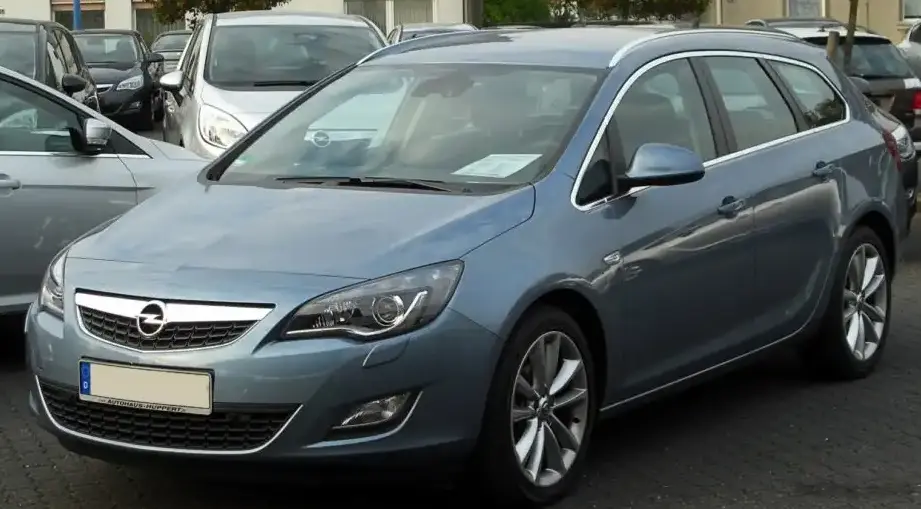
The Opel Astra J Sports Tourer 1.6 (115 hp) Automatic, produced between 2010 and 2012, represents a practical and fuel-conscious variant within the broader Astra J series. Positioned as a mid-range offering, it catered to buyers seeking the versatility of a station wagon (estate) body style combined with the convenience of an automatic transmission. This model occupied a space between the base-level engine options and the more performance-oriented trims, aiming for a balance of affordability, usability, and reasonable running costs. It was primarily marketed in Europe, where the station wagon format remained popular, offering a compelling alternative to hatchback models.
Technical Specifications
| Brand | Opel |
| Model | Astra |
| Generation | Astra J Sports Tourer |
| Type (Engine) | 1.6 (115 Hp) Automatic |
| Start of production | 2010 |
| End of production | 2012 |
| Powertrain Architecture | Internal Combustion engine |
| Body type | Station wagon (estate) |
| Seats | 5 |
| Doors | 5 |
| Fuel consumption (urban) | 10.1 l/100 km (23.3 US mpg / 28 UK mpg / 9.9 km/l) |
| Fuel consumption (extra urban) | 5.5 l/100 km (42.8 US mpg / 51.4 UK mpg / 18.2 km/l) |
| Fuel consumption (combined) | 7.2 l/100 km (32.7 US mpg / 39.2 UK mpg / 13.9 km/l) |
| CO2 emissions | 169 g/km |
| Fuel Type | Petrol (Gasoline) |
| Acceleration 0 – 100 km/h | 13.7 sec |
| Acceleration 0 – 62 mph | 13.7 sec |
| Acceleration 0 – 60 mph | 13 sec |
| Maximum speed | 180 km/h (111.85 mph) |
| Emission standard | Euro 5 |
| Weight-to-power ratio | 11.8 kg/Hp, 84.6 Hp/tonne |
| Weight-to-torque ratio | 8.8 kg/Nm, 114 Nm/tonne |
| Power | 115 Hp @ 6000 rpm |
| Power per litre | 72 Hp/l |
| Torque | 155 Nm @ 4000 rpm (114.32 lb.-ft. @ 4000 rpm) |
| Engine layout | Front, Transverse |
| Engine Model/Code | A16XER |
| Engine displacement | 1598 cm3 (97.52 cu. in.) |
| Number of cylinders | 4 |
| Engine configuration | Inline |
| Cylinder Bore | 79 mm (3.11 in.) |
| Piston Stroke | 81.5 mm (3.21 in.) |
| Compression ratio | 10.8:1 |
| Number of valves per cylinder | 4 |
| Fuel injection system | Multi-port manifold injection |
| Engine aspiration | Naturally aspirated engine |
| Valvetrain | DOHC |
| Engine oil capacity | 4.5 l (4.76 US qt | 3.96 UK qt) |
| Coolant capacity | 5.6 l (5.92 US qt | 4.93 UK qt) |
| Kerb Weight | 1360 kg (2998.29 lbs.) |
| Max. weight | 2000 kg (4409.25 lbs.) |
| Max load | 640 kg (1410.96 lbs.) |
| Trunk (boot) space – minimum | 550 l (19.42 cu. ft.) |
| Trunk (boot) space – maximum | 1550 l (54.74 cu. ft.) |
| Fuel tank capacity | 56 l (14.79 US gal | 12.32 UK gal) |
| Length | 4698 mm (184.96 in.) |
| Width | 1814 mm (71.42 in.) |
| Width including mirrors | 2013 mm (79.25 in.) |
| Height | 1535 mm (60.43 in.) |
| Wheelbase | 2685 mm (105.71 in.) |
| Front track | 1544 mm (60.79 in.) |
| Rear (Back) track | 1558 mm (61.34 in.) |
| Front overhang | 974 mm (38.35 in.) |
| Rear overhang | 1039 mm (40.91 in.) |
| Ride height (ground clearance) | 117 mm (4.61 in.) |
| Drag coefficient (Cd) | 0.33 |
| Minimum turning circle | 11.5 m (37.73 ft.) |
| Drivetrain Architecture | The Internal combustion engine (ICE) drives the front wheels of the vehicle. |
| Drive wheel | Front wheel drive |
| Number of gears and type of gearbox | 6 gears, automatic transmission |
| Front suspension | Independent type McPherson |
| Rear suspension | Semi-independent, coil spring |
| Front brakes | Ventilated discs |
| Rear brakes | Disc |
| Assisting systems | ABS (Anti-lock braking system) |
| Steering type | Steering rack and pinion |
| Power steering | Electric Steering |
| Tires size | 215/50 R17 |
| Wheel rims size | 17 |
Powertrain & Engine Architecture
The Astra J Sports Tourer 1.6 Automatic is powered by the Opel-designed A16XER engine, a 1.6-liter inline-four cylinder gasoline engine. This engine utilizes multi-point fuel injection and a double overhead camshaft (DOHC) valvetrain, contributing to reasonable efficiency and power output for its displacement. The A16XER is a naturally aspirated engine, meaning it doesn’t employ turbocharging or supercharging. The engine produces 115 horsepower at 6000 rpm and 155 Nm (114 lb-ft) of torque at 4000 rpm. Paired with this engine is a six-speed automatic transmission, designed to provide smooth gear changes and ease of driving. This transmission wasn’t known for particularly quick shifts, prioritizing comfort over sporty performance. The engine’s architecture is typical of European small-displacement gasoline engines of the era, focusing on balancing fuel economy with adequate performance for everyday driving.
Driving Characteristics
The 1.6-liter engine and six-speed automatic combination in the Astra J Sports Tourer delivers a comfortable, but not particularly exhilarating, driving experience. Acceleration from 0-100 km/h (0-62 mph) takes approximately 13.7 seconds, placing it firmly in the slower end of the spectrum for contemporary vehicles. The automatic transmission, while convenient, contributes to this slower acceleration due to its programming and the engine’s relatively modest torque output. Compared to the more powerful 1.8-liter or diesel variants, the 1.6 Automatic feels noticeably less responsive, especially when overtaking or climbing hills. The gear ratios are tuned for fuel efficiency rather than outright performance. However, for drivers prioritizing ease of use and fuel economy, the 1.6 Automatic provides a smooth and predictable driving experience.
Equipment & Trim Levels
The Astra J Sports Tourer 1.6 Automatic typically came equipped with a reasonable level of standard features. These generally included air conditioning, electric front windows, a basic audio system with CD player, and ABS brakes. Higher trim levels, often available as optional packages, added features such as alloy wheels, cruise control, parking sensors, and upgraded interior upholstery. Interior materials were generally durable but not luxurious, reflecting the car’s positioning as a mainstream family vehicle. The dashboard layout was functional and ergonomically designed, with easy-to-read instrumentation. Optional extras could significantly enhance the car’s comfort and convenience, but also increased the overall price.
Chassis & Braking
The Astra J Sports Tourer utilizes an independent McPherson strut suspension at the front and a semi-independent coil spring suspension at the rear. This setup provides a comfortable ride quality, absorbing bumps and imperfections in the road surface effectively. The front brakes are ventilated discs, offering good stopping power, while the rear brakes are solid discs. ABS (Anti-lock Braking System) is standard, enhancing safety during emergency braking situations. The steering is rack and pinion with electric power assistance, providing a light and responsive feel. The suspension tuning is geared towards comfort and stability rather than sporty handling, making it well-suited for everyday driving and long journeys.
Market Reception & Comparison
The Astra J Sports Tourer 1.6 Automatic was generally well-received by automotive critics as a practical and fuel-efficient option. However, its performance was often criticized as being somewhat underwhelming, particularly when compared to more powerful engine options. Fuel economy figures of around 7.2 l/100 km (32.7 US mpg) were considered respectable for its class. Compared to the 1.8-liter petrol or 1.9-liter diesel variants, the 1.6 Automatic offered lower running costs but sacrificed performance. The diesel models, in particular, provided significantly better fuel economy and torque. The 1.6 Automatic appealed to buyers who prioritized affordability, convenience, and fuel efficiency over outright performance.
Legacy
The A16XER engine, while generally reliable, is known to have some potential issues, including occasional oil leaks and timing chain wear, particularly if maintenance is neglected. The six-speed automatic transmission is also relatively robust, but regular fluid changes are crucial to ensure its longevity. In the used car market, the Astra J Sports Tourer 1.6 Automatic represents a relatively affordable and practical option. Its lower performance and potential maintenance concerns mean that prices are typically lower than those of more powerful or diesel-powered variants. However, its fuel efficiency and spacious interior continue to make it a viable choice for buyers seeking a budget-friendly station wagon.