Technical Specifications
| Brand | Opel |
| Model | Astra |
| Generation | Astra J Sports Tourer (facelift 2012) |
| Type (Engine) | 1.6 (115 Hp) Ecotec start/stop |
| Start of production | 2012 |
| End of production | 2015 |
| Powertrain Architecture | Internal Combustion engine |
| Body type | Station wagon (estate) |
| Seats | 5 |
| Doors | 5 |
| Fuel consumption (urban) | 8.1-8.3 l/100 km (29 – 28.3 US mpg) |
| Fuel consumption (extra urban) | 5.0-5.4 l/100 km (47 – 43.6 US mpg) |
| Fuel consumption (combined) | 6.1-6.4 l/100 km (38.6 – 36.8 US mpg) |
| CO2 emissions | 144-151 g/km |
| Fuel Type | Petrol (Gasoline) |
| Acceleration 0 – 100 km/h | 12.3 sec |
| Acceleration 0 – 62 mph | 12.3 sec |
| Acceleration 0 – 60 mph | 11.7 sec |
| Maximum speed | 185 km/h (114.95 mph) |
| Emission standard | Euro 5 |
| Weight-to-power ratio | 11.7 kg/Hp |
| Weight-to-torque ratio | 8.6 kg/Nm |
| Power | 115 Hp @ 6000 rpm |
| Torque | 155 Nm @ 4000 rpm (114.32 lb.-ft. @ 4000 rpm) |
| Engine layout | Front, Transverse |
| Engine Model/Code | A16XER |
| Engine displacement | 1598 cm3 (97.52 cu. in.) |
| Number of cylinders | 4 |
| Engine configuration | Inline |
| Cylinder Bore | 79 mm (3.11 in.) |
| Piston Stroke | 81.5 mm (3.21 in.) |
| Number of valves per cylinder | 4 |
| Fuel injection system | Multi-port manifold injection |
| Engine aspiration | Naturally aspirated engine |
| Engine oil capacity | 4.5 l (4.76 US qt | 3.96 UK qt) |
| Coolant capacity | 5.6 l (5.92 US qt | 4.93 UK qt) |
| Kerb Weight | 1340 kg (2954.19 lbs.) |
| Max. weight | 1980 kg (4365.15 lbs.) |
| Max load | 640 kg (1410.96 lbs.) |
| Trunk (boot) space – minimum | 500 l (17.66 cu. ft.) |
| Trunk (boot) space – maximum | 1550 l (54.74 cu. ft.) |
| Fuel tank capacity | 56 l (14.79 US gal | 12.32 UK gal) |
| Max. roof load | 100 kg (220.46 lbs.) |
| Permitted trailer load with brakes (12%) | 1000 kg (2204.62 lbs.) |
| Permitted trailer load without brakes | 700 kg (1543.24 lbs.) |
| Length | 4698 mm (184.96 in.) |
| Width | 1814 mm (71.42 in.) |
| Width with mirrors folded | 1831 mm (72.09 in.) |
| Width including mirrors | 2013 mm (79.25 in.) |
| Height | 1535 mm (60.43 in.) |
| Wheelbase | 2685 mm (105.71 in.) |
| Front track | 1541 mm (60.67 in.) |
| Rear (Back) track | 1551 mm (61.06 in.) |
| Ride height (ground clearance) | 165 mm (6.5 in.) |
| Minimum turning circle | 11.4 m (37.4 ft.) |
| Drivetrain | Front wheel drive |
| Number of gears and type of gearbox | 5 gears, manual transmission |
| Front brakes | Ventilated discs |
| Assisting systems | ABS (Anti-lock braking system) |
| Steering type | Steering rack and pinion |
| Power steering | Electric Steering |
| Tires size | 205/60 R16; 215/50 R17 |
| Wheel rims size | 16; 17 |
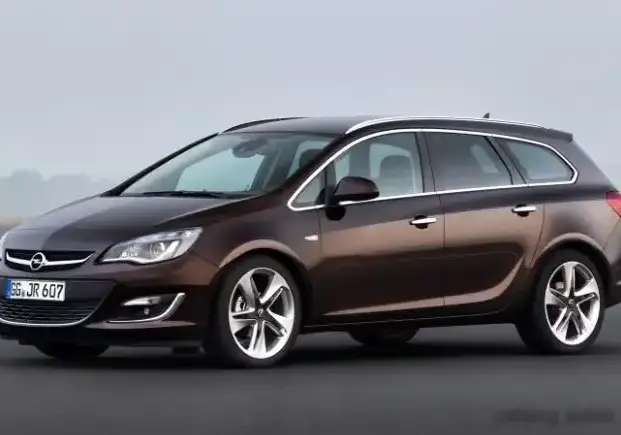
The Opel Astra J Sports Tourer (facelift, introduced in 2012) 1.6 (115 hp) Ecotec start/stop represents a key variant within the broader Astra J range, Opel’s compact family car. Positioned as a mid-range offering, this model combined the practicality of a station wagon (estate) body style with a fuel-efficient, albeit modestly powered, 1.6-liter gasoline engine. Production of this specific configuration ran from 2012 to 2015, serving primarily the European market where station wagons maintained significant popularity. The facelift brought styling updates and technological enhancements to the J series, aiming to improve its competitiveness in a crowded segment.
Powertrain & Engine Architecture
The heart of this Astra variant is the A16XER engine, a 1.6-liter inline-four cylinder gasoline engine. This engine belongs to Opel’s Ecotec family, known for its focus on fuel efficiency and reduced emissions. The A16XER utilizes multi-port fuel injection and a dual overhead camshaft (DOHC) valvetrain with four valves per cylinder. The Start/Stop system, a key feature, automatically shuts off the engine when the vehicle is stationary (e.g., at traffic lights) to conserve fuel and reduce emissions. The engine produces 115 horsepower at 6000 rpm and 155 Nm (114 lb-ft) of torque at 4000 rpm. This power is delivered to the front wheels through a five-speed manual transmission. While a six-speed automatic transmission was available on some Astra J models, the 1.6-liter engine was primarily paired with the five-speed manual in this configuration.
Driving Characteristics
The 1.6-liter engine, coupled with the five-speed manual transmission, provides adequate, but not exhilarating, performance. Acceleration from 0 to 62 mph (0-100 km/h) takes around 12.3 seconds. The engine feels most comfortable in the mid-range, offering sufficient power for everyday driving and highway cruising. However, it can feel strained when accelerating quickly or carrying a full load. Compared to the more powerful 1.4 Turbo or 2.0 Diesel variants, the 1.6-liter lacks the punch and responsiveness. The five-speed gearbox is well-matched to the engine’s characteristics, offering smooth shifts and reasonable gear ratios. The gear ratios are optimized for fuel economy rather than outright performance. The steering is light and precise, making the Astra easy to maneuver in urban environments.
Equipment & Trim Levels
The 1.6 (115 hp) Ecotec start/stop Sports Tourer typically came equipped with a reasonable level of standard features. These included air conditioning, electric front windows, a CD/MP3 stereo system, and ABS brakes. Higher trim levels, such as ‘Edition’ or ‘Sport’, added features like alloy wheels, cruise control, a multi-function steering wheel, and upgraded interior trim. Interior upholstery was typically cloth, with options for more premium materials on higher trims. The dashboard layout was functional and well-designed, with a clear instrument cluster and intuitive controls. Optional extras included a navigation system, parking sensors, and a panoramic sunroof.
Chassis & Braking
The Astra J Sports Tourer utilizes a MacPherson strut front suspension and a multi-link rear suspension. This setup provides a good balance between ride comfort and handling. The suspension is tuned for comfort, absorbing bumps and imperfections in the road surface effectively. Stabilizer bars are fitted to both the front and rear axles to reduce body roll during cornering. The braking system consists of ventilated discs on the front wheels and drum brakes on the rear wheels. ABS (Anti-lock Braking System) is standard, providing enhanced braking performance and stability. The steering is electrically assisted, providing a light and precise feel.
Market Reception & Comparison
The 1.6-liter Astra J Sports Tourer was generally well-received by critics as a practical and fuel-efficient family car. However, it was often criticized for its lack of outright performance compared to its rivals and even some of its Astra siblings. Fuel economy was a strong point, with combined figures ranging from 6.1 to 6.4 l/100 km (38.6 – 36.8 US mpg). The 1.4 Turbo offered a better balance of performance and fuel economy, while the 2.0 Diesel provided superior torque and fuel efficiency for long-distance driving. The 1.6-liter variant appealed to buyers who prioritized affordability and fuel economy over performance.
Legacy
The A16XER engine, while not known for being particularly groundbreaking, proved to be a relatively reliable unit when properly maintained. Common issues include occasional oil leaks and problems with the timing chain. The five-speed manual transmission is also generally reliable. Today, used examples of the Astra J Sports Tourer 1.6 Ecotec start/stop are readily available and represent an affordable option for buyers seeking a practical and economical estate car. However, potential buyers should be aware of the potential for age-related issues and ensure that the vehicle has been well-maintained. The Astra J series, as a whole, helped solidify Opel’s position as a major player in the European compact car market.