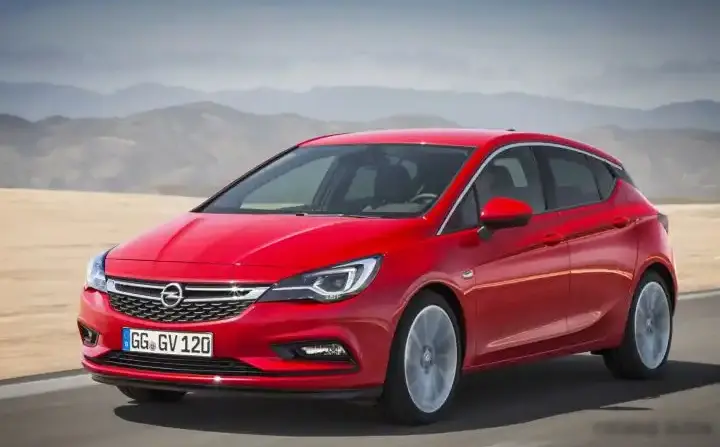
The Opel Astra K 1.6 Turbo (200 hp) Automatic, produced from 2018 to July 2019, represented a significant offering within the Astra K generation (launched in 2015). Positioned as a mid-to-upper trim level, this variant aimed to provide a balance of performance and convenience, appealing to drivers seeking more than the base engine options but not necessarily the outright sportiness of potential future performance models. It was a key component of Opel’s strategy to modernize the Astra and compete effectively in the highly competitive European C-segment hatchback market. The Astra K itself was a pivotal model for Opel, representing a substantial redesign and incorporating new technologies aimed at reducing weight and improving efficiency.
Technical Specifications
| Brand | Opel |
| Model | Astra |
| Generation | Astra K |
| Type (Engine) | 1.6 Turbo (200 Hp) Automatic |
| Start of production | 2018 |
| End of production | July, 2019 |
| Powertrain Architecture | Internal Combustion engine |
| Body type | Hatchback |
| Seats | 5 |
| Doors | 5 |
| Fuel consumption (urban) | 8.3-8.5 l/100 km (28.3 – 27.7 US mpg) |
| Fuel consumption (extra urban) | 5.3-5.5 l/100 km (44.4 – 42.8 US mpg) |
| Fuel consumption (combined) | 6.4-6.6 l/100 km (36.8 – 35.6 US mpg) |
| CO2 emissions | 146-151 g/km |
| Fuel Type | Petrol (Gasoline) |
| Acceleration 0 – 100 km/h | 7.8 sec |
| Acceleration 0 – 62 mph | 7.8 sec |
| Acceleration 0 – 60 mph | 7.4 sec |
| Maximum speed | 235 km/h (146.02 mph) |
| Emission standard | Euro 6d-Temp |
| Weight-to-power ratio | 6.5 kg/Hp, 153.5 Hp/tonne |
| Weight-to-torque ratio | 4.3 kg/Nm, 230.2 Nm/tonne |
| Power | 200 Hp @ 5500 rpm |
| Torque | 300 Nm @ 1650-4500 rpm (221.27 lb.-ft. @ 1650-4500 rpm) |
| Engine layout | Front, Transverse |
| Engine Model/Code | D16SHT |
| Engine displacement | 1598 cm3 (97.52 cu. in.) |
| Number of cylinders | 4 |
| Engine configuration | Inline |
| Cylinder Bore | 79 mm (3.11 in.) |
| Piston Stroke | 81.5 mm (3.21 in.) |
| Compression ratio | 9.5:1 |
| Number of valves per cylinder | 4 |
| Fuel injection system | Direct injection |
| Engine aspiration | Turbocharger, Intercooler |
| Engine oil capacity | 5.5 l (5.81 US qt | 4.84 UK qt) |
| Coolant | 5.9 l (6.23 US qt | 5.19 UK qt) |
| Kerb Weight | 1303 kg (2872.62 lbs.) |
| Max. weight | 1900 kg (4188.78 lbs.) |
| Max load | 597 kg (1316.16 lbs.) |
| Trunk (boot) space – minimum | 370 l (13.07 cu. ft.) |
| Trunk (boot) space – maximum | 1210 l (42.73 cu. ft.) |
| Fuel tank capacity | 48 l (12.68 US gal | 10.56 UK gal) |
| Max. roof load | 75 kg (165.35 lbs.) |
| Permitted trailer load with brakes (12%) | 1700 kg (3747.86 lbs.) |
| Permitted trailer load without brakes | 650 kg (1433 lbs.) |
| Length | 4370 mm (172.05 in.) |
| Width | 1809 mm (71.22 in.) |
| Width with mirrors folded | 1871 mm (73.66 in.) |
| Width including mirrors | 2042 mm (80.39 in.) |
| Height | 1485 mm (58.46 in.) |
| Wheelbase | 2662 mm (104.8 in.) |
| Front track | 1544 mm (60.79 in.) |
| Rear (Back) track | 1558 mm (61.34 in.) |
| Minimum turning circle | 11.05 m (36.25 ft.) |
| Drivetrain Architecture | The Internal combustion engine (ICE) drives the front wheels of the vehicle. |
| Drive wheel | Front wheel drive |
| Number of gears and type of gearbox | 6 gears, automatic transmission |
| Front brakes | Disc |
| Rear brakes | Disc |
| Assisting systems | ABS (Anti-lock braking system) |
| Steering type | Steering rack and pinion |
| Power steering | Electric Steering |
| Tires size | 205/55 R16; 225/40 R18 |
| Wheel rims size | 7J x 16; 7.5J x 18 |
Powertrain & Engine Architecture
At the heart of the Astra K 1.6 Turbo Automatic lies the D16SHT engine, a 1.6-liter turbocharged inline-four cylinder gasoline engine. This engine is part of Opel’s ‘Small Diesel/Gasoline’ (SDG) family, known for its modular design and efficiency. The D16SHT utilizes direct fuel injection, a technology that precisely meters fuel directly into the combustion chamber, improving combustion efficiency and reducing emissions. The turbocharger, coupled with an intercooler, forces more air into the engine, boosting power output. The engine’s valvetrain features four valves per cylinder, optimizing airflow for enhanced performance. The six-speed automatic transmission, sourced from Aisin, was chosen for its smooth shifting characteristics and efficiency. It’s a conventional torque-converter automatic, offering a balance between comfort and responsiveness.
Driving Characteristics
The 200 hp output and 300 Nm (221 lb-ft) of torque provided by the 1.6 Turbo engine delivered a noticeably more spirited driving experience compared to the lower-powered Astra K variants. Acceleration from 0-60 mph in around 7.4 seconds was respectable for the segment. The automatic transmission, while smooth, wasn’t particularly quick to downshift, meaning the engine sometimes felt slightly strained during aggressive acceleration. The gear ratios were tuned for a balance of fuel economy and performance, prioritizing comfortable cruising over outright sportiness. Compared to a manual transmission equipped Astra K 1.6 Turbo, the automatic offered greater convenience, especially in urban traffic, but sacrificed some driver engagement and potentially a slight amount of fuel efficiency.
Equipment & Trim Levels
The 1.6 Turbo Automatic trim typically included a generous level of standard equipment. This often encompassed features like air conditioning, a touchscreen infotainment system with Apple CarPlay and Android Auto compatibility, alloy wheels, cruise control, and a suite of safety systems including automatic emergency braking and lane departure warning. Interior upholstery was typically cloth, with options for leather upgrades. Higher sub-trims within the 1.6 Turbo Automatic range could add features like heated seats, a panoramic sunroof, and more advanced driver assistance systems.
Chassis & Braking
The Astra K utilized a MacPherson strut front suspension and a torsion beam rear suspension. This setup provided a good balance between ride comfort and handling. The 1.6 Turbo Automatic models generally featured slightly stiffer suspension components compared to the base models to cope with the increased power. Braking systems consisted of disc brakes on all four wheels, providing adequate stopping power. ABS (Anti-lock Braking System) was standard, enhancing safety during emergency braking situations. Steering was electrically assisted, offering a light and precise feel.
Market Reception & Comparison
The Astra K 1.6 Turbo Automatic was generally well-received by automotive critics. It was praised for its refined engine, comfortable ride, and well-equipped interior. However, some reviewers noted that the automatic transmission could feel a bit sluggish at times. Compared to rivals like the Volkswagen Golf, Ford Focus, and Peugeot 308, the Astra K offered a competitive package in terms of price, features, and performance. Fuel economy was respectable, falling in line with other turbocharged gasoline engines in the segment. Reliability reports were generally positive, although some owners reported minor issues with the infotainment system.
Legacy
The Opel Astra K 1.6 Turbo Automatic has proven to be a relatively reliable vehicle in the used car market. The D16SHT engine is generally considered durable, provided it has been properly maintained. The Aisin automatic transmission is also known for its robustness. Common maintenance items include regular oil changes, timing chain inspection (though less frequent than belt replacements), and monitoring of the turbocharger for any signs of wear. Today, these Astras represent a good value proposition for buyers seeking a comfortable, well-equipped, and reasonably efficient hatchback.