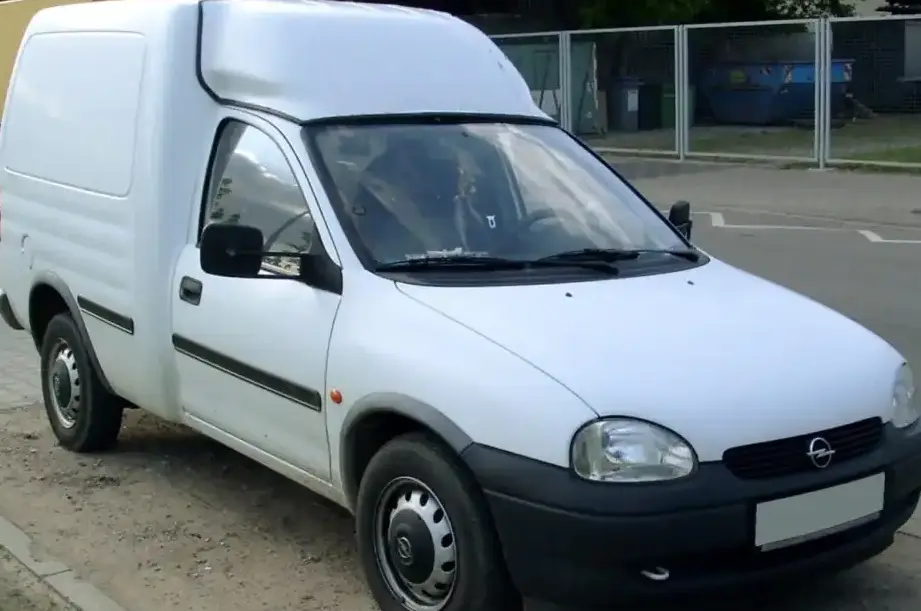
The Opel Combo Tour B 1.4i (60 hp) was a commercial vehicle produced from October 1993 to January 2001, representing a core offering within the Combo Tour B generation. Positioned as an entry-level workhorse, this variant catered to businesses and individuals requiring a practical and economical light commercial vehicle. Built on the shared platform with the Citroën Berlingo and Peugeot Partner, the Combo Tour B aimed to provide a robust and affordable solution in the compact van segment, primarily within European markets. This specific 1.4i engine and 5-speed manual transmission combination was designed for utility and low running costs, rather than outright performance.
Technical Specifications
| Brand | Opel |
| Model | Combo |
| Generation | Combo Tour B |
| Type (Engine) | 1.4i (60 Hp) |
| Start of production | October, 1993 |
| End of production | January, 2001 |
| Powertrain Architecture | Internal Combustion engine |
| Body type | Pick-up |
| Seats | 2 |
| Doors | 3 |
| Fuel Type | Petrol (Gasoline) |
| Power | 60 Hp @ 5200 rpm |
| Power per litre | 43.2 Hp/l |
| Torque | 103 Nm @ 2800 rpm (75.97 lb.-ft. @ 2800 rpm) |
| Engine Model/Code | C14NZ, X14SZ |
| Engine displacement | 1388 cm3 (84.7 cu. in.) |
| Number of cylinders | 4 |
| Engine configuration | Inline |
| Cylinder Bore | 77.6 mm (3.06 in.) |
| Piston Stroke | 73.4 mm (2.89 in.) |
| Compression ratio | 9.4:1 |
| Number of valves per cylinder | 2 |
| Fuel injection system | Single-point injection |
| Engine aspiration | Naturally aspirated engine |
| Engine oil capacity | 3.5 l (3.7 US qt | 3.08 UK qt) |
| Coolant | 5.8 l (6.13 US qt | 5.1 UK qt) |
| Trunk (boot) space – maximum | 3000 l (105.94 cu. ft.) |
| Length | 4230 mm (166.54 in.) |
| Width | 1686 mm (66.38 in.) |
| Height | 1805 mm (71.06 in.) |
| Wheelbase | 2480 mm (97.64 in.) |
| Front track | 1387 mm (54.61 in.) |
| Rear (Back) track | 1427 mm (56.18 in.) |
| Ride height (ground clearance) | 160 mm (6.3 in.) |
| Drivetrain Architecture | The Internal combustion engine (ICE) drives the front wheels of the vehicle. |
| Drive wheel | Front wheel drive |
| Number of gears and type of gearbox | 5 gears, manual transmission |
Powertrain & Engine Architecture
The Combo Tour B 1.4i utilized either the C14NZ or X14SZ engine code, both representing 1.4-liter inline four-cylinder gasoline engines. These engines were relatively simple in design, featuring a single overhead camshaft (SOHC) and two valves per cylinder. The fuel system employed single-point fuel injection, a cost-effective solution common in vehicles of this era. This system delivered fuel into the intake manifold rather than directly into the cylinders, resulting in slightly lower efficiency and power output compared to multi-point injection systems. The engine’s 9.4:1 compression ratio was a compromise between fuel economy and performance. The 5-speed manual transmission was the standard offering, providing a range of gear ratios designed to maximize fuel efficiency and provide adequate acceleration for light commercial duties. The transmission was a conventional setup, prioritizing durability and ease of maintenance over sophisticated features.
Driving Characteristics
The 60 hp output of the 1.4i engine translated to modest performance. Acceleration was slow, particularly when laden with cargo. The engine required frequent downshifting to maintain speed on inclines or when overtaking. The gear ratios in the 5-speed manual transmission were spaced to prioritize fuel economy, meaning the engine often operated at higher RPMs during highway cruising. Compared to the more powerful 1.6-liter or diesel variants, the 1.4i felt significantly underpowered. However, its simplicity and lower stress levels contributed to its reliability. The front-wheel-drive configuration provided predictable handling, but the vehicle’s high center of gravity and utilitarian suspension setup meant it wasn’t designed for spirited driving. The focus was firmly on practicality and load-carrying capability.
Equipment & Trim Levels
The Combo Tour B 1.4i was typically offered in a basic trim level, reflecting its position as the entry-level model. Standard equipment was minimal, focusing on essential functionality. This included a basic dashboard with analog gauges, vinyl or cloth upholstery, and steel wheels. Power steering was often an optional extra, as were features like a radio or electric windows. The interior was designed for durability and ease of cleaning, with hard-wearing plastics and simple controls. The emphasis was on providing a functional workspace rather than luxurious comfort. The pick-up body style offered a large cargo bed, ideal for transporting goods.
Chassis & Braking
The Combo Tour B featured a relatively simple chassis design. The front suspension utilized MacPherson struts, while the rear suspension employed a twist beam setup. This configuration prioritized cost-effectiveness and load-carrying capacity over sophisticated handling. Braking was typically accomplished with disc brakes on the front wheels and drum brakes on the rear. This configuration was common for vehicles in this price range and weight class. Anti-lock Braking System (ABS) was generally not standard equipment on the base 1.4i model. The vehicle’s ride height provided adequate ground clearance for navigating uneven surfaces, a common requirement for commercial vehicles.
Market Reception & Comparison
The Opel Combo Tour B 1.4i was generally well-received as a practical and affordable light commercial vehicle. Critics acknowledged its utilitarian nature and low running costs, but also noted its lack of refinement and modest performance. Compared to the more powerful 1.6-liter gasoline or 1.9-liter diesel variants, the 1.4i offered significantly lower performance but also lower fuel consumption and purchase price. The diesel models were favored by those requiring higher torque and fuel efficiency for long-distance hauling, while the 1.6-liter gasoline engine provided a better balance of performance and economy. The 1.4i appealed to businesses and individuals with limited budgets and relatively light hauling needs.
Legacy
The Opel Combo Tour B 1.4i has proven to be a relatively reliable vehicle, particularly when well-maintained. The simplicity of the engine and drivetrain contributes to its durability. Common issues include wear and tear on suspension components and corrosion, particularly in regions with harsh winters. In the used car market, these vehicles are typically very affordable, making them attractive to those seeking a cheap and practical work vehicle. While not known for its performance or luxury, the Combo Tour B 1.4i remains a testament to the enduring appeal of a simple, robust, and economical light commercial vehicle. Parts availability is generally good, further enhancing its appeal as a budget-friendly option.