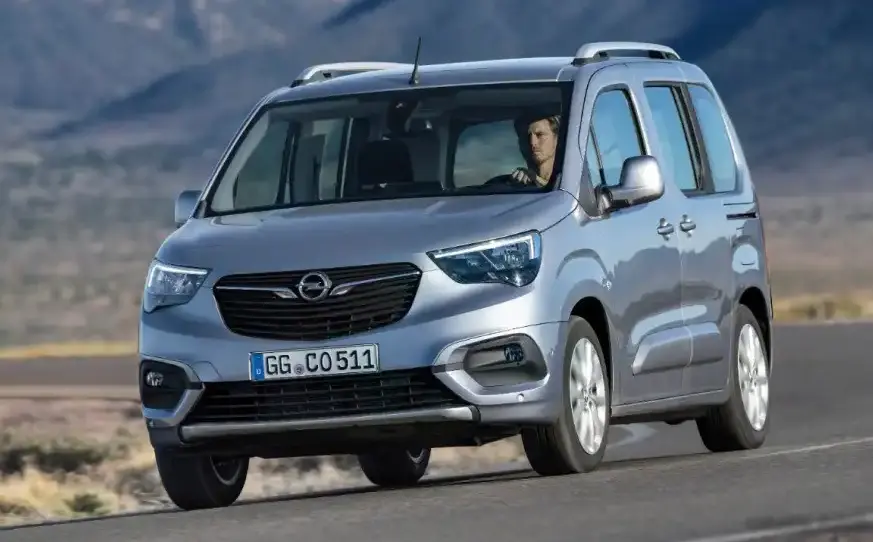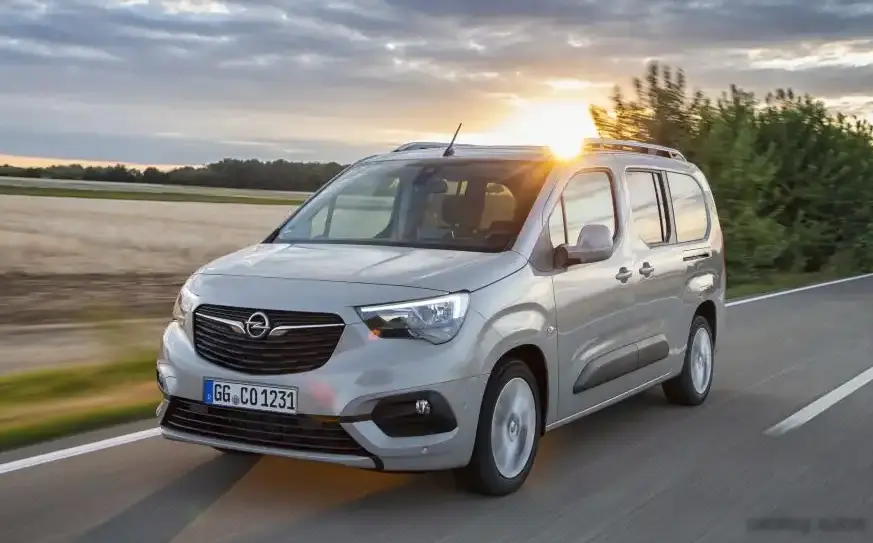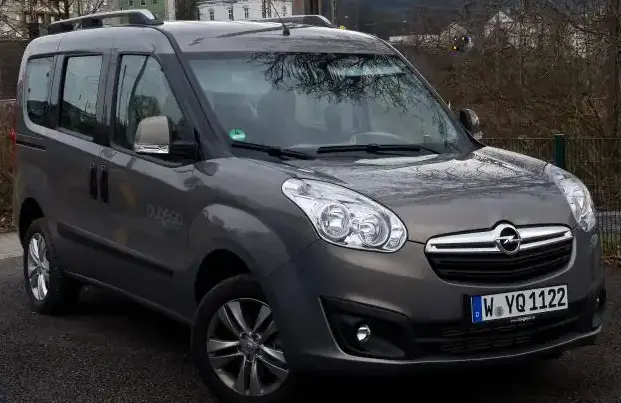
The Opel Combo Tour D 1.6 CDTI (95 hp) ecoFLEX was a commercially-oriented panel van and passenger vehicle produced from April 2015 to June 2017. Part of the Combo D generation (based on the Fiat Doblo platform), this variant occupied the entry-level position in the Tour D passenger vehicle lineup, offering a balance of fuel efficiency and practicality for families and small businesses. It was primarily sold in European markets, where compact vans and multi-purpose vehicles were highly popular. The “ecoFLEX” designation indicated Opel’s efforts to optimize fuel economy through various engineering enhancements.
Technical Specifications
| Brand | Opel |
| Model | Combo |
| Generation | Combo Tour D |
| Type (Engine) | 1.6 CDTI (95 Hp) ecoFLEX |
| Start of production | April, 2015 |
| End of production | June, 2017 |
| Powertrain Architecture | Internal Combustion engine |
| Body type | Minivan |
| Seats | 5 |
| Doors | 5 |
| Fuel consumption (combined) | 4.7 l/100 km (50 US mpg, 60.1 UK mpg, 21.3 km/l) |
| CO2 emissions | 124 g/km |
| Fuel Type | Diesel |
| Acceleration 0 – 100 km/h | 14.3 sec |
| Acceleration 0 – 62 mph | 14.3 sec |
| Acceleration 0 – 60 mph | 13.6 sec |
| Maximum speed | 158 km/h (98.18 mph) |
| Emission standard | Euro 6 |
| Power | 95 Hp @ 4000 rpm |
| Torque | 95 Nm @ 1500 rpm (70.07 lb.-ft. @ 1500 rpm) |
| Engine layout | Front, Transverse |
| Engine Model/Code | B16FD |
| Engine displacement | 1598 cm3 (97.52 cu. in.) |
| Number of cylinders | 4 |
| Engine configuration | Inline |
| Cylinder Bore | 79.5 mm (3.13 in.) |
| Piston Stroke | 80.5 mm (3.17 in.) |
| Fuel injection system | Diesel Commonrail |
| Engine aspiration | Turbocharger, Intercooler |
| Engine oil capacity | 4.9 l (5.18 US qt | 4.31 UK qt) |
| Coolant | 6.7 l (7.08 US qt | 5.9 UK qt) |
| Trunk (boot) space – maximum | 3200 l (113.01 cu. ft.) |
| Fuel tank capacity | 60 l (15.85 US gal | 13.2 UK gal) |
| Length | 4390 mm (172.83 in.) |
| Width | 1831 mm (72.09 in.) |
| Height | 1845-2100 mm (72.64 – 82.68 in.) |
| Wheelbase | 2755 mm (108.46 in.) |
| Front track | 1510 mm (59.45 in.) |
| Rear (Back) track | 1530 mm (60.24 in.) |
| Minimum turning circle | 11.2 m (36.75 ft.) |
| Drivetrain Architecture | Front wheel drive |
| Number of gears and type of gearbox | 6 gears, manual transmission |
| Assisting systems | ABS (Anti-lock braking system) |
| Steering type | Steering rack and pinion |
Powertrain & Engine Architecture
The Combo Tour D 1.6 CDTI ecoFLEX was powered by the B16FD engine, a 1.6-liter inline-four cylinder diesel engine. This engine belonged to Opel’s family of small-displacement diesel engines, designed for fuel efficiency and reduced emissions. It featured a common rail direct injection system, delivering fuel directly into the combustion chamber at high pressure for optimized combustion. A turbocharger with an intercooler was employed to increase power output and improve torque across a wider rev range. The engine produced 95 horsepower at 4000 rpm and 192 lb-ft of torque at 1500 rpm. The engine was transversely mounted in the front of the vehicle. The 6-speed manual transmission was the only transmission option available with this engine, prioritizing fuel economy over outright performance.
Driving Characteristics
The 1.6 CDTI 95 hp engine, paired with the 6-speed manual transmission, provided adequate, but not exhilarating, performance. Acceleration from 0-60 mph took approximately 13.6 seconds, and top speed was limited to around 98 mph. The engine’s torque characteristics meant that it felt relatively responsive at lower speeds, making it suitable for city driving and carrying loads. However, overtaking maneuvers on highways required careful planning. Compared to higher-output versions of the 1.6 CDTI or the more powerful 1.7 CDTI engine available in other Combo Tour D models, this variant offered a more economical driving experience at the expense of performance. The gear ratios were tuned for fuel efficiency, with a relatively long final drive.
Equipment & Trim Levels
The 1.6 CDTI ecoFLEX variant typically came with a modest level of standard equipment. This included features like power windows, central locking, a basic audio system with USB connectivity, and ABS brakes. Safety features such as driver and passenger airbags were standard. Interior upholstery was typically cloth, and the dashboard featured a functional, if somewhat basic, design. Optional extras included air conditioning, alloy wheels, parking sensors, and a more advanced infotainment system. The ecoFLEX trim often included specific aerodynamic enhancements and low rolling resistance tires to further improve fuel economy.
Chassis & Braking
The Combo Tour D utilized a relatively simple chassis design, prioritizing practicality and cost-effectiveness. The front suspension consisted of MacPherson struts, while the rear suspension employed a twist beam setup. This configuration provided a comfortable ride quality, but handling was not particularly sporty. The braking system featured disc brakes on the front wheels and drum brakes on the rear wheels. ABS (Anti-lock Braking System) was standard. The suspension was tuned to accommodate the vehicle’s typical payload, providing a stable and controlled driving experience even when fully loaded.
Market Reception & Comparison
The Opel Combo Tour D 1.6 CDTI ecoFLEX was generally well-received by critics as a practical and economical choice in the compact van segment. Its fuel efficiency was a major selling point, particularly for businesses and families looking to minimize running costs. However, some reviewers noted that the engine lacked outright power, especially when the vehicle was fully loaded. Compared to the more powerful 1.7 CDTI variant, the 1.6 CDTI offered lower performance but better fuel economy. Against competitors like the Volkswagen Caddy and Renault Kangoo, the Combo Tour D offered a competitive price point and a spacious interior.
Legacy
The Opel Combo Tour D 1.6 CDTI ecoFLEX has proven to be a relatively reliable vehicle in the used car market. The 1.6 CDTI engine, while not known for being particularly refined, is generally durable and capable of high mileage with proper maintenance. Common issues include diesel particulate filter (DPF) problems, particularly on vehicles that have primarily been used for short journeys. Regular servicing and the use of high-quality diesel fuel are essential for maintaining the engine’s longevity. Today, these vehicles represent an affordable and practical option for those seeking a compact van or multi-purpose vehicle with good fuel economy.