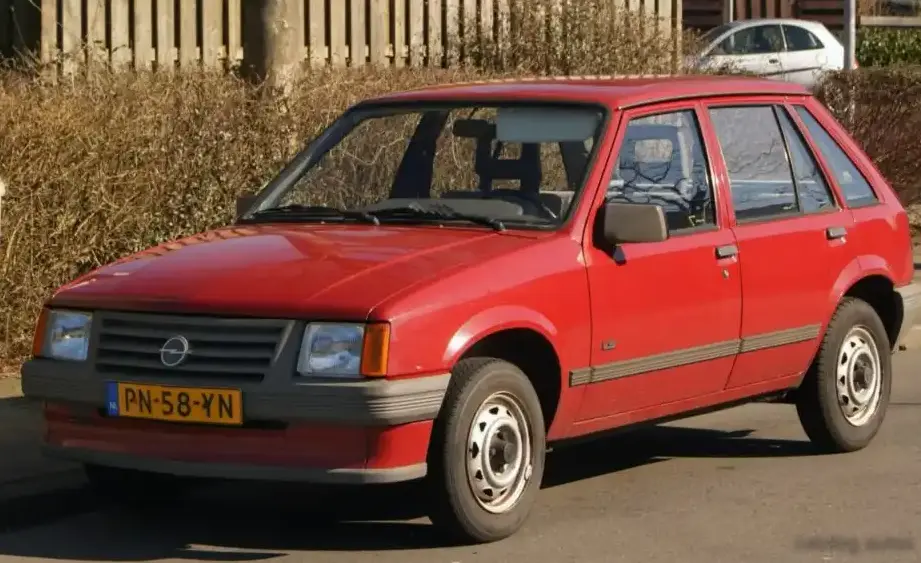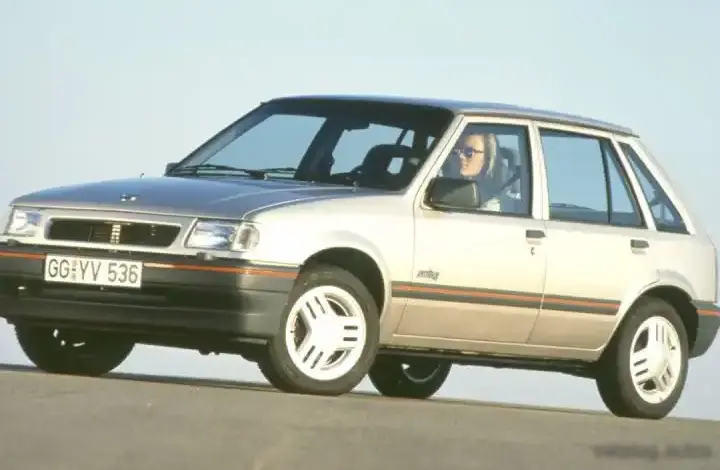
The Opel Corsa A (facelift, introduced in 1987) 1.2 S, producing 55 horsepower, represented an entry-level offering within the revitalized Corsa A range. Following the initial launch of the Corsa A in 1982, the 1987 facelift brought subtle but important styling updates and mechanical refinements. This particular variant, powered by the 12ST engine, was aimed at buyers seeking an economical and practical small hatchback, primarily in European markets. It served as a stepping stone into the Corsa lineup, positioned below the more powerful and better-equipped trims.
Technical Specifications
| Brand | Opel |
| Model | Corsa |
| Generation | Corsa A (facelift 1987) |
| Type (Engine) | 1.2 S (55 Hp) |
| Start of production | 1987 |
| End of production | 1990 |
| Powertrain Architecture | Internal Combustion engine |
| Body type | Hatchback |
| Seats | 5 |
| Doors | 3 |
| Fuel consumption (combined) | 6.9 l/100 km (34.1 US mpg, 40.9 UK mpg, 14.5 km/l) |
| Fuel Type | Petrol (Gasoline) |
| Acceleration 0 – 100 km/h | 16 sec |
| Acceleration 0 – 62 mph | 16 sec |
| Acceleration 0 – 60 mph | 15.2 sec |
| Maximum speed | 152 km/h (94.45 mph) |
| Weight-to-power ratio | 13.7 kg/Hp, 72.8 Hp/tonne |
| Weight-to-torque ratio | 8.4 kg/Nm, 119.2 Nm/tonne |
| Power | 55 Hp @ 5600 rpm |
| Power per litre | 46 Hp/l |
| Torque | 90 Nm @ 2200 rpm (66.38 lb.-ft. @ 2200 rpm) |
| Engine layout | Front, Transverse |
| Engine Model/Code | 12ST |
| Engine displacement | 1196 cm3 (72.98 cu. in.) |
| Number of cylinders | 4 |
| Engine configuration | Inline |
| Cylinder Bore | 77.8 mm (3.06 in.) |
| Piston Stroke | 62.9 mm (2.48 in.) |
| Compression ratio | 9.2:1 |
| Number of valves per cylinder | 2 |
| Fuel injection system | Carburettor |
| Engine aspiration | Naturally aspirated engine |
| Valvetrain | SOHC |
| Engine oil capacity | 3 l (3.17 US qt | 2.64 UK qt) |
| Coolant | 6.1 l (6.45 US qt | 5.37 UK qt) |
| Kerb Weight | 755 kg (1664.49 lbs.) |
| Max. weight | 1235 kg (2722.71 lbs.) |
| Max load | 480 kg (1058.22 lbs.) |
| Trunk (boot) space – minimum | 270 l (9.53 cu. ft.) |
| Trunk (boot) space – maximum | 1060 l (37.43 cu. ft.) |
| Fuel tank capacity | 42 l (11.1 US gal | 9.24 UK gal) |
| Length | 3622 mm (142.6 in.) |
| Width | 1532 mm (60.31 in.) |
| Height | 1365 mm (53.74 in.) |
| Wheelbase | 2343 mm (92.24 in.) |
| Front track | 1320 mm (51.97 in.) |
| Rear (Back) track | 1300 mm (51.18 in.) |
| Ride height (ground clearance) | 140 mm (5.51 in.) |
| Drag coefficient (Cd) | 0.36 |
| Minimum turning circle | 10 m (32.81 ft.) |
| Drivetrain Architecture | The Internal combustion engine (ICE) drives the front wheels of the vehicle. |
| Drive wheel | Front wheel drive |
| Number of gears and type of gearbox | 4 gears, manual transmission |
| Front brakes | Disc |
| Rear brakes | Drum |
| Tires size | 145/70 R13 |
| Wheel rims size | 13 |
Powertrain & Engine Architecture
The heart of the Corsa A 1.2 S was the 12ST engine, a 1.2-liter (1196 cc) inline-four cylinder unit. This engine utilized a single overhead camshaft (SOHC) valvetrain with two valves per cylinder. Crucially, this version employed a carburetor for fuel delivery, a cost-saving measure common in entry-level models of the era. The carburetor, while simpler and cheaper than fuel injection, resulted in slightly lower fuel efficiency and less precise throttle response compared to injected counterparts. The engine produced 55 horsepower at 5600 rpm and 90 Nm (66.38 lb-ft) of torque at 2200 rpm. The engine was transversely mounted, driving the front wheels. The transmission was a four-speed manual gearbox, chosen for its simplicity and affordability. This configuration was typical for small European hatchbacks of the late 1980s.
Driving Characteristics
The Corsa A 1.2 S, with its 55 hp and four-speed manual transmission, offered modest performance. Acceleration from 0 to 60 mph took approximately 15.2 seconds, and the top speed was around 94.45 mph. The engine felt relatively strained at higher speeds, and overtaking required careful planning. The gear ratios were geared towards economy rather than outright performance. Compared to the later Corsa A variants with larger engines (like the 1.4 or 1.6-liter versions), the 1.2 S felt noticeably slower. However, the light weight of the vehicle (755 kg) helped to mitigate the lack of power to some extent. The steering was light and responsive, making it easy to maneuver in urban environments. The suspension, while basic, provided a reasonably comfortable ride on most road surfaces.
Equipment & Trim Levels
The 1.2 S trim level was fairly basic, focusing on providing essential transportation. Standard features typically included cloth upholstery, a simple dashboard layout, and manual windows and door locks. The interior was functional rather than luxurious. Optional extras, such as a radio, upgraded seat fabrics, and a sunroof, were available, but these added to the overall cost. The exterior featured steel wheels with hubcaps, black plastic bumpers, and relatively minimal trim. The goal was to offer a competitively priced vehicle that met the needs of budget-conscious buyers.
Chassis & Braking
The Corsa A utilized a relatively simple chassis design. The front suspension consisted of MacPherson struts, while the rear suspension employed a twist-beam axle. The braking system featured disc brakes on the front wheels and drum brakes on the rear. This combination was adequate for the vehicle’s weight and performance, but it lacked the stopping power of more advanced braking systems. The steering was a rack-and-pinion system, providing reasonably precise control. Stabilizer bars were not typically fitted to the base 1.2 S model, contributing to a slightly more pronounced body roll in corners.
Market Reception & Comparison
The Opel Corsa A 1.2 S was generally well-received as an affordable and practical city car. Critics praised its fuel economy and ease of driving, but noted its lack of power and basic interior. Compared to other small hatchbacks of the time, such as the Fiat Uno or the Renault 5, the Corsa A offered a good balance of features and price. The 1.2 S was often seen as a sensible choice for first-time car buyers or those seeking a reliable and economical runabout. The more powerful Corsa variants, while offering better performance, came at a higher price point, making the 1.2 S an attractive option for budget-conscious consumers.
Legacy
The Opel Corsa A 1.2 S, while not a particularly exciting or technologically advanced vehicle, played an important role in establishing the Corsa as a popular small hatchback in Europe. The 12ST engine, while simple, proved to be relatively reliable, and many examples are still on the road today. In the used car market, these Corsas are often sought after by enthusiasts looking for a classic and affordable vehicle. Maintenance is generally straightforward, and parts are still readily available. However, potential buyers should be aware of the carburetor’s potential for requiring periodic adjustment and rebuilding. The Corsa A 1.2 S represents a snapshot of automotive engineering from the late 1980s, offering a glimpse into a time when simplicity and affordability were prioritized over outright performance and luxury.