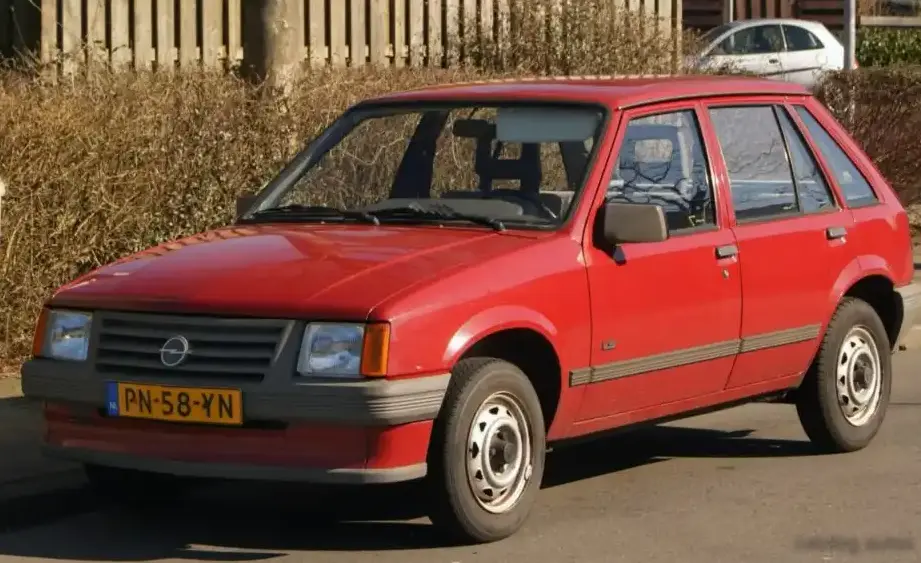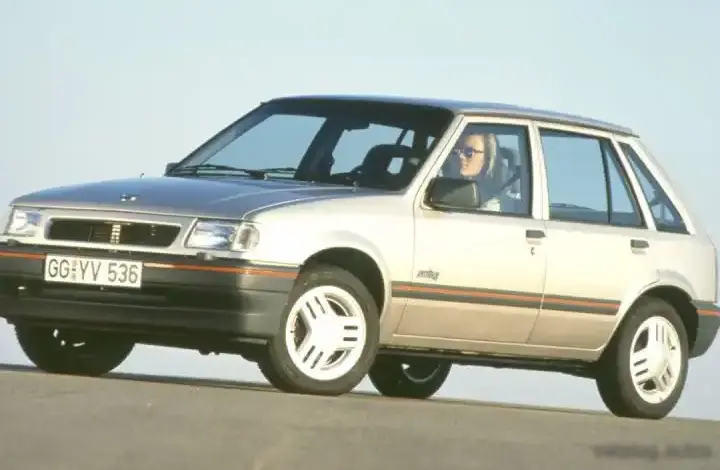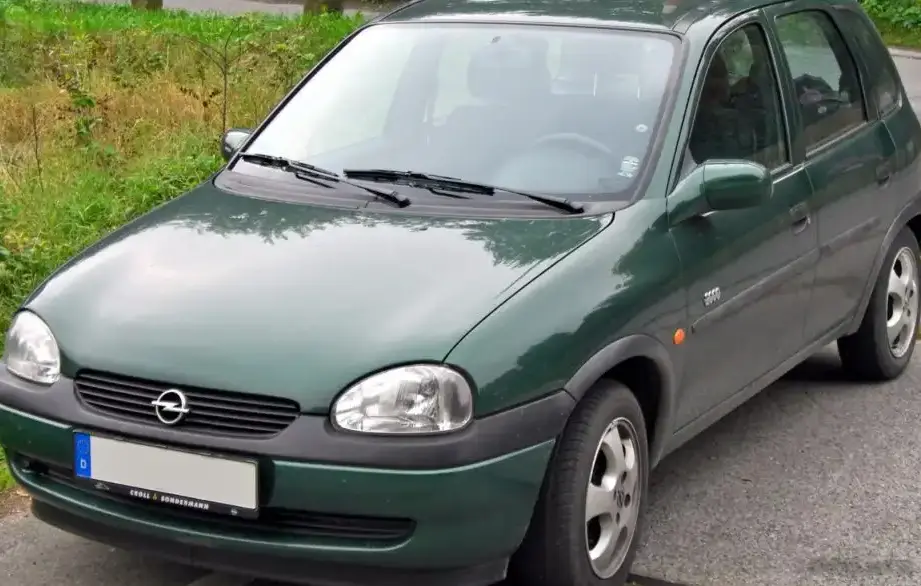
The Opel Corsa B, specifically the 1.4i variant producing 60 horsepower, represented an entry-level offering within the Corsa B range manufactured between March 1997 and June 1998. This facelifted version of the Corsa B (internally designated as the 1HX0/A3 platform) aimed to provide affordable and economical transportation, primarily targeting first-time car buyers and those seeking a practical city car. It occupied the lower end of the Corsa B lineup, positioned below the more powerful 1.6-liter and sportier versions.
Technical Specifications
| Brand | Opel |
| Model | Corsa |
| Generation | Corsa B (facelift 1997) |
| Type (Engine) | 1.4i (60 Hp) |
| Start of production | March, 1997 |
| End of production | June, 1998 |
| Powertrain Architecture | Internal Combustion engine |
| Body type | Hatchback |
| Seats | 5 |
| Doors | 3-5 |
| Fuel consumption (urban) | 10.3 l/100 km (22.8 US mpg, 27.4 UK mpg, 9.7 km/l) |
| Fuel consumption (extra urban) | 5.7 l/100 km (41.3 US mpg, 49.6 UK mpg, 17.5 km/l) |
| Fuel consumption (combined) | 7.4 l/100 km (31.8 US mpg, 38.2 UK mpg, 13.5 km/l) |
| CO2 emissions | 176 g/km |
| Fuel Type | Petrol (Gasoline) |
| Acceleration 0 – 100 km/h | 15 sec |
| Acceleration 0 – 62 mph | 15 sec |
| Acceleration 0 – 60 mph | 14.3 sec |
| Maximum speed | 155 km/h (96.31 mph) |
| Weight-to-power ratio | 14.9 kg/Hp, 67.3 Hp/tonne |
| Weight-to-torque ratio | 8.7 kg/Nm, 115.5 Nm/tonne |
| Power | 60 Hp @ 5400 rpm |
| Power per litre | 43.2 Hp/l |
| Torque | 103 Nm @ 2800 rpm (75.97 lb.-ft. @ 2800 rpm) |
| Engine layout | Front, Transverse |
| Engine Model/Code | X14SZ |
| Engine displacement | 1388 cm3 (84.7 cu. in.) |
| Number of cylinders | 4 |
| Engine configuration | Inline |
| Cylinder Bore | 77.6 mm (3.06 in.) |
| Piston Stroke | 73.4 mm (2.89 in.) |
| Compression ratio | 9.4:1 |
| Number of valves per cylinder | 2 |
| Fuel injection system | Single-point injection |
| Engine aspiration | Naturally aspirated engine |
| Valvetrain | OHC |
| Engine oil capacity | 3.5 l (3.7 US qt | 3.08 UK qt) |
| Coolant | 5.8 l (6.13 US qt | 5.1 UK qt) |
| Kerb Weight | 892 kg (1966.52 lbs.) |
| Max. weight | 1400 kg (3086.47 lbs.) |
| Max load | 508 kg (1119.95 lbs.) |
| Trunk (boot) space – minimum | 260 l (9.18 cu. ft.) |
| Trunk (boot) space – maximum | 1050 l (37.08 cu. ft.) |
| Fuel tank capacity | 46 l (12.15 US gal | 10.12 UK gal) |
| Length | 3740 mm (147.24 in.) |
| Width | 1610 mm (63.39 in.) |
| Height | 1420 mm (55.91 in.) |
| Wheelbase | 2445 mm (96.26 in.) |
| Front track | 1385 mm (54.53 in.) |
| Rear (Back) track | 1390 mm (54.72 in.) |
| Ride height (ground clearance) | 140 mm (5.51 in.) |
| Drag coefficient (Cd) | 0.35 |
| Drivetrain Architecture | The Internal combustion engine (ICE) drives the front wheels of the vehicle. |
| Drive wheel | Front wheel drive |
| Number of gears and type of gearbox | 5 gears, manual transmission |
| Front suspension | Coil spring |
| Rear suspension | Coil spring |
| Front brakes | Disc |
| Rear brakes | Drum |
| Assisting systems | ABS (Anti-lock braking system) |
| Steering type | Steering rack and pinion |
| Power steering | Hydraulic Steering |
| Tires size | 165/70 R13 |
| Wheel rims size | 5 J X 13 |
Powertrain & Engine Architecture
The heart of this Corsa B variant is the Opel X14SZ engine, a 1.4-liter inline-four cylinder petrol engine. This engine utilizes a single-point fuel injection system, a relatively simple and cost-effective technology for the time. The X14SZ features an overhead camshaft (OHC) valvetrain with two valves per cylinder. Its 1388cc displacement produced 60 horsepower at 5400 rpm and 103 Nm (76 lb-ft) of torque at 2800 rpm. The engine’s design prioritized fuel efficiency and reliability over outright performance. The transmission paired with this engine was typically a five-speed manual gearbox, although a four-speed automatic transmission was also available, albeit less common. The automatic transmission was a conventional hydraulic unit, offering smooth but not particularly sporty shifts.
Driving Characteristics
The 1.4i 60 hp Corsa B with a manual transmission offered adequate, if uninspiring, performance. Acceleration from 0-60 mph took around 14.3 seconds, and top speed was approximately 96 mph. The engine felt strained when pushed hard, particularly when fully loaded or climbing hills. The automatic transmission further dulled performance, increasing 0-60 mph times to around 15 seconds. Gear ratios were optimized for fuel economy rather than acceleration. The car was best suited for urban driving and shorter trips, where its nimble handling and relatively low running costs were appreciated. The suspension provided a comfortable ride, but body roll was noticeable in corners.
Equipment & Trim Levels
The 1.4i model typically came with basic equipment as standard. This included power steering, central locking, and a basic stereo system. Interior upholstery was typically cloth, and the dashboard featured a simple, functional design. Optional extras included air conditioning, electric windows, and alloy wheels. Trim levels varied slightly depending on the market, but generally, the 1.4i represented the entry point to the Corsa B range. Higher trim levels, such as the “Enjoy” or “Sport,” added more features and cosmetic enhancements.
Chassis & Braking
The Corsa B utilized a relatively simple chassis design. Front suspension consisted of coil springs and MacPherson struts, while the rear suspension employed a torsion beam setup. This configuration provided a good balance between ride comfort and handling. Braking was typically accomplished with disc brakes on the front wheels and drum brakes on the rear. An Anti-lock Braking System (ABS) was often included as standard equipment, enhancing safety. The steering was rack and pinion, providing precise and responsive control.
Market Reception & Comparison
The 1.4i Corsa B was generally well-received as an affordable and practical city car. Critics praised its fuel efficiency and ease of driving, but noted its lack of performance. Compared to the more powerful 1.6-liter versions, the 1.4i felt significantly slower and less refined. However, it offered lower running costs and insurance premiums, making it an attractive option for budget-conscious buyers. The 1.9-liter diesel (TDI) versions offered superior fuel economy but came with a higher purchase price and a less refined driving experience.
Legacy
The X14SZ engine, while not known for its performance, proved to be a relatively reliable unit. Properly maintained examples of the 1.4i Corsa B can still be found on the road today. The car’s simplicity and affordability have made it a popular choice for first-time drivers and those seeking a cheap and cheerful runabout. In the used car market, these Corsas are typically very affordable, but potential buyers should be aware of common issues such as rust and wear and tear on suspension components. The 1.4i Corsa B represents a practical and economical choice from a bygone era of affordable motoring.