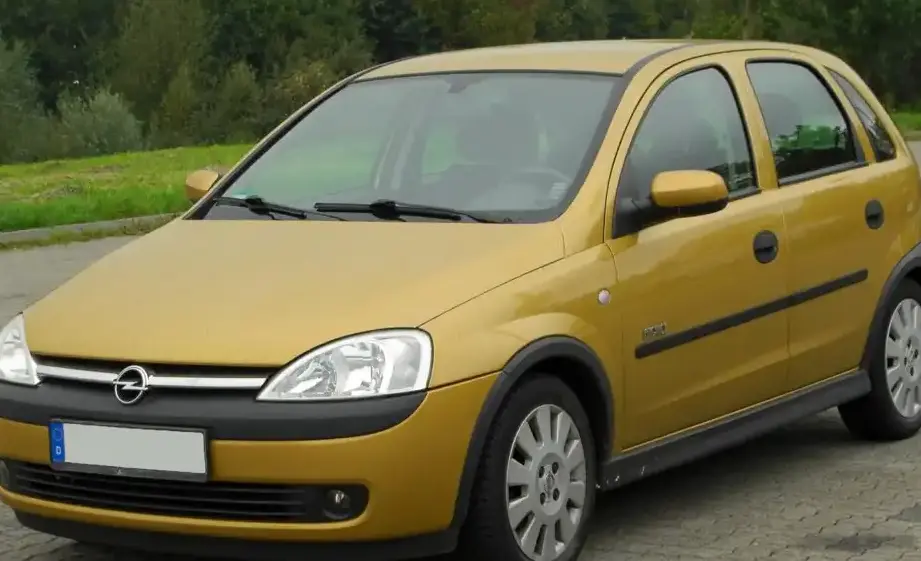
The Opel Corsa C 1.2 16V, produced from October 2000 to 2003, represented an entry-level offering within the broader Corsa C range (1999-2006). Positioned as a fuel-efficient and affordable hatchback, it served as a key model for Opel in the European small car segment. This variant, powered by the Z12XE engine and typically paired with a five-speed manual transmission (though an automatic was available), aimed to provide basic transportation with reasonable reliability. It was a direct competitor to vehicles like the Ford Fiesta, Volkswagen Polo, and Renault Clio in the European market.
Technical Specifications
| Brand | Opel |
| Model | Corsa |
| Generation | Corsa C |
| Type (Engine) | 1.2 16V (75 Hp) |
| Start of production | October, 2000 |
| End of production | 2003 |
| Powertrain Architecture | Internal Combustion engine |
| Body type | Hatchback |
| Seats | 5 |
| Doors | 3-5 |
| Fuel consumption (urban) | 8.2 l/100 km (28.7 US mpg, 34.4 UK mpg, 12.2 km/l) |
| Fuel consumption (extra urban) | 5.2 l/100 km (45.2 US mpg, 54.3 UK mpg, 19.2 km/l) |
| Fuel consumption (combined) | 6.3 l/100 km (37.3 US mpg, 44.8 UK mpg, 15.9 km/l) |
| CO2 emissions | 151 g/km |
| Fuel Type | Petrol (Gasoline) |
| Acceleration 0 – 100 km/h | 13 sec |
| Acceleration 0 – 62 mph | 13 sec |
| Acceleration 0 – 60 mph | 12.4 sec |
| Maximum speed | 170 km/h (105.63 mph) |
| Weight-to-power ratio | 12.1 kg/Hp, 82.4 Hp/tonne |
| Weight-to-torque ratio | 8.3 kg/Nm, 120.9 Nm/tonne |
| Power | 75 Hp @ 5600 rpm |
| Power per litre | 62.6 Hp/l |
| Torque | 110 Nm @ 4000 rpm (81.13 lb.-ft. @ 4000 rpm) |
| Engine layout | Front, Transverse |
| Engine Model/Code | Z12XE |
| Engine displacement | 1199 cm3 (73.17 cu. in.) |
| Number of cylinders | 4 |
| Engine configuration | Inline |
| Cylinder Bore | 72.5 mm (2.85 in.) |
| Piston Stroke | 72.6 mm (2.86 in.) |
| Compression ratio | 10.1:1 |
| Number of valves per cylinder | 4 |
| Fuel injection system | Multi-port manifold injection |
| Engine aspiration | Naturally aspirated engine |
| Valvetrain | DOHC |
| Engine oil capacity | 3.5 l (3.7 US qt | 3.08 UK qt) |
| Coolant capacity | 4.3 l (4.54 US qt | 3.78 UK qt) |
| Kerb Weight | 910-930 kg (2006.21 – 2050.3 lbs.) |
| Max. weight | 1430 kg (3152.61 lbs.) |
| Max load | 500-520 kg (1102.31 – 1146.4 lbs.) |
| Trunk (boot) space – minimum | 260 l (9.18 cu. ft.) |
| Trunk (boot) space – maximum | 1060 l (37.43 cu. ft.) |
| Fuel tank capacity | 44 l (11.62 US gal | 9.68 UK gal) |
| Length | 3817 mm (150.28 in.) |
| Width | 1646 mm (64.8 in.) |
| Height | 1440 mm (56.69 in.) |
| Wheelbase | 2491 mm (98.07 in.) |
| Front track | 1429 mm (56.26 in.) |
| Rear track | 1420 mm (55.91 in.) |
| Drivetrain Architecture | Front wheel drive |
| Drive wheel | Front wheel drive |
| Number of gears | 5 gears, manual transmission |
| Front suspension | Coil spring |
| Rear suspension | Coil spring |
| Front brakes | Disc |
| Rear brakes | Drum |
| Assisting systems | ABS (Anti-lock braking system) |
| Steering type | Steering rack and pinion |
| Tires size | 175/65 R13 |
| Wheel rims size | 13 |
Powertrain & Engine Architecture
The heart of the Corsa C 1.2 16V is the Z12XE engine, a 1.2-liter (1199 cc) inline-four cylinder petrol engine. This engine is characterized by its double overhead camshaft (DOHC) valvetrain, operating four valves per cylinder. It utilizes a multi-port fuel injection system, delivering fuel directly into the intake ports. The Z12XE is a naturally aspirated engine, meaning it doesn’t employ a turbocharger or supercharger. The engine’s design prioritized fuel efficiency and low emissions over outright performance. The five-speed manual transmission was the most common pairing, offering a relatively standard gear ratio spread for the class. An optional four-speed automatic transmission was available, but it significantly impacted acceleration and fuel economy.
Driving Characteristics
The 1.2 16V engine, producing 75 horsepower, delivered modest performance. Acceleration from 0 to 60 mph took around 12.4 seconds, and top speed was approximately 105 mph. The automatic transmission version was noticeably slower. The engine felt strained at higher speeds, particularly when fully loaded or climbing hills. The gear ratios in the manual transmission were well-suited for city driving and economical cruising, but required frequent downshifts for overtaking maneuvers. Compared to the more powerful 1.4 or 1.6-liter versions of the Corsa C, the 1.2 felt underpowered, but it offered a smoother and more forgiving driving experience for novice drivers.
Equipment & Trim Levels
The Corsa C 1.2 16V typically came with a basic level of equipment. Standard features generally included power steering, central locking, and an adjustable steering column. Interior upholstery was typically cloth, and the dashboard featured a simple, functional design. Optional extras included air conditioning, electric windows, and an upgraded audio system. Trim levels varied slightly depending on the market, but the 1.2 16V generally represented the entry point to the Corsa C range. Higher trim levels added features like alloy wheels, fog lights, and more luxurious interior appointments.
Chassis & Braking
The Corsa C utilized a relatively simple chassis design. Front suspension consisted of coil springs and MacPherson struts, while the rear suspension employed a torsion beam setup. Brakes were disc brakes on the front wheels and drum brakes on the rear, a common configuration for vehicles in this price segment. ABS (Anti-lock Braking System) was often included as standard equipment, enhancing safety. The suspension was tuned for comfort rather than sporty handling, providing a reasonably smooth ride on most road surfaces. Stabilizer bars were typically smaller in diameter on the 1.2 16V compared to higher-spec models.
Market Reception & Comparison
The Opel Corsa C 1.2 16V was generally well-received as an affordable and economical city car. Critics praised its fuel efficiency and ease of driving, but noted its lack of performance. Compared to the 1.4 and 1.6-liter versions, the 1.2 offered lower running costs but a less engaging driving experience. The automatic transmission version was often criticized for its sluggishness and reduced fuel economy. Reliability was generally considered average for the class, with some reports of minor electrical issues. However, the engine itself was known to be relatively durable.
Legacy
The Opel Corsa C 1.2 16V remains a relatively common sight on European roads today, often found as an affordable used car. The Z12XE engine, while not known for its power, has proven to be reasonably reliable with proper maintenance. Parts availability is generally good, and repair costs are relatively low. However, potential buyers should be aware of the possibility of age-related issues, such as corrosion and wear on suspension components. The Corsa C 1.2 16V represents a practical and economical choice for those seeking a basic, no-frills hatchback.