Technical Specifications
| Brand | Opel |
| Model | Corsa |
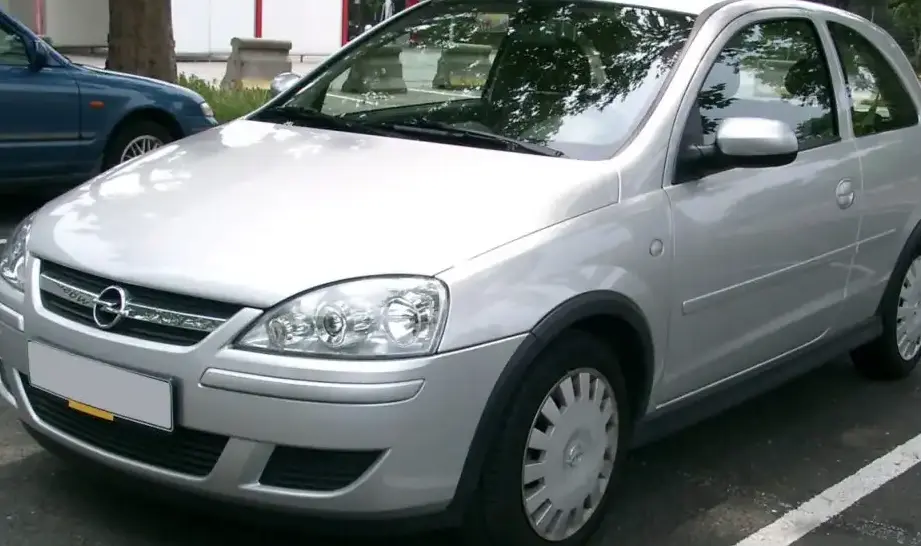
| Generation | Corsa C (facelift 2003) |
| Type (Engine) | 1.0 12V (60 Hp) |
| Start of production | July, 2003 |
| End of production | June, 2006 |
| Powertrain Architecture | Internal Combustion engine |
| Body type | Hatchback |
| Seats | 5 |
| Doors | 3-5 |
| Fuel consumption (urban) | 6.9 l/100 km (34.1 US mpg) |
| Fuel consumption (extra urban) | 4.4 l/100 km (53.5 US mpg) |
| Fuel consumption (combined) | 5.3 l/100 km (44.4 US mpg) |
| CO2 emissions | 127 g/km |
| Fuel Type | Petrol (Gasoline) |
| Acceleration 0 – 100 km/h | 16 sec |
| Acceleration 0 – 62 mph | 16 sec |
| Acceleration 0 – 60 mph | 15.2 sec |
| Maximum speed | 156 km/h (96.93 mph) |
| Weight-to-power ratio | 15.1 kg/Hp |
| Weight-to-torque ratio | 10.3 kg/Nm |
| Power | 60 Hp @ 5600 rpm |
| Torque | 88 Nm @ 3800 rpm (64.91 lb.-ft. @ 3800 rpm) |
| Engine layout | Front, Transverse |
| Engine Model/Code | Z10XEP |
| Engine displacement | 998 cm3 (60.9 cu. in.) |
| Number of cylinders | 3 |
| Engine configuration | Inline |
| Cylinder Bore | 73.4 mm (2.89 in.) |
| Piston Stroke | 78.6 mm (3.09 in.) |
| Compression ratio | 10.5:1 |
| Number of valves per cylinder | 4 |
| Fuel injection system | Multi-port manifold injection |
| Engine aspiration | Naturally aspirated |
| Engine oil capacity | 3 l (3.17 US qt | 2.64 UK qt) |
| Coolant capacity | 4.9 l (5.18 US qt | 4.31 UK qt) |
| Kerb Weight | 905 kg (1995.18 lbs.) |
| Max. weight | 1405 kg (3097.49 lbs.) |
| Max load | 500 kg (1102.31 lbs.) |
| Trunk (boot) space – minimum | 260 l (9.18 cu. ft.) |
| Trunk (boot) space – maximum | 1060 l (37.43 cu. ft.) |
| Fuel tank capacity | 44 l (11.62 US gal | 9.68 UK gal) |
| Length | 3839 mm (151.14 in.) |
| Width | 1646 mm (64.8 in.) |
| Height | 1440 mm (56.69 in.) |
| Wheelbase | 2491 mm (98.07 in.) |
| Front track | 1429 mm (56.26 in.) |
| Rear track | 1420 mm (55.91 in.) |
| Ride height (ground clearance) | 140 mm (5.51 in.) |
| Drag coefficient (Cd) | 0.32 |
| Drivetrain | Front wheel drive |
| Number of gears | 5 |
| Gearbox type | Manual transmission |
| Front brakes | Ventilated discs |
| Rear brakes | Drum |
| Tires size | 155/80 R13 |
| Wheel rims size | 13 |
The Opel Corsa C 1.0 12V, introduced after the 2003 facelift, was designed to appeal to budget-conscious buyers. It occupied the base trim level within the Corsa C lineup, sitting below the 1.2, 1.4, and 1.8-liter variants, as well as the sportier GSi models. The facelift brought subtle cosmetic changes, including revised headlights and bumpers, but the core mechanicals remained largely consistent. This variant was a mainstay in European cities, prized for its maneuverability and low fuel consumption. It was available in both 3-door and 5-door hatchback configurations.
Powertrain & Engine Architecture
The heart of the Corsa C 1.0 12V is the Z10XEP engine, a 998cc inline-three cylinder petrol engine. This engine utilizes a multi-port fuel injection system and a single overhead camshaft (SOHC) with four valves per cylinder. The 12V designation refers to the total number of valves. The Z10XEP is known for its simplicity and relatively robust design, though it lacks the refinement of larger, more powerful engines. The engine’s modest output is delivered through a five-speed manual transmission, which was the standard offering. The transmission’s gear ratios are geared towards maximizing fuel economy rather than providing rapid acceleration. The engine’s relatively low compression ratio of 10.5:1 contributes to its ability to run on lower octane fuel.
Driving Characteristics
The Corsa C 1.0 12V’s driving experience is best described as utilitarian. With only 60 horsepower, acceleration is slow, taking approximately 16 seconds to reach 62 mph (100 km/h). The engine feels strained when pushed hard, particularly when fully loaded or climbing hills. However, around town, the engine is adequate for everyday driving. The five-speed manual transmission allows for reasonable control, but the long shift throws and light pedal feel don’t inspire sporty driving. Compared to the 1.2 or 1.4-liter versions, the 1.0 feels significantly underpowered. The 1.8-liter GSi models offer a dramatically different, more engaging driving experience. The focus is clearly on fuel efficiency and ease of driving, making it a suitable choice for novice drivers or those primarily using the car for short commutes.
Equipment & Trim Levels
The base-level Corsa C 1.0 12V typically came equipped with basic features. Standard equipment included power steering, central locking, and a basic audio system. Air conditioning was often an optional extra, as were electric windows. Interior upholstery was typically cloth, with a simple dashboard layout. Higher trim levels, such as the ‘Enjoy’ or ‘Club’ offered additional features like alloy wheels, upgraded audio systems, and more comfortable seating. Safety features were also relatively basic, with driver and passenger airbags being standard, but ABS was often an optional extra.
Chassis & Braking
The Corsa C 1.0 12V utilizes a MacPherson strut front suspension and a torsion beam rear suspension. This setup provides a comfortable ride, but doesn’t offer particularly sharp handling. The front brakes are ventilated discs, providing adequate stopping power for the car’s weight and performance. However, the rear brakes are drums, which are less effective than disc brakes. The relatively narrow 155/80 R13 tires contribute to the car’s fuel efficiency but limit grip. Stabilizer bars were often omitted on the base model to keep costs down.
Market Reception & Comparison
The Corsa C 1.0 12V was generally well-received as an affordable and economical city car. Critics praised its low running costs and maneuverability, but criticized its lack of power and refinement. Compared to rivals like the Ford Fiesta and Renault Clio, the Corsa C 1.0 12V offered a similar level of practicality and fuel efficiency. However, some competitors offered more sophisticated engines and a more engaging driving experience. In terms of reliability, the Z10XEP engine is generally considered to be reliable, but regular maintenance is essential. Fuel economy figures of around 44.4 US mpg (combined) were competitive for the time.
Legacy
The Corsa C 1.0 12V remains a common sight on European roads today, often as a first car or a budget-friendly runabout. The Z10XEP engine, while not known for its performance, has proven to be relatively durable with proper maintenance. Used examples are readily available and typically priced very affordably. However, potential buyers should be aware of potential issues such as oil leaks and wear on the timing chain. The Corsa C 1.0 12V represents a practical and economical choice for those seeking a simple and reliable city car, but it’s important to manage expectations regarding performance and refinement.