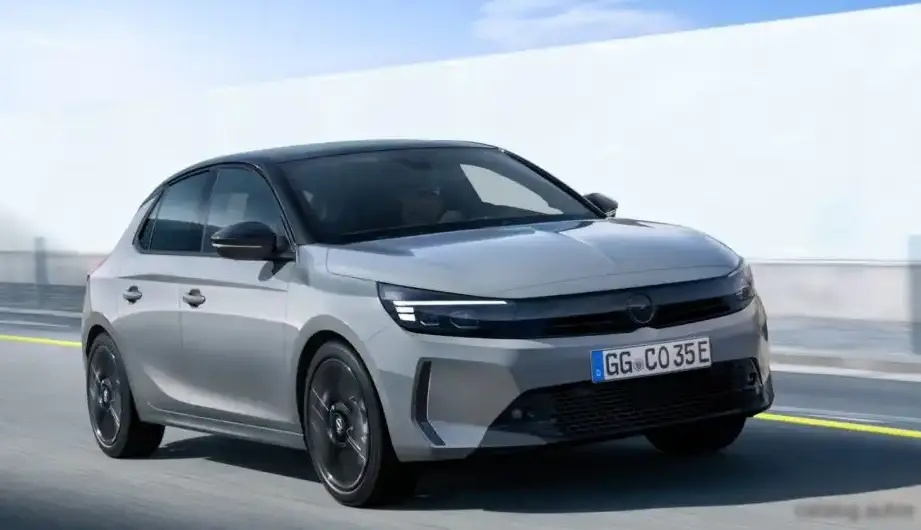
The Opel Corsa F (facelift, introduced in July 2023) 1.2 Turbo 100 hp Automatic represents a key variant within the sixth generation of Opel’s popular subcompact hatchback. Positioned as a mid-range offering, this version aimed to balance fuel efficiency with acceptable performance for everyday driving. It builds upon the foundation of the Corsa F platform (shared with Peugeot and Citroën as part of the Stellantis group) and incorporates a turbocharged three-cylinder engine paired with an eight-speed automatic transmission. This combination was intended to appeal to buyers seeking a convenient and economical city car with the ease of an automatic gearbox.
Technical Specifications
| Brand | Opel |
| Model | Corsa |
| Generation | Corsa F (facelift 2023) |
| Type (Engine) | 1.2 Turbo (100 Hp) Automatic |
| Start of production | July, 2023 |
| Powertrain Architecture | Internal Combustion engine |
| Body type | Hatchback |
| Seats | 5 |
| Doors | 5 |
| Fuel consumption at Low speed (WLTP) | 6.8-6.9 l/100 km (34.6 – 34.1 US mpg, 41.5 – 40.9 UK mpg, 14.7 – 14.5 km/l) |
| Fuel consumption at Medium speed (WLTP) | 5.3-5.4 l/100 km (44.4 – 43.6 US mpg, 53.3 – 52.3 UK mpg, 18.9 – 18.5 km/l) |
| Fuel consumption at high speed (WLTP) | 4.6-4.7 l/100 km (51.1 – 50 US mpg, 61.4 – 60.1 UK mpg, 21.7 – 21.3 km/l) |
| Fuel consumption at very high speed (WLTP) | 5.7 l/100 km (41.3 US mpg, 49.6 UK mpg, 17.5 km/l) |
| Combined fuel consumption (WLTP) | 5.4-5.5 l/100 km (43.6 – 42.8 US mpg, 52.3 – 51.4 UK mpg, 18.5 – 18.2 km/l) |
| CO2 emissions (WLTP) | 122-124 g/km |
| Fuel Type | Petrol (Gasoline) |
| Acceleration 0 – 100 km/h | 10.8 sec |
| Acceleration 0 – 62 mph | 10.8 sec |
| Acceleration 0 – 60 mph | 10.3 sec |
| Maximum speed | 192 km/h (119.3 mph) |
| Emission standard | Euro 6d |
| Weight-to-power ratio | 11.3 kg/Hp, 88.7 Hp/tonne |
| Weight-to-torque ratio | 5.5 kg/Nm, 181.7 Nm/tonne |
| Power | 100 Hp @ 5500 rpm |
| Power per litre | 83.4 Hp/l |
| Torque | 205 Nm @ 1750 rpm (151.2 lb.-ft. @ 1750 rpm) |
| Engine layout | Front, Transverse |
| Engine Model/Code | HN05 |
| Engine displacement | 1199 cm3 (73.17 cu. in.) |
| Number of cylinders | 3 |
| Engine configuration | Inline |
| Compression ratio | 10.5:1 |
| Number of valves per cylinder | 4 |
| Fuel injection system | Direct injection |
| Engine aspiration | Turbocharger, Intercooler |
| Engine oil capacity | 3.5 l (3.7 US qt | 3.08 UK qt) |
| Kerb Weight | 1128 kg (2486.81 lbs.) |
| Max. weight | 1645 kg (3626.6 lbs.) |
| Max load | 517 kg (1139.79 lbs.) |
| Trunk (boot) space – minimum | 309 l (10.91 cu. ft.) |
| Trunk (boot) space – maximum | 1081 l (38.18 cu. ft.) |
| Fuel tank capacity | 44 l (11.62 US gal | 9.68 UK gal) |
| Max. roof load | 70 kg (154.32 lbs.) |
| Permitted trailer load with brakes (12%) | 1200 kg (2645.55 lbs.) |
| Permitted trailer load without brakes | 580 kg (1278.68 lbs.) |
| Permitted towbar download | 55 kg (121.25 lbs.) |
| Length | 4061 mm (159.88 in.) |
| Width | 1765 mm (69.49 in.) |
| Width including mirrors | 1960 mm (77.17 in.) |
| Height | 1435 mm (56.5 in.) |
| Wheelbase | 2538 mm (99.92 in.) |
| Front track | 1501 mm (59.09 in.) |
| Rear (Back) track | 1500 mm (59.06 in.) |
| Front overhang | 832 mm (32.76 in.) |
| Rear overhang | 691 mm (27.2 in.) |
| Minimum turning circle (turning diameter) | 10.7 m (35.1 ft.) |
| Drivetrain Architecture | The Internal combustion engine (ICE) drives the front wheels of the vehicle. |
| Drive wheel | Front wheel drive |
| Number of gears and type of gearbox | 8 gears, automatic transmission |
| Front brakes | Ventilated discs |
| Rear brakes | Disc |
| Assisting systems | ABS (Anti-lock braking system) |
| Steering type | Steering rack and pinion |
| Power steering | Electric Steering |
| Tires size | 195/55 R16; 205/45 R17 |
| Wheel rims size | 6.5J x 16; 7J x 17 |
Powertrain & Engine Architecture
The heart of this Corsa variant is the HN05, a 1.2-liter turbocharged three-cylinder petrol engine. This engine is part of Stellantis’s “PureTech” family, known for its compact size and efficiency. It utilizes direct fuel injection, delivering fuel directly into the combustion chamber for improved combustion control and power output. The engine also features a turbocharger with an intercooler, which forces more air into the cylinders, boosting power and torque. The HN05 engine produces 100 horsepower at 5500 rpm and 205 Nm (151.2 lb-ft) of torque at 1750 rpm. This torque figure is particularly noteworthy for a small-displacement engine, providing good low-end responsiveness. The engine is paired with an eight-speed automatic transmission, providing smooth gear changes and contributing to overall fuel efficiency. This transmission is a conventional torque-converter automatic, offering a balance between comfort and efficiency.
Driving Characteristics
The 1.2 Turbo 100 hp Automatic Corsa F offers a comfortable and undemanding driving experience. Acceleration from 0-60 mph takes around 10.3 seconds, which is adequate for city and suburban driving but not particularly sporty. The automatic transmission is well-tuned, providing smooth shifts and keeping the engine within its optimal power band. However, it isn’t as quick to respond as some dual-clutch transmissions. The relatively low weight of the Corsa (1128 kg / 2486.81 lbs) helps to mitigate the modest power output. Compared to the more powerful 1.2 Turbo variants or diesel options, this version prioritizes fuel economy over outright performance. The gear ratios are optimized for fuel efficiency, meaning the engine doesn’t rev as high during cruising speeds.
Equipment & Trim Levels
The 1.2 Turbo 100 hp Automatic trim typically included standard features such as air conditioning, a touchscreen infotainment system with Apple CarPlay and Android Auto compatibility, Bluetooth connectivity, and a suite of safety features including lane departure warning and automatic emergency braking. Higher trim levels offered additional features like a larger touchscreen, navigation system, heated seats, and parking sensors. Interior upholstery was typically cloth, with options for upgraded materials on higher trims. The dashboard layout was modern and functional, with a focus on ease of use.
Chassis & Braking
The Corsa F utilizes a front-wheel-drive platform with a MacPherson strut front suspension and a torsion beam rear suspension. This setup provides a good balance between ride comfort and handling. The front brakes are ventilated discs, while the rear brakes are solid discs. ABS (Anti-lock Braking System) is standard. The steering is electric power-assisted, providing light and precise steering feel. The suspension is tuned for comfort, absorbing bumps and imperfections in the road surface effectively. Stabilizer bars are fitted to both the front and rear axles to reduce body roll during cornering.
Market Reception & Comparison
The Opel Corsa F 1.2 Turbo 100 hp Automatic was generally well-received by automotive critics as a practical and economical city car. It was praised for its fuel efficiency, comfortable ride, and user-friendly technology. However, some critics noted that the engine could feel strained when fully loaded or driving uphill. Compared to the diesel variants, the 1.2 Turbo offered lower running costs in terms of fuel, but potentially higher maintenance costs due to the complexity of the turbocharger system. Against higher-powered petrol versions, it offered a more affordable entry point but with a noticeable performance deficit.
Legacy
The HN05 engine, while generally reliable, has been subject to some reports of timing chain issues in certain applications. Regular oil changes and adherence to the manufacturer’s maintenance schedule are crucial for ensuring long-term reliability. The eight-speed automatic transmission has also proven to be relatively durable. In the used car market, the Corsa F 1.2 Turbo 100 hp Automatic represents a good value proposition for buyers seeking an affordable and fuel-efficient hatchback. Its compact size and easy driving characteristics make it well-suited for urban environments.