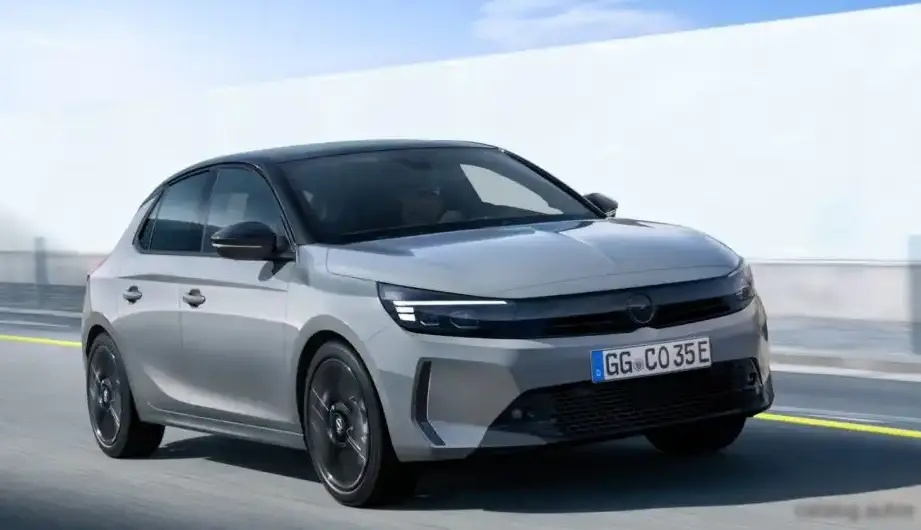
The Opel Corsa F (facelift 2023) 1.2 Turbo (145 Hp) Hybrid eDCT represents a significant evolution in Opel’s subcompact offering, introduced for the 2025 model year. This variant builds upon the already successful Corsa F platform (launched in 2019), incorporating mild hybrid technology to enhance fuel efficiency and reduce emissions. Positioned as a mid-range offering within the Corsa F lineup, it bridges the gap between the base models and the more performance-oriented trims. The facelift brought styling updates and a revised interior, alongside the introduction of this hybrid powertrain option, aimed at appealing to environmentally conscious buyers in the European market.
Technical Specifications
| Brand | Opel |
| Model | Corsa |
| Generation | Corsa F (facelift 2023) |
| Type (Engine) | 1.2 Turbo (145 Hp) Hybrid eDCT |
| Start of production | April, 2025 |
| Powertrain Architecture | MHEV (Mild Hybrid Electric Vehicle) |
| Body type | Hatchback |
| Seats | 5 |
| Doors | 5 |
| Fuel consumption at Low speed (WLTP) | 4 l/100 km (58.8 US mpg, 70.6 UK mpg, 25 km/l) |
| Fuel consumption at Medium speed (WLTP) | 4.1-4.2 l/100 km (57.4 – 56 US mpg, 68.9 – 67.3 UK mpg, 24.4 – 23.8 km/l) |
| Fuel consumption at high speed (WLTP) | 4.2 l/100 km (56 US mpg, 67.3 UK mpg, 23.8 km/l) |
| Fuel consumption at very high speed (WLTP) | 5.6 l/100 km (42 US mpg, 50.4 UK mpg, 17.9 km/l) |
| Combined fuel consumption (WLTP) | 4.6-4.7 l/100 km (51.1 – 50 US mpg, 61.4 – 60.1 UK mpg, 21.7 – 21.3 km/l) |
| CO2 emissions (WLTP) | 105 g/km |
| Fuel Type | Petrol (Gasoline) |
| Acceleration 0 – 100 km/h | 7.9 sec |
| Acceleration 0 – 62 mph | 7.9 sec |
| Acceleration 0 – 60 mph | 7.5 sec |
| Maximum speed | 210 km/h (130.49 mph) |
| Emission standard | Euro 6e-bis |
| Weight-to-power ratio | 8.2 kg/Hp, 121.6 Hp/tonne |
| Weight-to-torque ratio | 5.2 kg/Nm, 193 Nm/tonne |
| Battery voltage | 48 V |
| Battery technology | Lithium-ion (Li-Ion) |
| Battery location | Below the floor, under the front seats |
| Electric motor power | 21 Hp @ 4265 rpm |
| Electric motor location | Integrated into the transmission |
| Electric motor type | Synchronous |
| System power | 145 Hp |
| Power | 136 Hp @ 5500 rpm |
| Power per litre | 113.4 Hp/l |
| Torque | 230 Nm @ 1750 rpm (169.64 lb.-ft. @ 1750 rpm) |
| Engine layout | Front, Transverse |
| Engine Model/Code | HN09 |
| Engine displacement | 1199 cm3 (73.17 cu. in.) |
| Number of cylinders | 3 |
| Engine configuration | Inline |
| Number of valves per cylinder | 4 |
| Fuel injection system | Direct injection |
| Engine aspiration | Turbocharger, Intercooler |
| Engine oil capacity | 3.5 l (3.7 US qt | 3.08 UK qt) |
| Kerb Weight | 1192 kg (2627.91 lbs.) |
| Max. weight | 1690 kg (3725.81 lbs.) |
| Max load | 498 kg (1097.9 lbs.) |
| Trunk (boot) space – minimum | 309 l (10.91 cu. ft.) |
| Trunk (boot) space – maximum | 1081 l (38.18 cu. ft.) |
| Fuel tank capacity | 44 l (11.62 US gal | 9.68 UK gal) |
| Max. roof load | 70 kg (154.32 lbs.) |
| Permitted trailer load with brakes (12%) | 1200 kg (2645.55 lbs.) |
| Permitted trailer load without brakes | 610 kg (1344.82 lbs.) |
| Permitted towbar download | 55 kg (121.25 lbs.) |
| Length | 4061 mm (159.88 in.) |
| Width | 1765 mm (69.49 in.) |
| Width including mirrors | 1960 mm (77.17 in.) |
| Height | 1435 mm (56.5 in.) |
| Wheelbase | 2538 mm (99.92 in.) |
| Front track | 1501 mm (59.09 in.) |
| Rear (Back) track | 1500 mm (59.06 in.) |
| Front overhang | 832 mm (32.76 in.) |
| Rear overhang | 691 mm (27.2 in.) |
| Minimum turning circle (turning diameter) | 10.74 m (35.24 ft.) |
| Drivetrain Architecture | ICE and electric motor drive the front wheels |
| Drive wheel | Front wheel drive |
| Number of gears and type of gearbox | 6 gears, automatic transmission eDCT |
| Front brakes | Ventilated discs |
| Rear brakes | Disc |
| Tires size | 195/55 R16; 205/45 R17 |
| Wheel rims size | 16; 17 |
INTRODUCTION
The Opel Corsa F (facelift 2023) 1.2 Turbo (145 Hp) Hybrid eDCT is a front-wheel-drive, five-door hatchback that represents a key offering in Opel’s compact car range. Introduced as part of the Corsa F’s mid-life refresh, this variant combines a 1.2-liter turbocharged three-cylinder engine with a 48-volt mild hybrid system and a six-speed eDCT (efficient Dual Clutch Transmission). This powertrain is designed to deliver a balance of performance, fuel economy, and reduced emissions, catering to the growing demand for more sustainable vehicles. The Corsa F itself is built on the Stellantis CMP (Common Modular Platform) and shares its underpinnings with other vehicles like the Peugeot 208 and Citroën C3.
Powertrain & Engine Architecture
At the heart of this Corsa variant lies the HN09 1.2-liter turbocharged three-cylinder engine. This engine utilizes direct fuel injection and an intercooled turbocharger to produce 136 horsepower at 5500 rpm and 230 Nm (169.64 lb.-ft.) of torque at 1750 rpm. The addition of the 48-volt mild hybrid system, featuring a small electric motor integrated into the transmission, provides a power boost of up to 21 hp and assists during acceleration. The electric motor also enables a start/stop system that operates more smoothly and efficiently than traditional systems. The eDCT transmission offers quick and precise gear changes, contributing to both performance and fuel economy. The engine’s architecture is designed for compactness and lightweight construction, aiding in overall vehicle efficiency.
Driving Characteristics
The 1.2 Turbo Hybrid eDCT Corsa offers a surprisingly refined driving experience. The mild hybrid system provides a noticeable boost during initial acceleration, making city driving feel more responsive. The eDCT transmission shifts smoothly and quickly, minimizing power interruption. While not a performance-focused model, the 7.9-second 0-62 mph acceleration time is respectable for its class. Compared to the non-hybrid 1.2-liter versions, the hybrid offers improved responsiveness and a slightly more refined feel. The gear ratios are tuned for a balance of fuel efficiency and everyday usability, prioritizing smooth cruising over outright performance. The steering is light and precise, making it easy to maneuver in urban environments.
Equipment & Trim Levels
The 1.2 Turbo Hybrid eDCT trim typically includes a generous level of standard equipment. This often includes features such as a touchscreen infotainment system with Apple CarPlay and Android Auto compatibility, a digital instrument cluster, automatic climate control, and a suite of safety features like lane departure warning, automatic emergency braking, and traffic sign recognition. Interior upholstery is typically cloth, with options for upgraded materials available. Higher trim levels may add features like heated seats, a panoramic sunroof, and advanced driver-assistance systems. The overall interior design is modern and functional, with a focus on user-friendliness.
Chassis & Braking
The Corsa F utilizes a MacPherson strut front suspension and a torsion beam rear suspension. This setup provides a good balance of ride comfort and handling. The chassis is relatively lightweight, contributing to the car’s agility. The braking system consists of ventilated discs on the front wheels and solid discs on the rear. ABS (Anti-lock Braking System) is standard, along with electronic brake-force distribution. The suspension is tuned to provide a comfortable ride without sacrificing handling precision. Stabilizer bars are fitted to both the front and rear axles to reduce body roll during cornering.
Market Reception & Comparison
The Opel Corsa F 1.2 Turbo Hybrid eDCT has been generally well-received by automotive critics. It’s praised for its fuel efficiency, refined driving experience, and well-equipped interior. Compared to the non-hybrid versions of the Corsa, the hybrid offers improved fuel economy and a more responsive powertrain. It competes with other subcompact hatchbacks like the Volkswagen Polo, Renault Clio, and Ford Fiesta. The hybrid variant offers a compelling alternative for buyers seeking a more environmentally friendly option without sacrificing practicality or comfort. Some critics have noted that the mild hybrid system doesn’t provide a dramatic improvement in fuel economy compared to the most efficient non-hybrid engines, but it does contribute to a smoother and more refined driving experience.
Legacy
The Opel Corsa F 1.2 Turbo Hybrid eDCT represents a step towards electrification for the Corsa model line. While the mild hybrid system is not a full hybrid, it demonstrates Opel’s commitment to reducing emissions and improving fuel efficiency. The long-term reliability of the powertrain remains to be fully assessed, but the 1.2-liter turbocharged engine has proven to be generally reliable in other Opel and Stellantis vehicles. As a used car, this variant is likely to hold its value well due to its fuel efficiency and modern features. It represents a practical and well-rounded choice for buyers seeking a subcompact hatchback with a touch of hybrid technology.