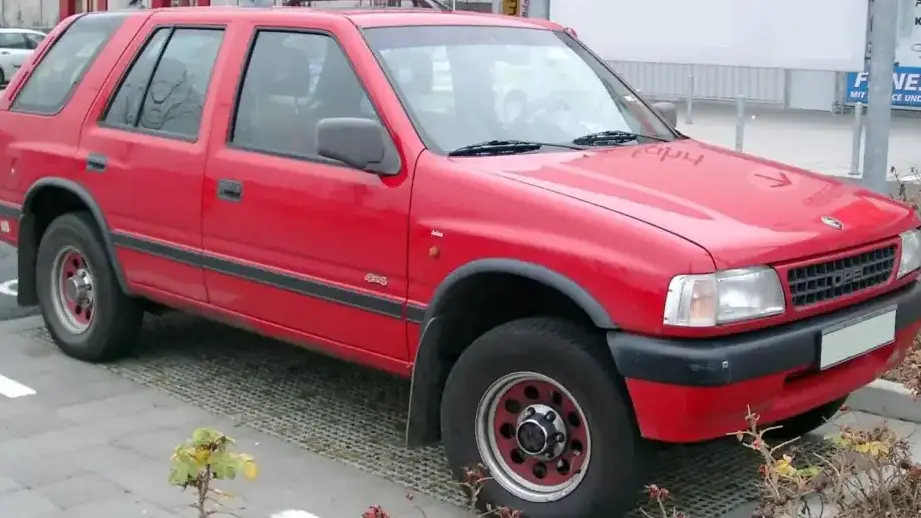
The Opel Frontera A 2.2i (136 hp) was a mid-range variant of Opel’s first foray into the rapidly growing SUV market of the 1990s. Produced from February 1995 to June 1998, it occupied a crucial position in the Frontera A lineup, offering a balance between affordability and capability. The Frontera A, built on the 60/80 platform shared with the Isuzu Rodeo and Holden Jackaroo, aimed to provide a robust, body-on-frame SUV experience for European buyers. This 2.2-liter gasoline engine, paired with a five-speed manual transmission, represented a popular choice for those seeking a versatile vehicle for both on-road comfort and occasional off-road adventures.
Technical Specifications
| Brand | Opel |
| Model | Frontera |
| Generation | Frontera A |
| Type (Engine) | 2.2i (136 Hp) |
| Start of production | February, 1995 |
| End of production | June, 1998 |
| Powertrain Architecture | Internal Combustion engine |
| Body type | SUV |
| Seats | 5 |
| Doors | 5 |
| Fuel consumption (urban) | 15 l/100 km (15.7 US mpg, 18.8 UK mpg, 6.7 km/l) |
| Fuel consumption (extra urban) | 9.4 l/100 km (25 US mpg, 30.1 UK mpg, 10.6 km/l) |
| Fuel consumption (combined) | 11.4 l/100 km (20.6 US mpg, 24.8 UK mpg, 8.8 km/l) |
| CO2 emissions | 270 g/km |
| Fuel Type | Petrol (Gasoline) |
| Acceleration 0 – 100 km/h | 13.6 sec |
| Acceleration 0 – 62 mph | 13.6 sec |
| Acceleration 0 – 60 mph | 12.9 sec |
| Maximum speed | 161 km/h (100.04 mph) |
| Emission standard | Euro 2 |
| Weight-to-power ratio | 13.3 kg/Hp, 75.4 Hp/tonne |
| Weight-to-torque ratio | 8.9 kg/Nm, 112 Nm/tonne |
| Power | 136 Hp @ 5200 rpm |
| Power per litre | 61.9 Hp/l |
| Torque | 202 Nm @ 2600 rpm (148.99 lb.-ft. @ 2600 rpm) |
| Engine layout | Front, Longitudinal |
| Engine Model/Code | X22XE |
| Engine displacement | 2198 cm3 (134.13 cu. in.) |
| Number of cylinders | 4 |
| Engine configuration | Inline |
| Cylinder Bore | 86 mm (3.39 in.) |
| Piston Stroke | 94.6 mm (3.72 in.) |
| Compression ratio | 10.5:1 |
| Number of valves per cylinder | 4 |
| Fuel injection system | Multi-port manifold injection |
| Engine aspiration | Naturally aspirated engine |
| Valvetrain | DOHC |
| Engine oil capacity | 5 l (5.28 US qt | 4.4 UK qt) |
| Coolant | 8.3 l (8.77 US qt | 7.3 UK qt) |
| Kerb Weight | 1803 kg (3974.93 lbs.) |
| Max. weight | 2510 kg (5533.6 lbs.) |
| Max load | 707 kg (1558.67 lbs.) |
| Trunk (boot) space – minimum | 540 l (19.07 cu. ft.) |
| Trunk (boot) space – maximum | 1720 l (60.74 cu. ft.) |
| Fuel tank capacity | 80 l (21.13 US gal | 17.6 UK gal) |
| Length | 4692 mm (184.72 in.) |
| Width | 1764 mm (69.45 in.) |
| Height | 1753 mm (69.02 in.) |
| Wheelbase | 2760 mm (108.66 in.) |
| Front track | 1455 mm (57.28 in.) |
| Rear (Back) track | 1460 mm (57.48 in.) |
| Ride height (ground clearance) | 230 mm (9.06 in.) |
| Drivetrain Architecture | The Internal combustion engine (ICE) drives the rear wheels of the vehicle. |
| Drive wheel | Rear wheel drive |
| Number of gears and type of gearbox | 5 gears, manual transmission |
| Front suspension | Torsion |
| Rear suspension | Rigid axle suspension |
| Front brakes | Ventilated discs |
| Rear brakes | Ventilated discs |
| Assisting systems | ABS (Anti-lock braking system) |
| Steering type | Worm-reduction unit |
| Power steering | Hydraulic Steering |
| Tires size | 235/70 R16 |
| Wheel rims size | 7J x 16 |
Powertrain & Engine Architecture
The heart of the Frontera A 2.2i was the X22XE engine, a 2.2-liter inline-four cylinder gasoline engine. This engine was a member of Opel’s ‘E’ family of engines, known for their durability and relatively simple design. It featured a dual overhead camshaft (DOHC) valvetrain with four valves per cylinder, contributing to its respectable power output for its displacement. Fuel delivery was handled by a multi-port fuel injection system, optimizing combustion efficiency. The X22XE produced 136 horsepower at 5200 rpm and 202 Nm (148.99 lb-ft) of torque at 2600 rpm. The five-speed manual transmission offered precise gear changes and allowed drivers to effectively utilize the engine’s power band. The transmission’s gear ratios were tuned for a balance of acceleration and fuel economy, though the Frontera’s weight inevitably impacted both.
Driving Characteristics
The Frontera A 2.2i, while capable, wasn’t a performance-oriented SUV. Acceleration from 0 to 60 mph took around 12.9 seconds, and its top speed was approximately 100 mph. The engine felt somewhat strained when pushed hard, particularly when fully loaded or tackling steep inclines. However, in everyday driving conditions, it provided adequate power for comfortable cruising and overtaking. The manual transmission allowed for greater driver control compared to the optional four-speed automatic, and the gear ratios were well-suited for maintaining momentum on highways. The rear-wheel-drive configuration provided a more traditional SUV feel, offering good traction on loose surfaces, but lacking the all-weather capability of four-wheel-drive models.
Equipment & Trim Levels
The 2.2i trim typically included features such as power steering, central locking, electric windows, and an AM/FM radio. Interior upholstery was generally cloth, with a durable and practical design. Optional extras included air conditioning, a sunroof, and upgraded audio systems. The dashboard layout was functional and straightforward, prioritizing usability over aesthetics. Higher trim levels, such as the ‘Sport’ or ‘Elegance’ variants, added features like alloy wheels, upgraded interior trim, and additional comfort options.
Chassis & Braking
The Frontera A utilized a body-on-frame construction, providing a robust and durable chassis. Front suspension consisted of torsion bars, while the rear featured a rigid axle suspension. This setup offered a comfortable ride on paved roads, but could feel somewhat bouncy on rough terrain. Braking duties were handled by ventilated discs on all four wheels, supplemented by an Anti-lock Braking System (ABS) for improved stopping power and stability. The ABS system was a valuable safety feature, particularly in slippery conditions.
Market Reception & Comparison
The Frontera A 2.2i was generally well-received by critics as a practical and affordable SUV. However, it faced competition from rivals such as the Suzuki Vitara, Nissan Terrano, and Mitsubishi Pajero. Compared to the higher-powered 2.5-liter V6 engine option, the 2.2i offered better fuel economy but lacked the V6’s outright performance. The 2.0-liter diesel variant provided even better fuel economy but was significantly slower. The 2.2i struck a balance between these extremes, appealing to buyers who prioritized value and practicality over outright speed. Fuel economy averaged around 20.6 US mpg in combined driving, which was typical for an SUV of its size and class in the mid-1990s.
Legacy
The Opel Frontera A, particularly the 2.2i variant, has developed a reputation for reliability and durability. The X22XE engine is known to be a robust unit, capable of high mileage with proper maintenance. Today, well-maintained examples are sought after by enthusiasts and collectors. While not as popular as some of its competitors, the Frontera A remains a distinctive and capable SUV, representing a significant chapter in Opel’s history. The Frontera A 2.2i offers a relatively affordable entry point into the classic SUV market, providing a blend of practicality, durability, and retro charm.