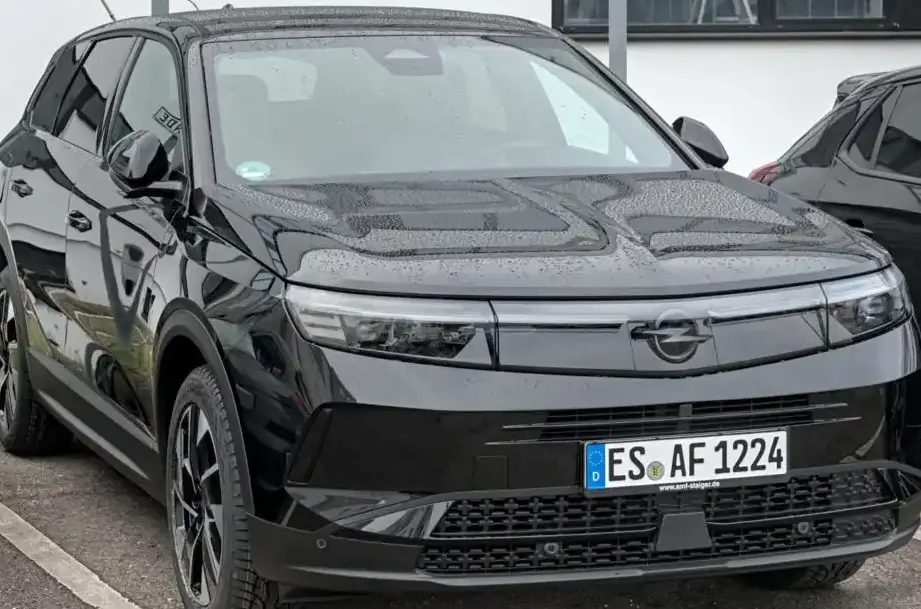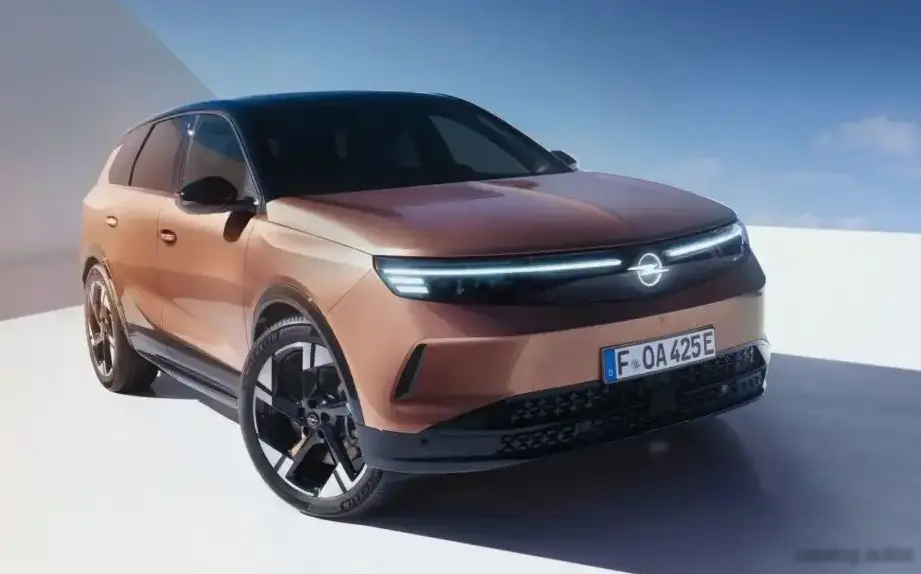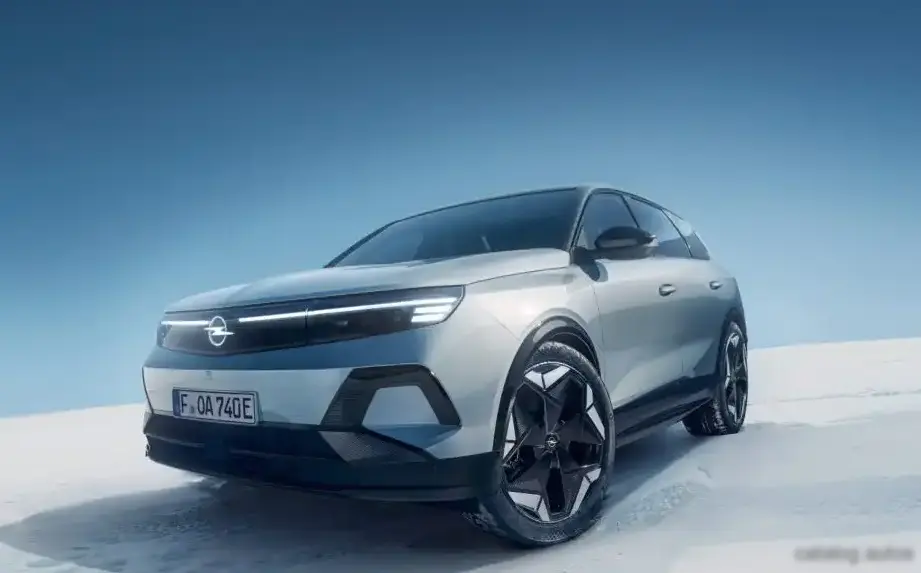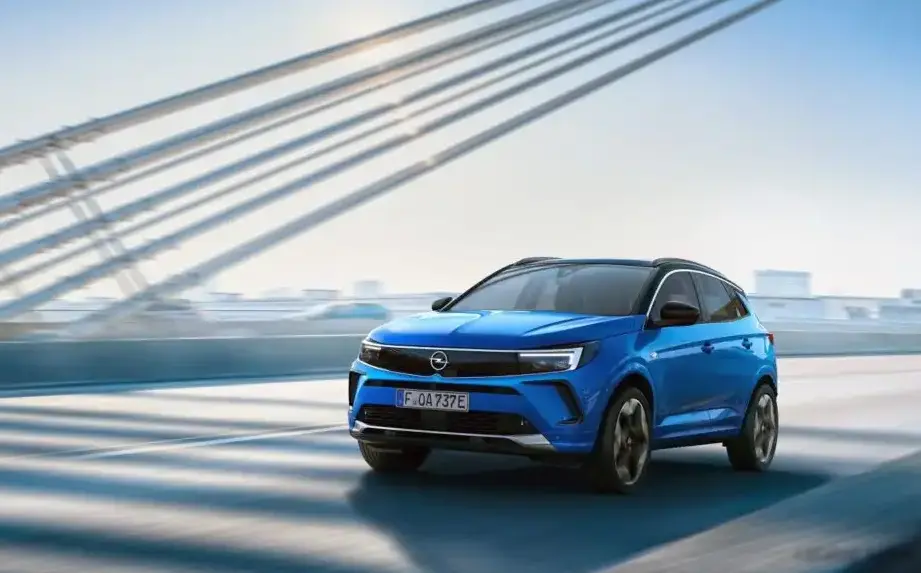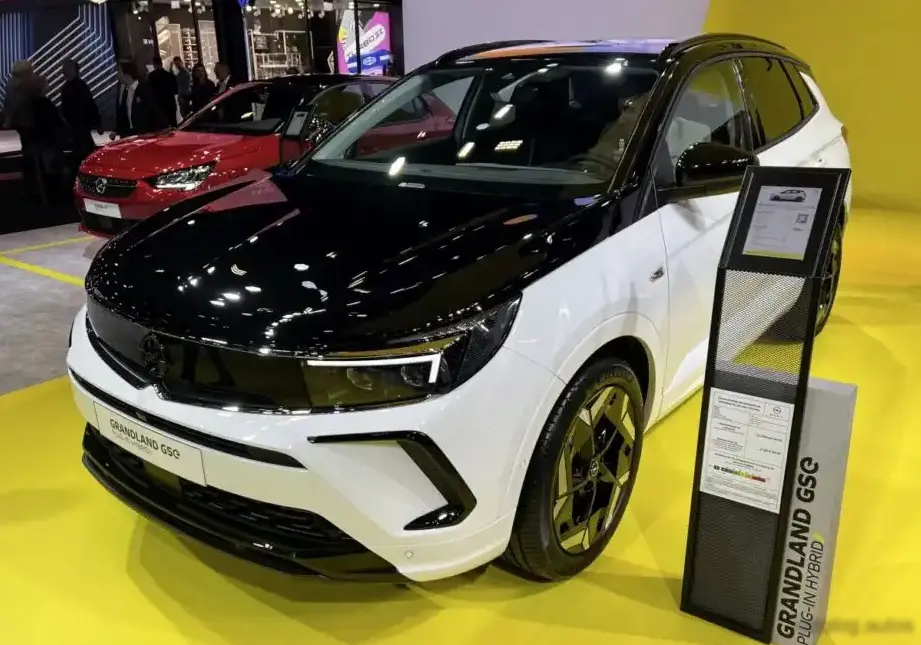
The Opel Grandland GSe 1.6i Turbo Plug-in Hybrid4 AWD Automatic, produced from July 2021 to September 2024, represents the performance-oriented variant of Opel’s compact SUV. Positioned as the flagship trim within the facelifted Grandland range (introduced in 2021), the GSe model combined a turbocharged gasoline engine with a plug-in hybrid electric system and all-wheel drive. It aimed to deliver both spirited performance and improved fuel efficiency, appealing to buyers seeking a versatile and technologically advanced SUV. The Grandland itself is based on the EMP2 platform, shared with other Stellantis vehicles like the Peugeot 3008 and Citroën C5 Aircross.
Technical Specifications
| Brand | Opel |
| Model | Grandland |
| Generation | Grandland (facelift 2021) |
| Type (Engine) | GSe 1.6i Turbo (300 Hp) Plug-in Hybrid4 AWD Automatic |
| Start of production | July, 2021 |
| End of production | September, 2024 |
| Powertrain Architecture | PHEV (Plug-in Hybrid Electric Vehicle) |
| Body type | SUV |
| Seats | 5 |
| Doors | 5 |
| Combined fuel consumption (WLTP) | 1.2-1.7 l/100 km (196 – 138.4 US mpg, 235.4 – 166.2 UK mpg, 83.3 – 58.8 km/l) |
| CO2 emissions (WLTP) | 28-39 g/km |
| Fuel consumption (NEDC, WLTP equivalent) | 1.5-1.6 l/100 km (156.8 – 147 US mpg, 188.3 – 176.6 UK mpg, 66.7 – 62.5 km/l) |
| CO2 emissions (NEDC, WLTP equivalent) | 33-37 g/km |
| Fuel Type | Petrol / electricity |
| Acceleration 0 – 100 km/h | 6.1 sec |
| Acceleration 0 – 62 mph | 6.1 sec |
| Acceleration 0 – 60 mph | 5.8 sec |
| Maximum speed | 235 km/h (146.02 mph) |
| Emission standard | Euro 6d |
| Weight-to-power ratio | 6 kg/Hp, 166.6 Hp/tonne |
| Weight-to-torque ratio | 3.5 kg/Nm, 288.7 Nm/tonne |
| Gross battery capacity | 13.2 kWh |
| Battery technology | Lithium-ion (Li-Ion) |
| All-electric range (WLTP) | 55-65 km (34.18 – 40.39 mi) |
| All-electric range (NEDC, WLTP equivalent) | 67-69 km (41.63 – 42.87 mi) |
| Average Energy consumption (WLTP) | 14.9-17.4 kWh/100 km (23.98 – 28 kWh/100 mi, 141 – 120 MPGe, 6.7 – 5.7 km/kWh, 4.2 – 3.6 mi/kWh) |
| Max speed (electric) | 135 km/h (83.89 mph) |
| Electric motor power (1) | 110 Hp @ 2500 rpm (164 kW) |
| Electric motor Torque (1) | 320 Nm @ 500-2500 rpm (236.02 lb.-ft. @ 500-2500 rpm) |
| Electric motor location (1) | Between the combustion engine and the transmission |
| Electric motor power (2) | 113 Hp @ 14000 rpm (84 kW) |
| Electric motor Torque (2) | 166 Nm @ 0-4760 rpm (122.44 lb.-ft. @ 0-4760 rpm) |
| Electric motor location (2) | Rear axle, Transverse |
| System power | 300 Hp (221 kW) |
| System torque | 520 Nm (383.53 lb.-ft.) |
| Power | 200 Hp @ 6000 rpm (147 kW) |
| Power per litre | 125.2 Hp/l |
| Torque | 300 Nm @ 3000 rpm (221.27 lb.-ft. @ 3000 rpm) |
| Engine layout | Front, Transverse |
| Engine Model/Code | F16XHR |
| Engine displacement | 1598 cm3 (97.52 cu. in.) |
| Number of cylinders | 4 |
| Engine configuration | Inline |
| Number of valves per cylinder | 4 |
| Fuel injection system | Direct injection |
| Engine aspiration | Turbocharger, Intercooler |
| Engine oil capacity | 4.25 l (4.49 US qt | 3.74 UK qt) |
| Kerb Weight | 1801 kg (3970.53 lbs.) |
| Max. weight | 2370 kg (5224.96 lbs.) |
| Max load | 569 kg (1254.43 lbs.) |
| Trunk (boot) space – minimum | 390 l (13.77 cu. ft.) |
| Trunk (boot) space – maximum | 1528 l (53.96 cu. ft.) |
| Fuel tank capacity | 43 l (11.36 US gal | 9.46 UK gal) |
| Max. roof load | 85 kg (187.39 lbs.) |
| Permitted trailer load with brakes (12%) | 1250 kg (2755.78 lbs.) |
| Permitted trailer load without brakes | 750 kg (1653.47 lbs.) |
| Permitted towbar download | 70 kg (154.32 lbs.) |
| Length | 4477 mm (176.26 in.) |
| Width | 1906 mm (75.04 in.) |
| Width including mirrors | 2098 mm (82.6 in.) |
| Height | 1609 mm (63.35 in.) |
| Wheelbase | 2675 mm (105.31 in.) |
| Front track | 1579-1595 mm (62.17 – 62.8 in.) |
| Rear (Back) track | 1587-1610 mm (62.48 – 63.39 in.) |
| Front overhang | 933 mm (36.73 in.) |
| Rear overhang | 869 mm (34.21 in.) |
| Minimum turning circle (turning diameter) | 10.67 m (35.01 ft.) |
| Drivetrain Architecture | An Internal combustion engine (ICE) drives the front wheels, one electric motor drives the front wheels, one electric motor drives the rear wheels. There is an ability for running in full electric or mixed mode. |
| Drive wheel | All wheel drive (4×4) |
| Number of gears and type of gearbox | 8 gears, automatic transmission |
| Front brakes | Ventilated discs |
| Rear brakes | Disc |
| Assisting systems | ABS (Anti-lock braking system) |
| Steering type | Steering rack and pinion |
| Power steering | Electric Steering |
| Tires size | 225/55 R18; 205/55 R19 |
| Wheel rims size | 7.5J x 18; 7J x 19 |
INTRODUCTION
The Opel Grandland GSe 1.6i Turbo Plug-in Hybrid4 AWD Automatic, launched in July 2021, marked a significant step in Opel’s electrification strategy. The “GSe” designation, revived from Opel’s performance heritage (originally standing for “Grand Sport Einspritzung”), now signified a focus on sporty driving dynamics combined with eco-friendly technology. This variant sat at the top of the Grandland range, offering a compelling blend of performance, efficiency, and all-weather capability. It was primarily marketed in Europe, where demand for plug-in hybrid SUVs was rapidly growing, offering a practical alternative to traditional gasoline or diesel vehicles.
Powertrain & Engine Architecture
At the heart of the Grandland GSe lies a 1.6-liter turbocharged four-cylinder gasoline engine (code F16XHR) producing 200 horsepower and 300 Nm (221 lb-ft) of torque. This engine utilizes direct fuel injection and a single turbocharger with an intercooler to maximize efficiency and power output. Crucially, it’s paired with a sophisticated plug-in hybrid system. This system incorporates two electric motors: one integrated with the front axle and another driving the rear axle, providing all-wheel drive capability. The combined system output reaches 300 horsepower and 520 Nm (383 lb-ft) of torque. The 13.2 kWh lithium-ion battery pack allows for an all-electric range of 55-65 km (34-40 miles) under WLTP testing. The transmission is an 8-speed automatic, specifically tuned to work seamlessly with the hybrid powertrain. The electric motors are powered by a 13.2 kWh lithium-ion battery pack, enabling a significant all-electric range.
Driving Characteristics
The Grandland GSe delivers a noticeably more engaging driving experience than lower-powered Grandland variants. The instant torque from the electric motors provides brisk acceleration, with a 0-100 km/h (0-62 mph) time of 6.1 seconds. The all-wheel drive system enhances traction and stability, particularly in adverse weather conditions. In electric mode, the vehicle operates silently and smoothly, ideal for urban driving. Switching to hybrid mode allows the gasoline engine to kick in when more power is needed, or when the battery is depleted. The 8-speed automatic transmission provides smooth and responsive gear changes, although some reviewers noted a slight delay in downshifts during aggressive driving. The gear ratios are optimized for both fuel efficiency and performance, providing a good balance between the two.
Equipment & Trim Levels
The GSe trim level came generously equipped as standard. Interior features typically included sport seats upholstered in Alcantara and leather, a leather-wrapped steering wheel, and a digital instrument cluster. Infotainment was provided by a touchscreen display with navigation, Apple CarPlay, and Android Auto compatibility. Standard safety features included advanced driver-assistance systems (ADAS) such as adaptive cruise control, lane-keeping assist, and automatic emergency braking. Optional extras included a panoramic sunroof, premium audio system, and head-up display. The interior design featured unique GSe badging and accents to differentiate it from other Grandland trims.
Chassis & Braking
The Grandland GSe features a MacPherson strut front suspension and a multi-link rear suspension, tuned for a balance of comfort and handling. The suspension setup is slightly firmer than that of standard Grandland models, contributing to the GSe’s more sporty feel. Brakes are ventilated discs at the front and solid discs at the rear, providing adequate stopping power. The electronic stability control (ESC) system is integrated with the all-wheel drive system to enhance stability and control. The steering is electrically assisted, offering a precise and responsive feel.
Market Reception & Comparison
The Grandland GSe was generally well-received by automotive critics, who praised its performance, efficiency, and all-wheel drive capability. Compared to the standard Grandland 1.2-liter gasoline or 1.5-liter diesel variants, the GSe offered significantly more power and a more refined driving experience. However, it also came at a higher price point. Compared to other plug-in hybrid SUVs in its class, such as the Peugeot 3008 Hybrid4 and Mitsubishi Outlander PHEV, the Grandland GSe offered a competitive combination of performance, range, and features. Fuel economy was a strong point, with the ability to travel significant distances on electric power alone.
Legacy
The Opel Grandland GSe 1.6i Turbo Plug-in Hybrid4 AWD Automatic represents an important step in Opel’s transition to electrification. While production ended in September 2024, the model has established itself as a capable and desirable plug-in hybrid SUV. The powertrain, while complex, has proven to be relatively reliable, with few widespread issues reported. On the used car market, the GSe commands a premium over lower-spec Grandland models, reflecting its higher performance and advanced technology. Its combination of power, efficiency, and all-wheel drive capability ensures its continued appeal to buyers seeking a versatile and environmentally conscious SUV.