Technical Specifications
| Brand | Opel |
| Model | Grandland |
| Generation | Grandland X |
| Type (Engine) | 1.2 Turbo (130 Hp) Automatic |
| Start of production | October, 2017 |
| End of production | April, 2018 |
| Powertrain Architecture | Internal Combustion engine |
| Body type | SUV |
| Seats | 5 |
| Doors | 5 |
| Fuel consumption (urban) | 6.4 l/100 km (36.8 US mpg, 44.1 UK mpg, 15.6 km/l) |
| Fuel consumption (extra urban) | 4.9 l/100 km (48 US mpg, 57.6 UK mpg, 20.4 km/l) |
| Fuel consumption (combined) | 5.5 l/100 km (42.8 US mpg, 51.4 UK mpg, 18.2 km/l) |
| CO2 emissions | 127 g/km |
| Fuel Type | Petrol (Gasoline) |
| Acceleration 0 – 100 km/h | 10.9 sec |
| Acceleration 0 – 62 mph | 10.9 sec |
| Acceleration 0 – 60 mph | 10.4 sec |
| Maximum speed | 188 km/h (116.82 mph) |
| Emission standard | Euro 6 |
| Weight-to-power ratio | 10 kg/Hp, 100.4 Hp/tonne |
| Weight-to-torque ratio | 5.6 kg/Nm, 177.6 Nm/tonne |
| Power | 130 Hp @ 5550 rpm |
| Power per litre | 108.4 Hp/l |
| Torque | 230 Nm @ 1750 rpm (169.64 lb.-ft. @ 1750 rpm) |
| Engine layout | Front, Transverse |
| Engine Model/Code | B12XHT |
| Engine displacement | 1199 cm3 (73.17 cu. in.) |
| Number of cylinders | 3 |
| Engine configuration | Inline |
| Cylinder Bore | 75 mm (2.95 in.) |
| Piston Stroke | 90.5 mm (3.56 in.) |
| Compression ratio | 10.5:1 |
| Number of valves per cylinder | 4 |
| Fuel injection system | Direct injection |
| Engine aspiration | Turbocharger, Intercooler |
| Engine oil capacity | 3.5 l (3.7 US qt | 3.08 UK qt) |
| Kerb Weight | 1295 kg (2854.99 lbs.) |
| Max. weight | 1960 kg (4321.06 lbs.) |
| Max load | 665 kg (1466.07 lbs.) |
| Trunk (boot) space – minimum | 514 l (18.15 cu. ft.) |
| Trunk (boot) space – maximum | 1652 l (58.34 cu. ft.) |
| Fuel tank capacity | 53 l (14 US gal | 11.66 UK gal) |
| Max. roof load | 85 kg (187.39 lbs.) |
| Permitted trailer load with brakes (12%) | 1100 kg (2425.08 lbs.) |
| Permitted trailer load without brakes | 680 kg (1499.14 lbs.) |
| Permitted towbar download | 70 kg (154.32 lbs.) |
| Length | 4477 mm (176.26 in.) |
| Width | 1856 mm (73.07 in.) |
| Width including mirrors | 2098 mm (82.6 in.) |
| Height | 1609 mm (63.35 in.) |
| Wheelbase | 2675 mm (105.31 in.) |
| Front track | 1595 mm (62.8 in.) |
| Rear (Back) track | 1610 mm (63.39 in.) |
| Minimum turning circle | 11.05 m (36.25 ft.) |
| Drivetrain Architecture | Front wheel drive |
| Number of gears and type of gearbox | 6 gears, automatic transmission |
| Front brakes | Ventilated discs |
| Rear brakes | Disc |
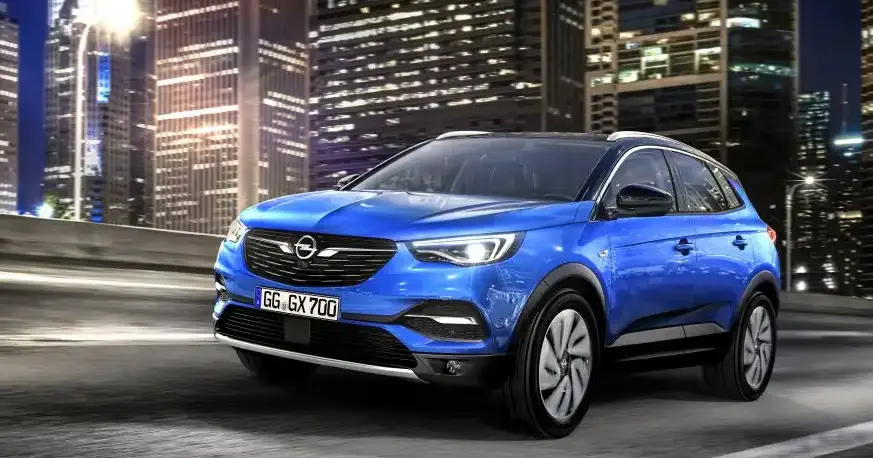
The Opel Grandland X 1.2 Turbo (130 hp) Automatic was a front-wheel-drive compact SUV produced between October 2017 and April 2018. Positioned as a mid-range offering within the Grandland X lineup, it aimed to provide a balance of fuel efficiency and practicality for family buyers. This variant utilized a downsized turbocharged engine paired with a six-speed automatic transmission, a configuration designed to appeal to drivers prioritizing ease of use over outright performance. It was a key model in Opel’s attempt to gain market share in the increasingly popular compact SUV segment, particularly in Europe.
Powertrain & Engine Architecture
The heart of the Grandland X 1.2 Turbo Automatic is the B12XHT engine, a 1.2-liter, three-cylinder turbocharged gasoline engine. This engine is part of Opel’s Small Displacement Efficient (SDE) family, designed for fuel economy and reduced emissions. It features direct fuel injection, which precisely meters fuel into the combustion chamber for improved efficiency and reduced knock. The engine utilizes a single-scroll turbocharger with an intercooler to boost power output. The valvetrain employs four valves per cylinder, contributing to efficient gas exchange. The six-speed automatic transmission, sourced from Aisin, was chosen for its smooth operation and efficiency. It features a torque converter and electronic control for optimized shift points.
Driving Characteristics
The 130 hp output and 230 Nm (169.64 lb-ft) of torque, combined with the automatic transmission, resulted in a comfortable, if not particularly sporty, driving experience. Acceleration from 0-60 mph took around 10.4 seconds, and top speed was 116.82 mph. The automatic transmission was tuned for fuel efficiency, often prioritizing higher gears at lower speeds. This could sometimes result in a slight hesitation when requesting sudden acceleration. Compared to the more powerful 1.6-liter diesel or higher-horsepower gasoline variants, the 1.2 Turbo Automatic offered a more relaxed driving style, prioritizing comfort and ease of use over outright performance. The gear ratios were optimized for cruising, making it a suitable choice for long highway journeys.
Equipment & Trim Levels
The Grandland X 1.2 Turbo Automatic typically came equipped with a respectable level of standard features. These included air conditioning, a touchscreen infotainment system with Bluetooth connectivity, alloy wheels, and a suite of safety features such as ABS, ESP (Electronic Stability Program), and multiple airbags. Higher trim levels offered options like navigation, parking sensors, a rearview camera, and upgraded interior upholstery. Interior materials were generally of good quality for the segment, with a focus on durability and practicality. The dashboard layout was clean and functional, with intuitive controls.
Chassis & Braking
The Grandland X featured a typical front-wheel-drive SUV chassis configuration. The suspension consisted of MacPherson struts at the front and a twist-beam axle at the rear. This setup provided a comfortable ride quality, absorbing bumps and imperfections in the road surface effectively. The braking system utilized ventilated discs on the front wheels and solid discs on the rear. ABS (Anti-lock Braking System) was standard, enhancing braking performance and stability. The steering was electrically assisted, providing light and precise control.
Market Reception & Comparison
The Opel Grandland X 1.2 Turbo Automatic received mixed reviews from automotive critics. While praised for its fuel efficiency and comfortable ride, some reviewers found the engine to be underpowered, particularly when fully loaded. Compared to the diesel variants, the 1.2 Turbo offered lower running costs but sacrificed some performance. Against competitors like the Nissan Qashqai and Peugeot 3008, the Grandland X offered a competitive package, but its styling and driving dynamics weren’t always considered class-leading. Fuel economy was a strong point, consistently achieving around 42.8 US mpg in combined driving conditions.
Legacy
The 1.2-liter turbocharged engine and Aisin six-speed automatic transmission pairing proved to be relatively reliable in the Grandland X. While some owners reported minor issues with the turbocharger or fuel injection system, these were generally infrequent. The powertrain’s longevity and relatively low maintenance costs have contributed to its continued popularity in the used car market. Today, the Grandland X 1.2 Turbo Automatic represents a practical and affordable option for buyers seeking a compact SUV with decent fuel economy and a comfortable driving experience. Its simplicity and relatively robust design make it a viable choice for those seeking a dependable family vehicle.