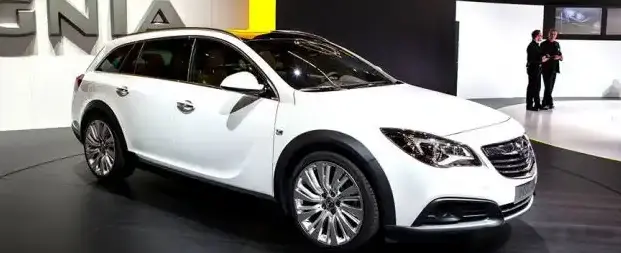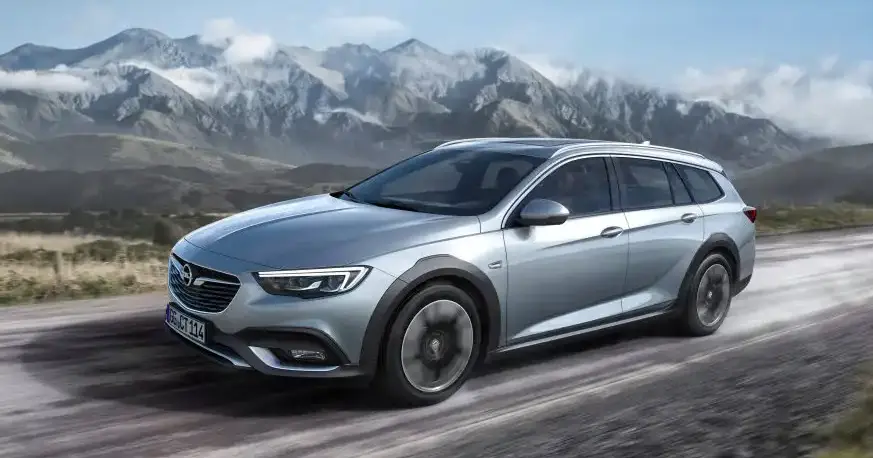
The Opel Insignia Country Tourer (B) 2.0 Automatic, produced from October 2017 to April 2018, represents a niche offering within the broader Insignia B generation (2017-2022). Positioned as a more rugged, all-weather variant of the standard Insignia Sports Tourer (wagon), the Country Tourer aimed to blend estate car practicality with a degree of off-road capability and a more premium feel. This specific 2.0-liter diesel automatic configuration served as a mid-range option, offering a balance between performance, fuel economy, and price within the Country Tourer lineup. It was primarily marketed in Europe, where the demand for practical, efficient wagons with all-wheel drive options remains strong.
Technical Specifications
| Brand | Opel |
| Model | Insignia |
| Generation | Insignia Country Tourer (B) |
| Type (Engine) | 2.0 (170 Hp) Automatic |
| Start of production | October, 2017 |
| End of production | April, 2018 |
| Powertrain Architecture | Internal Combustion engine |
| Body type | Station wagon (estate) |
| Seats | 5 |
| Doors | 5 |
| Fuel consumption (urban) | 7.6 l/100 km (30.9 US mpg, 37.2 UK mpg, 13.2 km/l) |
| Fuel consumption (extra urban) | 5 l/100 km (47 US mpg, 56.5 UK mpg, 20 km/l) |
| Fuel consumption (combined) | 6 l/100 km (39.2 US mpg, 47.1 UK mpg, 16.7 km/l) |
| CO2 emissions | 157 g/km |
| Fuel Type | Diesel |
| Acceleration 0 – 100 km/h | 9.4 sec |
| Acceleration 0 – 62 mph | 9.4 sec |
| Acceleration 0 – 60 mph | 8.9 sec |
| Maximum speed | 218 km/h (135.46 mph) |
| Emission standard | Euro 6 |
| Weight-to-power ratio | 9.4 kg/Hp, 106.9 Hp/tonne |
| Weight-to-torque ratio | 4 kg/Nm, 251.4 Nm/tonne |
| Power | 170 Hp @ 3500-4000 rpm |
| Power per litre | 86.9 Hp/l |
| Torque | 400 Nm @ 1750-2500 rpm (295.02 lb.-ft. @ 1750-2500 rpm) |
| Engine layout | Front, Transverse |
| Engine Model/Code | B20DTH |
| Engine displacement | 1956 cm3 (119.36 cu. in.) |
| Number of cylinders | 4 |
| Engine configuration | Inline |
| Cylinder Bore | 83 mm (3.27 in.) |
| Piston Stroke | 90.4 mm (3.56 in.) |
| Compression ratio | 16.5:1 |
| Number of valves per cylinder | 4 |
| Fuel injection system | Diesel Commonrail |
| Engine aspiration | Turbocharger, Intercooler |
| Engine oil capacity | 4.9 l (5.18 US qt | 4.31 UK qt) |
| Coolant | 5.9 l (6.23 US qt | 5.19 UK qt) |
| Kerb Weight | 1591 kg (3507.55 lbs.) |
| Max. weight | 2270 kg (5004.49 lbs.) |
| Max load | 679 kg (1496.94 lbs.) |
| Trunk (boot) space – minimum | 560 l (19.78 cu. ft.) |
| Trunk (boot) space – maximum | 1665 l (58.8 cu. ft.) |
| Fuel tank capacity | 62 l (16.38 US gal | 13.64 UK gal) |
| Max. roof load | 100 kg (220.46 lbs.) |
| Permitted trailer load with brakes (12%) | 1700 kg (3747.86 lbs.) |
| Permitted trailer load without brakes | 750 kg (1653.47 lbs.) |
| Length | 5004 mm (197.01 in.) |
| Width | 1871 mm (73.66 in.) |
| Width including mirrors | 2093 mm (82.4 in.) |
| Height | 1525 mm (60.04 in.) |
| Wheelbase | 2829 mm (111.38 in.) |
| Front track | 1607 mm (63.27 in.) |
| Rear (Back) track | 1610 mm (63.39 in.) |
| Front overhang | 1002 mm (39.45 in.) |
| Rear overhang | 1173 mm (46.18 in.) |
| Minimum turning circle | 11.74 m (38.52 ft.) |
| Drivetrain Architecture | Front wheel drive |
| Drive wheel | Front wheel drive |
| Number of gears and type of gearbox | 8 gears, automatic transmission |
| Front brakes | Ventilated discs |
| Rear brakes | Disc |
| Assisting systems | ABS (Anti-lock braking system) |
| Steering type | Steering rack and pinion |
| Power steering | Electric Steering |
| Tires size | 235/50 R18 |
| Wheel rims size | 18 |
Powertrain & Engine Architecture
The heart of this Insignia Country Tourer is the B20DTH, a 2.0-liter inline-four cylinder diesel engine. This engine is a member of the GM/Opel’s family of turbocharged diesels, known for its relatively robust construction and decent fuel efficiency. The B20DTH utilizes a common rail direct injection system, delivering fuel at extremely high pressures for optimized combustion. A single turbocharger, often paired with an intercooler, provides forced induction, boosting power and torque. The engine features four valves per cylinder (DOHC) and a compression ratio of 16.5:1, contributing to its efficiency. The engine is transversely mounted in the front of the vehicle. Paired with this engine is an eight-speed automatic transmission, providing smooth gear changes and contributing to relaxed highway cruising. This transmission was designed to balance fuel economy with responsive performance.
Driving Characteristics
The 170 horsepower and 400 Nm (295 lb-ft) of torque delivered by the B20DTH engine, combined with the eight-speed automatic, resulted in a comfortable and capable driving experience. Acceleration from 0-60 mph took approximately 8.9 seconds, which was adequate for everyday driving but noticeably slower than the more powerful petrol (gasoline) variants like the 2.0 Turbo. The automatic transmission was programmed for fuel efficiency, meaning it would upshift quickly to maintain lower engine speeds. While this contributed to good fuel economy, it could sometimes feel hesitant during overtaking maneuvers. The Country Tourer’s all-wheel drive system (available as an option, and common on this trim) provided enhanced traction in inclement weather and on loose surfaces, making it a practical choice for those living in regions with harsh winters or unpaved roads. The steering was light and precise, making it easy to maneuver in urban environments.
Equipment & Trim Levels
The Insignia Country Tourer 2.0 Automatic typically came well-equipped, reflecting its positioning as a premium wagon. Standard features often included automatic climate control, a touchscreen infotainment system with navigation, Bluetooth connectivity, and a suite of safety features such as ABS, ESP (Electronic Stability Program), and multiple airbags. Interior upholstery was typically cloth or a combination of cloth and leatherette. Optional extras included leather seats, a panoramic sunroof, adaptive cruise control, and a premium sound system. The Country Tourer trim also added unique exterior styling elements, such as plastic cladding around the wheel arches and sills, and roof rails, giving it a more rugged appearance.
Chassis & Braking
The Insignia Country Tourer utilized a MacPherson strut front suspension and a multi-link rear suspension, providing a good balance between ride comfort and handling. Stabilizer bars were fitted to both axles to reduce body roll during cornering. Braking duties were handled by ventilated discs at the front and solid discs at the rear. ABS (Anti-lock Braking System) was standard, ensuring safe and controlled braking in emergency situations. The suspension was tuned to prioritize comfort, but it still offered a reasonably engaging driving experience.
Market Reception & Comparison
The Insignia Country Tourer 2.0 Automatic received generally positive reviews from automotive critics. It was praised for its spacious interior, comfortable ride, and good fuel economy. However, some critics noted that the 170 horsepower engine could feel underpowered, especially when fully loaded or tackling steep hills. Compared to the more powerful petrol variants, the diesel offered better fuel economy but lacked the same level of performance. Against competitors like the Volkswagen Passat Alltrack and the Skoda Octavia Scout, the Insignia Country Tourer offered a compelling combination of practicality, comfort, and value.
Legacy
The B20DTH engine, while generally reliable, is known to require regular maintenance, particularly regarding the diesel particulate filter (DPF). Proper servicing and the use of high-quality diesel fuel are crucial to prevent DPF issues. The eight-speed automatic transmission has also proven to be relatively durable, but fluid changes should be performed according to the manufacturer’s recommendations. On the used car market, the Insignia Country Tourer 2.0 Automatic represents a good value proposition for buyers seeking a spacious, comfortable, and fuel-efficient wagon. Its all-wheel drive capability and rugged styling make it a practical choice for those living in areas with challenging weather conditions. However, potential buyers should be aware of the potential maintenance costs associated with the diesel engine and DPF system.