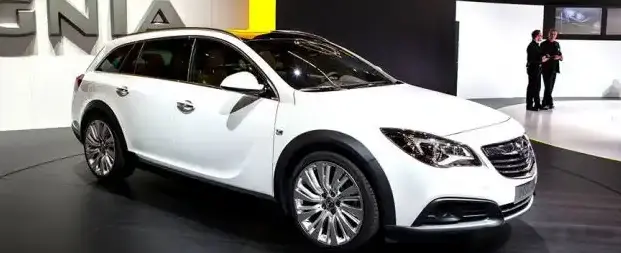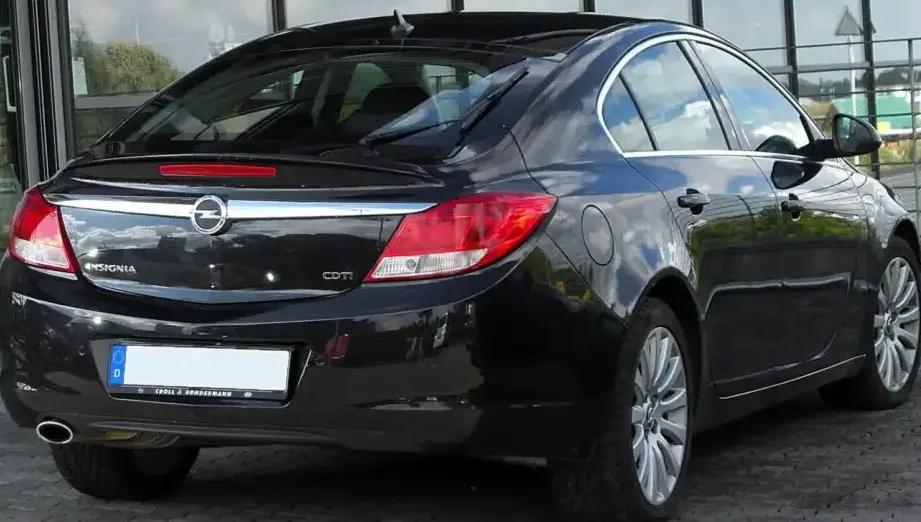
The Opel Insignia Hatchback (A) 2.0 CDTI with 131 horsepower and a six-speed automatic transmission, equipped with a Diesel Particulate Filter (DPF) and Start/Stop system, was produced from July 2010 to June 2013. This variant occupied a mid-range position within the Insignia Hatchback lineup, offering a balance between fuel efficiency, reasonable performance, and comfort. It was primarily marketed in Europe as a practical and refined family vehicle, competing with models like the Ford Mondeo, Volkswagen Passat, and Peugeot 508.
Technical Specifications
| Brand | Opel |
| Model | Insignia |
| Generation | Insignia Hatchback (A) |
| Type (Engine) | 2.0 CDTI (131 Hp) DPF Automatic start/stop |
| Start of production | July, 2010 |
| End of production | June, 2013 |
| Powertrain Architecture | Internal Combustion engine |
| Body type | Hatchback |
| Seats | 5 |
| Doors | 5 |
| Fuel consumption (urban) | 9.2 l/100 km (25.6 US mpg) |
| Fuel consumption (extra urban) | 5.2 l/100 km (45.2 US mpg) |
| Fuel consumption (combined) | 6.7 l/100 km (35.1 US mpg) |
| Fuel Type | Diesel |
| Acceleration 0 – 100 km/h | 11.2 sec |
| Acceleration 0 – 62 mph | 11.2 sec |
| Acceleration 0 – 60 mph | 10.6 sec |
| Maximum speed | 204 km/h (126.76 mph) |
| Emission standard | Euro 5 |
| Weight-to-power ratio | 12.6 kg/Hp |
| Weight-to-torque ratio | 5.5 kg/Nm |
| Power | 131 Hp @ 4000 rpm |
| Torque | 300 Nm @ 1750 rpm (221.27 lb.-ft. @ 1750 rpm) |
| Engine layout | Front, Transverse |
| Engine Model/Code | A20DT |
| Engine displacement | 1956 cm3 (119.36 cu. in.) |
| Number of cylinders | 4 |
| Engine configuration | Inline |
| Cylinder Bore | 83 mm (3.27 in.) |
| Piston Stroke | 90.4 mm (3.56 in.) |
| Compression ratio | 16.5:1 |
| Number of valves per cylinder | 4 |
| Fuel injection system | Diesel Commonrail |
| Engine aspiration | Turbocharger, Intercooler |
| Valvetrain | OHC |
| Engine oil capacity | 4.5 l (4.76 US qt | 3.96 UK qt) |
| Coolant capacity | 9 l (9.51 US qt | 7.92 UK qt) |
| Kerb Weight | 1655 kg (3648.65 lbs.) |
| Max. weight | 2170 kg (4784.03 lbs.) |
| Max load | 515 kg (1135.38 lbs.) |
| Trunk (boot) space – minimum | 520 l (18.36 cu. ft.) |
| Trunk (boot) space – maximum | 1465 l (51.74 cu. ft.) |
| Fuel tank capacity | 70 l (18.49 US gal | 15.4 UK gal) |
| Length | 4830 mm (190.16 in.) |
| Width | 1856 mm (73.07 in.) |
| Height | 1498 mm (58.98 in.) |
| Wheelbase | 2737 mm (107.76 in.) |
| Front track | 1585 mm (62.4 in.) |
| Rear track | 1587 mm (62.48 in.) |
| Ride height (ground clearance) | 160 mm (6.3 in.) |
| Minimum turning circle | 11.4 m (37.4 ft.) |
| Drivetrain Architecture | Front wheel drive |
| Number of gears | 6 |
| Gearbox type | Automatic transmission |
| Front brakes | Ventilated discs |
| Rear brakes | Disc |
| Tires size | 215/60 R16; 225/55 R17 |
| Wheel rims size | 16; 17 |
Powertrain & Engine Architecture
The heart of this Insignia variant is the A20DT 2.0-liter four-cylinder diesel engine. This engine is a member of the GM/Opel family of common rail direct injection diesels. It features a turbocharger with an intercooler to boost power and efficiency. The engine utilizes a single overhead camshaft (OHC) design with four valves per cylinder. The common rail diesel injection system, operating at very high pressures, ensures precise fuel delivery for optimized combustion. The six-speed automatic transmission, sourced from Aisin, was chosen for its smoothness and efficiency. It features adaptive shift patterns designed to optimize fuel economy and provide comfortable gear changes. The Start/Stop system, a relatively new technology at the time, automatically shuts off the engine when the vehicle is stationary (e.g., at traffic lights) to reduce fuel consumption and emissions.
Driving Characteristics
The 131 horsepower output and 300 Nm (221 lb-ft) of torque provide adequate, though not exhilarating, performance. Acceleration from 0-60 mph takes around 10.6 seconds, and the top speed is 126.76 mph. Compared to the more powerful 160 hp or 195 hp versions of the 2.0 CDTI, this variant feels noticeably slower, particularly during overtaking maneuvers. The automatic transmission, while smooth, can sometimes feel hesitant when downshifting. However, the well-chosen gear ratios help to keep the engine within its optimal torque band for everyday driving. Fuel economy is a strong point, with combined figures around 35.1 US mpg, making it an attractive option for high-mileage drivers.
Equipment & Trim Levels
The 2.0 CDTI 131 hp Automatic typically came with a reasonable level of standard equipment. This included air conditioning, alloy wheels (usually 16 or 17 inch), a CD/radio system with MP3 compatibility, electric windows and mirrors, and ABS brakes. Higher trim levels, such as SE or Elite, added features like leather upholstery, a sunroof, parking sensors, and a more advanced infotainment system. Optional extras included navigation, heated seats, and a premium sound system.
Chassis & Braking
The Insignia Hatchback (A) utilizes a front-wheel-drive platform with MacPherson strut suspension at the front and a multi-link suspension at the rear. This setup provides a good balance between ride comfort and handling. The front brakes are ventilated discs, while the rear brakes are solid discs. ABS (Anti-lock Braking System) is standard. The suspension tuning is generally geared towards comfort, but the car still offers decent body control in corners. Stabilizer bars are fitted front and rear to reduce body roll.
Market Reception & Comparison
The Opel Insignia, in general, was well-received by automotive critics for its stylish design, spacious interior, and comfortable ride. However, the 131 hp 2.0 CDTI Automatic variant was often seen as a compromise. While it offered good fuel economy, its performance was considered adequate at best. Compared to the higher-powered versions, it lacked the punch needed for more spirited driving. Reliability was generally good, although some owners reported issues with the DPF system, a common problem with modern diesel engines. Fuel economy was competitive with other vehicles in its class, and maintenance costs were reasonable.
Legacy
The Opel Insignia Hatchback (A) 2.0 CDTI 131 hp Automatic remains a relatively common sight on European roads today. The A20DT engine, when properly maintained, is known for its durability. However, potential buyers should be aware of the potential for DPF issues and ensure that the car has a full service history. In the used car market, this variant represents a good value proposition for those seeking a comfortable, fuel-efficient, and practical family hatchback, but it’s important to acknowledge its limitations in terms of outright performance.