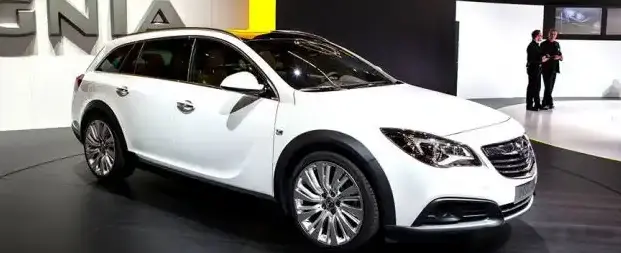
The Opel Insignia Hatchback, specifically the variant powered by the 1.4-liter Turbo Ecotec engine with 140 horsepower and featuring Start/Stop technology, was a key offering in the refreshed (facelift) A generation of the Insignia, produced from July 2013 to January 2017. This model represented a balance within the Insignia lineup, aiming to provide a blend of fuel efficiency, reasonable performance, and affordability. It was positioned as a mainstream option, appealing to buyers seeking a comfortable and practical family hatchback without the higher costs associated with the more powerful engine options.
Technical Specifications
| Brand | Opel |
| Model | Insignia |
| Generation | Insignia Hatchback (A, facelift 2013) |
| Type (Engine) | 1.4 (140 Hp) Turbo Ecotec Start/Stop |
| Start of production | July, 2013 |
| End of production | January, 2017 |
| Powertrain Architecture | Internal Combustion engine |
| Body type | Hatchback |
| Seats | 5 |
| Doors | 5 |
| Fuel consumption (urban) | 6.8 l/100 km (34.6 US mpg, 41.5 UK mpg, 14.7 km/l) |
| Fuel consumption (extra urban) | 4.3 l/100 km (54.7 US mpg, 65.7 UK mpg, 23.3 km/l) |
| Fuel consumption (combined) | 5.2 l/100 km (45.2 US mpg, 54.3 UK mpg, 19.2 km/l) |
| CO2 emissions | 123 g/km |
| Fuel Type | Petrol (Gasoline) |
| Acceleration 0 – 100 km/h | 10.9 sec |
| Acceleration 0 – 62 mph | 10.9 sec |
| Acceleration 0 – 60 mph | 10.4 sec |
| Maximum speed | 205 km/h (127.38 mph) |
| Emission standard | Euro 5 |
| Weight-to-power ratio | 8.2 kg/Hp, 121.7 Hp/tonne |
| Weight-to-torque ratio | 5.8 kg/Nm, 173.9 Nm/tonne |
| Power | 140 Hp @ 4900-6000 rpm |
| Power per litre | 102.6 Hp/l |
| Torque | 200 Nm @ 1850-4900 rpm (147.51 lb.-ft. @ 1850-4900 rpm) |
| Engine layout | Front, Transverse |
| Engine Model/Code | B14NET |
| Engine displacement | 1364 cm3 (83.24 cu. in.) |
| Number of cylinders | 4 |
| Engine configuration | Inline |
| Cylinder Bore | 72.5 mm (2.85 in.) |
| Piston Stroke | 82.6 mm (3.25 in.) |
| Compression ratio | 9.5:1 |
| Number of valves per cylinder | 4 |
| Fuel injection system | Multi-port manifold injection |
| Engine aspiration | Turbocharger, Intercooler |
| Engine oil capacity | 4 l (4.23 US qt | 3.52 UK qt) |
| Coolant | 9 l (9.51 US qt | 7.92 UK qt) |
| Kerb Weight | 1150 kg (2535.32 lbs.) |
| Max. weight | 2020 kg (4453.34 lbs.) |
| Max load | 870 kg (1918.02 lbs.) |
| Trunk (boot) space – minimum | 530 l (18.72 cu. ft.) |
| Trunk (boot) space – maximum | 1470 l (51.91 cu. ft.) |
| Fuel tank capacity | 70 l (18.49 US gal | 15.4 UK gal) |
| Length | 4842 mm (190.63 in.) |
| Width | 1856 mm (73.07 in.) |
| Width including mirrors | 2084 mm (82.05 in.) |
| Height | 1498 mm (58.98 in.) |
| Wheelbase | 2737 mm (107.76 in.) |
| Front track | 1587 mm (62.48 in.) |
| Rear (Back) track | 1590 mm (62.6 in.) |
| Minimum turning circle | 10.9 m (35.76 ft.) |
| Drivetrain Architecture | The Internal combustion engine (ICE) drives the front wheels of the vehicle. |
| Drive wheel | Front wheel drive |
| Number of gears and type of gearbox | 6 gears, manual transmission |
| Assisting systems | ABS (Anti-lock braking system) |
INTRODUCTION
The Opel Insignia A, launched in 2008, was a significant model for Opel, representing a move upmarket and offering a more sophisticated alternative to traditional family cars. The facelift in 2013 brought styling revisions, updated technology, and revised engine options. The 1.4 Turbo Ecotec Start/Stop variant, producing 140 horsepower, was introduced as a fuel-efficient and accessible entry point into the Insignia range. Built on the GM Delta II platform (also known as the 1HX0/A3 platform), the Insignia aimed to compete with established rivals like the Ford Mondeo, Volkswagen Passat, and Peugeot 508. This particular engine and transmission combination was aimed at drivers prioritizing economy and comfort over outright performance.
Powertrain & Engine Architecture
The heart of this Insignia variant is the B14NET engine, a 1.4-liter inline-four cylinder gasoline engine. This engine utilizes a single-scroll turbocharger with an intercooler to boost power and efficiency. The engine employs multi-port fuel injection, delivering fuel directly into the intake ports. The valvetrain features four valves per cylinder, contributing to improved breathing and power output. The Start/Stop system automatically shuts off the engine when the vehicle is stationary (e.g., at traffic lights) to reduce fuel consumption and emissions. The engine is transversely mounted at the front of the vehicle. The 1.4L engine was paired with a six-speed manual transmission, providing a balance between fuel economy and driver control. The transmission’s gear ratios were tuned for everyday driving, prioritizing smooth shifts and reasonable acceleration.
Driving Characteristics
The 140 horsepower and 200 Nm (147.51 lb-ft) of torque delivered by the 1.4 Turbo Ecotec engine provided adequate performance for typical driving situations. Acceleration from 0-60 mph took around 10.4 seconds, and the top speed was 205 km/h (127.38 mph). While not a particularly sporty setup, the engine offered sufficient power for overtaking and highway cruising. Compared to the more powerful 1.6 and 2.0-liter turbocharged engines available in the Insignia range, this variant felt less responsive, particularly at lower engine speeds. However, the lighter engine weight contributed to improved handling and fuel economy. The six-speed manual transmission allowed drivers to maintain optimal engine speed for efficiency or performance, but the gear ratios were not particularly short, emphasizing cruising comfort over spirited driving.
Equipment & Trim Levels
The 1.4 Turbo Ecotec Start/Stop Insignia typically came equipped with a reasonable level of standard features. These included air conditioning, electric front windows, a CD/radio system with USB connectivity, and alloy wheels. Safety features such as ABS, ESP (Electronic Stability Program), and multiple airbags were also standard. Higher trim levels offered additional features such as leather upholstery, heated front seats, a touchscreen infotainment system with navigation, and parking sensors. Optional extras included a panoramic sunroof, adaptive cruise control, and a premium sound system. Interior upholstery was typically cloth, with higher trims offering leather options. The dashboard layout was generally functional and well-designed, with a focus on ergonomics.
Chassis & Braking
The Insignia A featured a MacPherson strut front suspension and a multi-link rear suspension, providing a comfortable and controlled ride. The suspension was tuned to prioritize comfort over outright sportiness. The 1.4 Turbo Ecotec variant typically used disc brakes on the front wheels and drum brakes on the rear wheels. ABS (Anti-lock Braking System) was standard, enhancing braking performance and stability. Stabilizer bars were fitted to both the front and rear axles to reduce body roll during cornering. The steering system utilized a rack-and-pinion setup, providing precise and responsive steering feel.
Market Reception & Comparison
The 1.4 Turbo Ecotec Insignia was generally well-received by critics as a practical and fuel-efficient option. It was praised for its comfortable ride, spacious interior, and good value for money. However, some reviewers noted that the engine lacked the punch of the more powerful alternatives. Compared to the 2.0-liter turbocharged models, the 1.4 offered significantly better fuel economy (around 5.2 l/100 km combined) but slower acceleration. The 1.6-liter diesel variant offered similar fuel economy with more torque, making it a popular alternative for drivers covering long distances. Reliability reports suggest that the 1.4 Turbo Ecotec engine is generally reliable, although regular maintenance is essential to prevent issues with the turbocharger and fuel injection system.
Legacy
The Opel Insignia A, including the 1.4 Turbo Ecotec variant, established the Insignia as a strong contender in the mid-size family car segment. While the model has since been superseded by newer generations, the A-series Insignia remains a popular choice on the used car market. The 1.4 Turbo Ecotec engine, while not the most powerful option, offers a good balance of fuel efficiency and reliability, making it a sensible choice for budget-conscious buyers. Parts availability is generally good, and maintenance costs are relatively reasonable. The Insignia A’s comfortable ride and spacious interior continue to appeal to families and drivers seeking a practical and affordable vehicle.