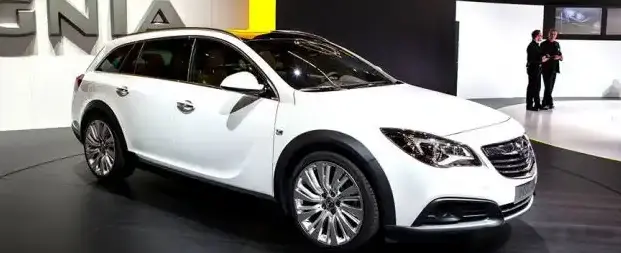
The Opel Insignia Hatchback, specifically the facelifted A-generation produced from July 2013 to January 2017, represented a significant offering in the European mid-size car segment. This variant, equipped with a 1.6-liter turbocharged Ecotec engine producing 170 horsepower, and a six-speed manual transmission, aimed to balance fuel efficiency with respectable performance. Positioned as a mid-range option within the Insignia lineup, it catered to buyers seeking a more economical alternative to the higher-powered versions while still offering a spacious and well-equipped family vehicle. The Insignia, as a whole, was Opel’s flagship model, intended to elevate the brand’s image and compete with established rivals like the Ford Mondeo and Volkswagen Passat.
Technical Specifications
| Brand | Opel |
| Model | Insignia |
| Generation | Insignia Hatchback (A, facelift 2013) |
| Type (Engine) | 1.6 (170 Hp) Turbo Ecotec start/stop |
| Start of production | July, 2013 |
| End of production | January, 2017 |
| Powertrain Architecture | Internal Combustion engine |
| Body type | Hatchback |
| Seats | 5 |
| Doors | 5 |
| Fuel consumption (urban) | 7.5 l/100 km (31.4 US mpg) |
| Fuel consumption (extra urban) | 5 l/100 km (47 US mpg) |
| Fuel consumption (combined) | 5.9 l/100 km (39.9 US mpg) |
| CO2 emissions | 139 g/km |
| Fuel Type | Petrol (Gasoline) |
| Acceleration 0 – 100 km/h | 9.2 sec |
| Acceleration 0 – 62 mph | 9.2 sec |
| Acceleration 0 – 60 mph | 8.7 sec |
| Maximum speed | 220 km/h (136.7 mph) |
| Emission standard | Euro 5 |
| Power | 170 Hp @ 4250 rpm |
| Torque | 260 Nm @ 1650-4250 rpm (191.77 lb.-ft. @ 1650-4250 rpm) |
| Engine layout | Front, Transverse |
| Engine Model/Code | A16XHT, B16SHL |
| Engine displacement | 1598 cm3 (97.52 cu. in.) |
| Number of cylinders | 4 |
| Engine configuration | Inline |
| Cylinder Bore | 79 mm (3.11 in.) |
| Piston Stroke | 81.5 mm (3.21 in.) |
| Number of valves per cylinder | 4 |
| Fuel injection system | Multi-port manifold injection |
| Engine aspiration | Turbocharger, Intercooler |
| Engine oil capacity | 5.5 l (5.81 US qt | 4.84 UK qt) |
| Coolant | 5.8 l (6.13 US qt | 5.1 UK qt) |
| Trunk (boot) space – minimum | 530 l (18.72 cu. ft.) |
| Trunk (boot) space – maximum | 1470 l (51.91 cu. ft.) |
| Fuel tank capacity | 70 l (18.49 US gal | 15.4 UK gal) |
| Length | 4842 mm (190.63 in.) |
| Width | 1856 mm (73.07 in.) |
| Width including mirrors | 2084 mm (82.05 in.) |
| Height | 1498 mm (58.98 in.) |
| Wheelbase | 2737 mm (107.76 in.) |
| Front track | 1587 mm (62.48 in.) |
| Rear (Back) track | 1590 mm (62.6 in.) |
| Minimum turning circle | 11.4 m (37.4 ft.) |
| Drivetrain Architecture | Front wheel drive |
| Number of gears | 6 gears, manual transmission |
Powertrain & Engine Architecture
The heart of this Insignia variant is the A16XHT (or B16SHL, depending on the specific production date) 1.6-liter inline-four cylinder engine. This engine is part of Opel’s Ecotec family, known for its focus on efficiency and refinement. It features a single-scroll turbocharger with an intercooler, boosting power output to 170 horsepower at 4250 rpm and 260 Nm (191.77 lb-ft) of torque available from a low 1650 rpm, sustaining through 4250 rpm. The engine utilizes multi-port fuel injection and a double overhead camshaft (DOHC) valvetrain with four valves per cylinder. The Start/Stop system, standard on this model, further enhances fuel economy by automatically shutting off the engine when the vehicle is stationary. The six-speed manual transmission provides precise gear changes and contributes to the overall driving experience.
Driving Characteristics
The 1.6-liter turbo engine, paired with the six-speed manual, delivers a balanced driving experience. Acceleration from 0 to 60 mph takes approximately 8.7 seconds, and top speed is rated at 136.7 mph. While not as brisk as the 2.0-liter Turbo models, the 1.6L provides sufficient power for everyday driving and highway cruising. The engine’s torque curve is relatively flat, offering good responsiveness in most situations. The manual transmission allows for greater driver control, and the gear ratios are well-matched to the engine’s power delivery. Compared to the automatic transmission options available on other Insignia trims, the manual version offers a more engaging driving experience and slightly improved fuel economy.
Equipment & Trim Levels
The 1.6 Turbo Ecotec Start/Stop Insignia typically came equipped with a respectable level of standard features. These included air conditioning, a CD/MP3 stereo system with auxiliary input, power windows and mirrors, and central locking. Safety features such as ABS, Electronic Stability Program (ESP), and multiple airbags were also standard. Higher trim levels, such as SE or Elite, added features like alloy wheels, a touchscreen infotainment system, cruise control, and parking sensors. Interior upholstery was typically cloth, with options for leather upgrades. The dashboard layout was modern and functional, with a focus on ergonomics.
Chassis & Braking
The Insignia’s chassis is based on the GM Delta platform, providing a good balance of ride comfort and handling. The front suspension utilizes MacPherson struts, while the rear suspension employs a multi-link setup. This configuration contributes to a stable and controlled ride. Braking duties are handled by disc brakes on the front wheels and drum brakes on the rear wheels. ABS (Anti-lock Braking System) is standard, enhancing braking performance and safety. Stabilizer bars are fitted to both the front and rear axles to reduce body roll during cornering.
Market Reception & Comparison
The 1.6-liter Turbo Ecotec Insignia was generally well-received by automotive critics as a practical and efficient option. It was praised for its fuel economy, comfortable ride, and spacious interior. However, some reviewers noted that the engine could feel strained when fully loaded or during aggressive driving. Compared to the 2.0-liter Turbo models, the 1.6L offered lower running costs but less outright performance. Against competitors like the Ford Mondeo and Volkswagen Passat, the Insignia offered a compelling package with a distinctive design and a good level of equipment.
Legacy
The 1.6-liter Turbo Ecotec engine, while not known for being exceptionally durable, generally proved to be reliable with regular maintenance. Common issues included occasional turbocharger problems and oil leaks. The manual transmission is considered robust and relatively trouble-free. Today, used examples of this Insignia variant are readily available and represent a relatively affordable entry point into the mid-size car segment. Its fuel efficiency and practicality continue to make it an appealing option for budget-conscious buyers seeking a comfortable and spacious family vehicle. The Insignia, in general, helped to solidify Opel’s reputation for building well-engineered and stylish cars.