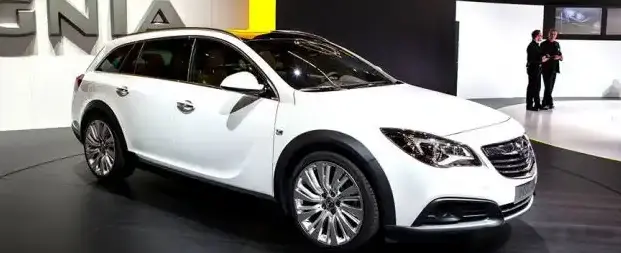
The Opel Insignia Hatchback, specifically the 1.6 CDTI variant producing 120 horsepower, represented a key offering in Opel’s mid-size lineup from July 2015 to January 2017. This version arrived as part of the A generation’s facelift (2013 onwards), aiming to provide a balance of fuel efficiency and practicality for European drivers. Positioned as a mid-range trim, it slotted below the more powerful petrol and diesel options, and above the base models, appealing to buyers prioritizing economy over outright performance. The Insignia, in general, was Opel’s flagship model intended to compete with established players like the Ford Mondeo, Volkswagen Passat, and Peugeot 508, offering a spacious interior and a focus on comfort.
Technical Specifications
| Brand | Opel |
| Model | Insignia |
| Generation | Insignia Hatchback (A, facelift 2013) |
| Type (Engine) | 1.6 CDTI (120 Hp) |
| Start of production | July, 2015 |
| End of production | January, 2017 |
| Powertrain Architecture | Internal Combustion engine |
| Body type | Hatchback |
| Seats | 5 |
| Doors | 5 |
| Fuel consumption (urban) | 4.9-4.7 l/100 km (48 – 50 US mpg, 57.6 – 60.1 UK mpg, 20.4 – 21.3 km/l) |
| Fuel consumption (extra urban) | 3.7-3.5 l/100 km (63.6 – 67.2 US mpg, 76.3 – 80.7 UK mpg, 27 – 28.6 km/l) |
| Fuel consumption (combined) | 4.1-3.9 l/100 km (57.4 – 60.3 US mpg, 68.9 – 72.4 UK mpg, 24.4 – 25.6 km/l) |
| CO2 emissions | 109-104 g/km |
| Fuel Type | Diesel |
| Acceleration 0 – 100 km/h | 11.9 sec |
| Acceleration 0 – 62 mph | 11.9 sec |
| Acceleration 0 – 60 mph | 11.3 sec |
| Maximum speed | 195 km/h (121.17 mph) |
| Emission standard | Euro 6 |
| Weight-to-power ratio | 12.7 kg/Hp, 78.9 Hp/tonne |
| Weight-to-torque ratio | 4.8 kg/Nm, 210.4 Nm/tonne |
| Power | 120 Hp @ 4000 rpm |
| Power per litre | 75.1 Hp/l |
| Torque | 320 Nm @ 2000 rpm (236.02 lb.-ft. @ 2000 rpm) |
| Engine layout | Front, Transverse |
| Engine Model/Code | B16DTJ |
| Engine displacement | 1598 cm3 (97.52 cu. in.) |
| Number of cylinders | 4 |
| Engine configuration | Inline |
| Cylinder Bore | 79.7 mm (3.14 in.) |
| Piston Stroke | 80.1 mm (3.15 in.) |
| Compression ratio | 16:1 |
| Fuel injection system | Diesel Commonrail |
| Engine aspiration | Turbocharger, Intercooler |
| Engine oil capacity | 4.5 l (4.76 US qt | 3.96 UK qt) |
| Coolant | 9 l (9.51 US qt | 7.92 UK qt) |
| Kerb Weight | 1521 kg (3353.23 lbs.) |
| Max. weight | 2110 kg (4651.75 lbs.) |
| Max load | 589 kg (1298.52 lbs.) |
| Trunk (boot) space – minimum | 530 l (18.72 cu. ft.) |
| Trunk (boot) space – maximum | 1470 l (51.91 cu. ft.) |
| Fuel tank capacity | 70 l (18.49 US gal | 15.4 UK gal) |
| Max. roof load | 100 kg (220.46 lbs.) |
| Permitted trailer load with brakes (12%) | 1800 kg (3968.32 lbs.) |
| Permitted trailer load without brakes | 750 kg (1653.47 lbs.) |
| Length | 4842 mm (190.63 in.) |
| Width | 1856 mm (73.07 in.) |
| Width including mirrors | 2084 mm (82.05 in.) |
| Height | 1498 mm (58.98 in.) |
| Wheelbase | 2737 mm (107.76 in.) |
| Front track | 1587 mm (62.48 in.) |
| Rear (Back) track | 1590 mm (62.6 in.) |
| Minimum turning circle | 11.40 m (37.4 ft.) |
| Drivetrain Architecture | The Internal combustion engine (ICE) drives the front wheels of the vehicle. |
| Drive wheel | Front wheel drive |
| Number of gears and type of gearbox | 6 gears, manual transmission |
| Front brakes | Ventilated discs |
| Rear brakes | Disc |
| Assisting systems | ABS (Anti-lock braking system) |
| Steering type | Steering rack and pinion |
| Power steering | Electric Steering |
| Wheel rims size | 6.5J x 16 |
Powertrain & Engine Architecture
The heart of this Insignia variant is the B16DTJ engine, a 1.6-liter inline-four cylinder diesel. This engine belongs to Opel’s ‘Whisper Diesel’ family, known for its focus on refinement and fuel efficiency. It utilizes a common-rail direct injection system, delivering fuel at extremely high pressure for optimized combustion. A turbocharger with an intercooler is employed to boost power output, providing 120 horsepower at 4000 rpm and a respectable 320 Nm (236 lb-ft) of torque at just 2000 rpm. The engine features a relatively high compression ratio of 16:1, contributing to its thermal efficiency. The 6-speed manual transmission was standard, chosen for its balance of cost and driver engagement. While an automatic transmission was offered on other Insignia models, it wasn’t typically paired with this specific 1.6 CDTI output.
Driving Characteristics
The 1.6 CDTI 120 hp Insignia offered a comfortable and composed driving experience, prioritizing fuel economy over sporty performance. Acceleration from 0-60 mph took around 11.3 seconds, and top speed was limited to 195 km/h (121 mph). The engine’s torque peak at 2000 rpm meant that everyday driving felt effortless, with sufficient power for overtaking and merging onto highways. Compared to the more powerful 2.0 CDTI variants, this engine felt less strained at higher speeds, but lacked the same punch. The manual transmission, while precise, required more driver involvement than the automatic options available on higher-spec models. The gear ratios were tuned for economy, meaning the engine didn’t rev as freely as some competitors.
Equipment & Trim Levels
The 1.6 CDTI 120 hp Insignia typically came equipped with a reasonable level of standard features. These included air conditioning, electric front windows, a basic audio system with USB connectivity, and stability control. Interior upholstery was generally cloth, with a functional but not luxurious design. Optional extras included alloy wheels, a touchscreen infotainment system with navigation, parking sensors, and heated seats. Trim levels varied slightly depending on the market, but generally offered progressive upgrades in terms of comfort and technology.
Chassis & Braking
The Insignia’s chassis was designed to provide a comfortable ride and stable handling. The front suspension utilized MacPherson struts, while the rear employed a multi-link setup. This configuration helped to absorb bumps and maintain composure on uneven surfaces. Braking was handled by ventilated discs at the front and solid discs at the rear, providing adequate stopping power for the vehicle’s weight. ABS (Anti-lock Braking System) was standard. Stabilizer bars were fitted front and rear to reduce body roll during cornering.
Market Reception & Comparison
The 1.6 CDTI 120 hp Insignia was generally well-received by critics as a practical and economical choice. It offered a compelling blend of space, comfort, and fuel efficiency, making it a popular option for fleet buyers and private drivers alike. Compared to the more powerful Insignia variants, it offered significantly better fuel economy, but at the expense of performance. Its fuel consumption figures of around 4.1-3.9 l/100 km (57.4-60.3 mpg) were competitive within its class. Reliability was generally good, although some owners reported minor issues with the diesel particulate filter (DPF).
Legacy
The 1.6 CDTI engine proved to be a relatively reliable unit, although regular servicing and the use of quality oil are essential for long-term durability. The Insignia, as a whole, established Opel as a serious contender in the mid-size segment. On the used car market, the 1.6 CDTI 120 hp variant represents a good value proposition for buyers seeking an affordable and economical family car. Its lower power output means it’s less desirable to performance enthusiasts, which can translate into lower prices. However, its fuel efficiency and practicality make it a sensible choice for everyday driving.