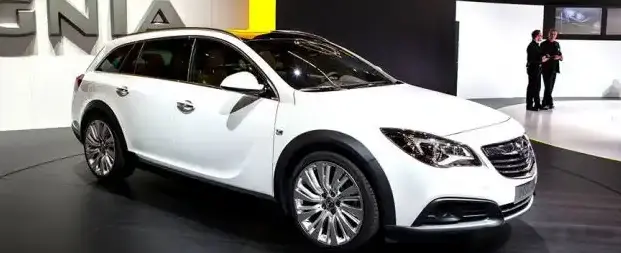
The Opel Insignia, particularly the hatchback variant, represented a significant step forward for the German automaker when it debuted in 2008. The facelifted version, introduced in July 2013 and produced through January 2017, refined the original design and offered a wider range of engine options. Among these, the 2.0-liter (250 hp) AWD Turbo Ecotec Start/Stop model occupied a performance-oriented niche within the Insignia lineup. This variant aimed to deliver a blend of practicality, comfort, and spirited driving, appealing to buyers seeking a capable and refined family car with enhanced all-weather capability. It was positioned as a premium offering, sitting above the base models and often featuring a higher level of standard equipment.
Technical Specifications
| Brand | Opel |
| Model | Insignia |
| Generation | Insignia Hatchback (A, facelift 2013) |
| Type (Engine) | 2.0 (250 Hp) AWD Turbo Ecotec Start/Stop |
| Start of production | July, 2013 |
| End of production | January, 2017 |
| Powertrain Architecture | Internal Combustion engine |
| Body type | Hatchback |
| Seats | 5 |
| Doors | 5 |
| Fuel consumption (urban) | 10.6 l/100 km (22.2 US mpg, 26.6 UK mpg, 9.4 km/l) |
| Fuel consumption (extra urban) | 6.3 l/100 km (37.3 US mpg, 44.8 UK mpg, 15.9 km/l) |
| Fuel consumption (combined) | 7.8 l/100 km (30.2 US mpg, 36.2 UK mpg, 12.8 km/l) |
| CO2 emissions | 184 g/km |
| Fuel Type | Petrol (Gasoline) |
| Acceleration 0 – 100 km/h | 7.5 sec |
| Acceleration 0 – 62 mph | 7.5 sec |
| Acceleration 0 – 60 mph | 7.1 sec |
| Maximum speed | 250 km/h (155.34 mph) |
| Emission standard | Euro 5 |
| Power | 250 Hp @ 5300 rpm |
| Power per litre | 125.1 Hp/l |
| Torque | 400 Nm @ 2500-4000 rpm (295.02 lb.-ft. @ 2500-4000 rpm) |
| Engine layout | Front, Transverse |
| Engine Model/Code | A20NHT, B20NHT |
| Engine displacement | 1998 cm3 (121.93 cu. in.) |
| Number of cylinders | 4 |
| Engine configuration | Inline |
| Cylinder Bore | 86 mm (3.39 in.) |
| Piston Stroke | 86 mm (3.39 in.) |
| Number of valves per cylinder | 4 |
| Fuel injection system | Direct injection |
| Engine aspiration | Turbocharger, Intercooler |
| Engine oil capacity | 6 l (6.34 US qt | 5.28 UK qt) |
| Coolant | 8 l (8.45 US qt | 7.04 UK qt) |
| Trunk (boot) space – minimum | 530 l (18.72 cu. ft.) |
| Trunk (boot) space – maximum | 1470 l (51.91 cu. ft.) |
| Fuel tank capacity | 70 l (18.49 US gal | 15.4 UK gal) |
| Length | 4842 mm (190.63 in.) |
| Width | 1856 mm (73.07 in.) |
| Width including mirrors | 2084 mm (82.05 in.) |
| Height | 1498 mm (58.98 in.) |
| Wheelbase | 2737 mm (107.76 in.) |
| Front track | 1587 mm (62.48 in.) |
| Rear (Back) track | 1590 mm (62.6 in.) |
| Minimum turning circle | 11.4 m (37.4 ft.) |
| Drive wheel | All wheel drive (4×4) |
| Number of gears | 6 |
| Gearbox type | Manual transmission |
| Assisting systems | ABS (Anti-lock braking system) |
| Steering type | Steering rack and pinion |
Powertrain & Engine Architecture
At the heart of the Insignia 2.0 AWD was the A20NHT or B20NHT engine, a 1.998-liter inline-four cylinder gasoline engine. This engine featured direct fuel injection, a technology that improved both power and fuel efficiency by injecting fuel directly into the combustion chamber. A single turbocharger with an intercooler boosted output, delivering 250 horsepower at 5300 rpm and 400 Nm (295 lb-ft) of torque between 2500 and 4000 rpm. The engine utilized a timing chain for durability and featured Opel’s Start/Stop system to further enhance fuel economy in urban driving conditions. The six-speed manual transmission was standard, providing drivers with full control over the engine’s power delivery. The all-wheel-drive system, utilizing a multi-plate clutch, dynamically distributed torque between the front and rear axles, enhancing traction and stability, particularly in adverse weather conditions.
Driving Characteristics
The 250 hp AWD Insignia offered a noticeably more engaging driving experience compared to lower-powered variants. Acceleration from 0 to 60 mph took approximately 7.1 seconds, and the car felt responsive and capable in most driving situations. The manual transmission allowed for precise gear changes, and the turbocharger provided a strong mid-range punch. While not a dedicated sports car, the Insignia offered a good balance between performance and comfort. The all-wheel-drive system inspired confidence on slippery surfaces, and the chassis felt well-planted and stable. Compared to the 1.6L turbo models, the 2.0L offered significantly more power and torque, resulting in quicker acceleration and more effortless highway cruising. It also provided a more satisfying driving experience than the diesel options, which prioritized fuel economy over outright performance.
Equipment & Trim Levels
The 2.0 AWD Insignia typically came well-equipped, reflecting its position as a higher-end trim level. Standard features often included alloy wheels, automatic climate control, a touchscreen infotainment system with navigation, and a suite of safety features such as ABS, ESP (Electronic Stability Program), and multiple airbags. Interior upholstery was typically cloth or leather, with higher trims offering premium leather options. Optional extras included a panoramic sunroof, adaptive cruise control, and a premium sound system. The dashboard layout was modern and functional, with a focus on ergonomics and ease of use.
Chassis & Braking
The Insignia’s chassis was designed to provide a comfortable yet controlled ride. The front suspension utilized MacPherson struts, while the rear suspension employed a multi-link setup. This configuration helped to minimize body roll and provide a stable platform for spirited driving. The braking system consisted of ventilated disc brakes on all four wheels, providing ample stopping power. ABS (Anti-lock Braking System) was standard, enhancing safety during emergency braking maneuvers. Stabilizer bars were fitted to both the front and rear axles to further reduce body roll and improve handling.
Market Reception & Comparison
The Opel Insignia 2.0 AWD was generally well-received by automotive critics. It was praised for its stylish design, spacious interior, and strong performance. The all-wheel-drive system was also highlighted as a significant advantage, particularly in regions with harsh winters. Fuel economy, while respectable, was not a standout feature, with combined figures around 30.2 US mpg. Compared to rivals such as the Ford Mondeo and Volkswagen Passat, the Insignia offered a compelling combination of value, performance, and features. The 2.0L AWD variant often represented a sweet spot in the lineup, offering a significant performance upgrade over the base models without the higher price tag of the flagship trims.
Legacy
The Opel Insignia 2.0 AWD Turbo Ecotec Start/Stop has proven to be a relatively reliable powertrain in the used car market. The engine is generally robust, and the six-speed manual transmission is known for its durability. Regular maintenance, including oil changes and timing chain inspections, is crucial for long-term reliability. While some owners have reported minor issues with the infotainment system, these are typically easily resolved. Today, the Insignia 2.0 AWD represents a good value proposition for buyers seeking a spacious, comfortable, and capable family car with a touch of performance. Its all-wheel-drive system and strong engine make it a practical choice for those living in areas with challenging weather conditions.