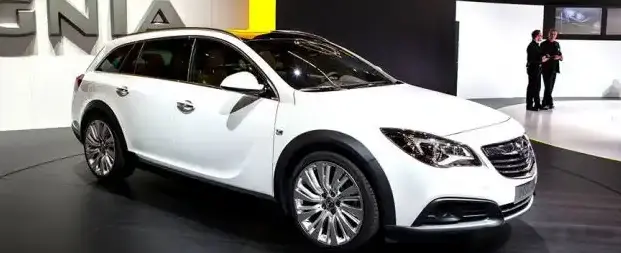
Technical Specifications
| Brand | Opel |
| Model | Insignia |
| Generation | Insignia Hatchback (A, facelift 2013) |
| Type (Engine) | 2.0 CDTI (140 Hp) Ecotec ecoFLEX start/stop |
| Start of production | July, 2013 |
| End of production | June, 2015 |
| Powertrain Architecture | Internal Combustion engine |
| Body type | Hatchback |
| Seats | 5 |
| Doors | 5 |
| Fuel consumption (urban) | 4.6 l/100 km (51.1 US mpg, 61.4 UK mpg, 21.7 km/l) |
| Fuel consumption (extra urban) | 3.3 l/100 km (71.3 US mpg, 85.6 UK mpg, 30.3 km/l) |
| Fuel consumption (combined) | 3.7 l/100 km (63.6 US mpg, 76.3 UK mpg, 27 km/l) |
| CO2 emissions | 99 g/km |
| Fuel Type | Diesel |
| Acceleration 0 – 100 km/h | 10.5 sec |
| Acceleration 0 – 62 mph | 10.5 sec |
| Acceleration 0 – 60 mph | 10 sec |
| Maximum speed | 205 km/h (127.38 mph) |
| Emission standard | Euro 5 |
| Power | 140 Hp @ 4000 rpm |
| Power per litre | 71.6 Hp/l |
| Torque | 350 Nm @ 1750-2500 rpm (258.15 lb.-ft. @ 1750-2500 rpm) |
| Engine layout | Front, Transverse |
| Engine Model/Code | A20DTE |
| Engine displacement | 1956 cm3 (119.36 cu. in.) |
| Number of cylinders | 4 |
| Engine configuration | Inline |
| Cylinder Bore | 83 mm (3.27 in.) |
| Piston Stroke | 90.4 mm (3.56 in.) |
| Number of valves per cylinder | 4 |
| Fuel injection system | Diesel Commonrail |
| Engine aspiration | Turbocharger, Intercooler |
| Engine oil capacity | 4.5 l (4.76 US qt | 3.96 UK qt) |
| Coolant | 9 l (9.51 US qt | 7.92 UK qt) |
| Trunk (boot) space – minimum | 530 l (18.72 cu. ft.) |
| Trunk (boot) space – maximum | 1470 l (51.91 cu. ft.) |
| Fuel tank capacity | 70 l (18.49 US gal | 15.4 UK gal) |
| Length | 4842 mm (190.63 in.) |
| Width | 1856 mm (73.07 in.) |
| Width including mirrors | 2084 mm (82.05 in.) |
| Height | 1498 mm (58.98 in.) |
| Wheelbase | 2737 mm (107.76 in.) |
| Front track | 1587 mm (62.48 in.) |
| Rear (Back) track | 1590 mm (62.6 in.) |
| Minimum turning circle | 11.4 m (37.4 ft.) |
| Drivetrain Architecture | The Internal combustion engine (ICE) drives the front wheels of the vehicle. |
| Drive wheel | Front wheel drive |
| Number of gears and type of gearbox | 6 gears, manual transmission |
| Assisting systems | ABS (Anti-lock braking system) |
| Steering type | Steering rack and pinion |
The Opel Insignia, launched in 2008, marked a significant step upmarket for the German manufacturer, challenging established players like the Ford Mondeo and Volkswagen Passat in the mid-size segment. The A-generation Insignia received a facelift in 2013, bringing with it styling refinements and updated technology. Among the engine options available, the 2.0 CDTI (140 hp) Ecotec ecoFLEX start/stop, offered from July 2013 to June 2015, proved to be a popular choice, particularly for fleet buyers and families seeking a balance between fuel economy and practicality. This variant aimed to deliver reasonable performance while minimizing running costs through Opel’s ecoFLEX efficiency technologies.
Powertrain & Engine Architecture
At the core of this Insignia variant lies the A20DTE, a 2.0-liter inline four-cylinder turbocharged diesel engine. This engine belongs to Opel’s Ecotec engine family, which prioritizes efficiency and reduced emissions. The A20DTE utilizes a common rail direct injection system, injecting fuel directly into the combustion chamber at very high pressure for optimized combustion. A variable geometry turbocharger (VGT) is crucial to its performance, enhancing low-end torque and improving responsiveness throughout the engine’s operating range. An intercooler is also incorporated to cool the intake air, further boosting power output. The engine produces 140 horsepower at 4000 rpm, and a substantial 350 Nm (258 lb-ft) of torque is available between 1750 and 2500 rpm, providing ample pulling power for everyday driving. This engine was exclusively paired with a six-speed manual transmission, chosen for its efficiency and driver engagement. The “ecoFLEX” designation signifies the inclusion of a start/stop system, which automatically shuts off the engine when the vehicle is stationary, contributing to lower fuel consumption and reduced emissions.
Driving Characteristics
The Insignia 2.0 CDTI (140 hp) with a manual transmission offers a comfortable and refined driving experience. While not designed for outright performance, the engine and gearbox combination provides sufficient power for most driving scenarios. Acceleration from 0 to 60 mph takes approximately 10.5 seconds, and the vehicle has a top speed of around 127 mph. The engine’s strong low-end torque makes it easy to navigate urban environments and execute overtaking maneuvers on the highway. The six-speed manual transmission provides precise gear changes and allows the driver to maintain control over the engine’s power delivery. Compared to the more powerful 2.0-liter BiTurbo diesel versions of the Insignia, this variant feels less urgent, but it delivers a more relaxed and fuel-efficient driving experience. The suspension is tuned for comfort, effectively absorbing bumps and imperfections in the road surface. Steering is light and precise, making the Insignia easy to maneuver in tight spaces.
Equipment & Trim Levels
The 2.0 CDTI (140 hp) Ecotec ecoFLEX start/stop typically occupied a mid-range position within the Insignia lineup, offering a good balance between features and affordability. Standard equipment generally included air conditioning, a CD/MP3 stereo system, electric front windows, and central locking. Higher trim levels added features such as alloy wheels, a touchscreen infotainment system, cruise control, and parking sensors. Interior upholstery was typically cloth, with options for leather available on more upscale trims. The dashboard layout was functional and well-designed, featuring clear instrumentation and intuitive controls.
Chassis & Braking
The Insignia A-generation was built on a front-wheel-drive platform, utilizing MacPherson strut suspension at the front and a multi-link suspension at the rear. This configuration provided a good compromise between ride comfort and handling characteristics. The braking system consisted of disc brakes on the front wheels and drum brakes on the rear wheels. An Anti-lock Braking System (ABS) was standard equipment, enhancing safety and stability during emergency braking situations. The steering system employed a rack-and-pinion setup, delivering precise and responsive steering feel.
Market Reception & Comparison
The 2.0 CDTI (140 hp) Ecotec ecoFLEX start/stop variant of the Opel Insignia was generally well-received by automotive critics and consumers. It was praised for its fuel efficiency, comfortable ride quality, and spacious interior. Compared to the more powerful engine options, this variant offered a lower purchase price and reduced running costs. Some reviewers noted that the engine could feel somewhat underpowered when the vehicle was fully loaded or when driving uphill. In terms of fuel economy, this variant consistently outperformed many of its competitors, achieving up to 76.3 mpg on the combined cycle. Reliability was generally considered good, with relatively few reported issues.
Legacy
The Opel Insignia 2.0 CDTI (140 hp) Ecotec ecoFLEX start/stop continues to be a popular choice in the used car market. Its fuel efficiency, practicality, and affordability make it an appealing option for buyers seeking a budget-friendly vehicle. The A20DTE engine is known for its durability and relatively low maintenance requirements. While not a particularly sporty car, it provides a comfortable and reliable transportation solution for families and commuters. The Insignia, as a whole, helped Opel establish a stronger presence in the competitive mid-size segment, and this specific variant played a significant role in attracting fleet buyers and environmentally conscious consumers.