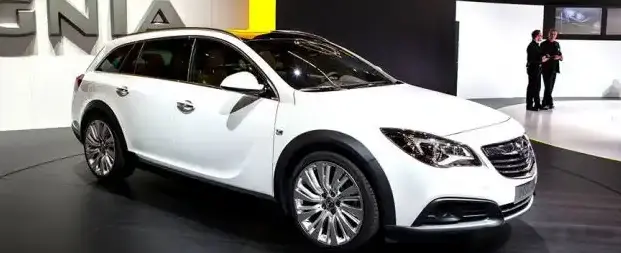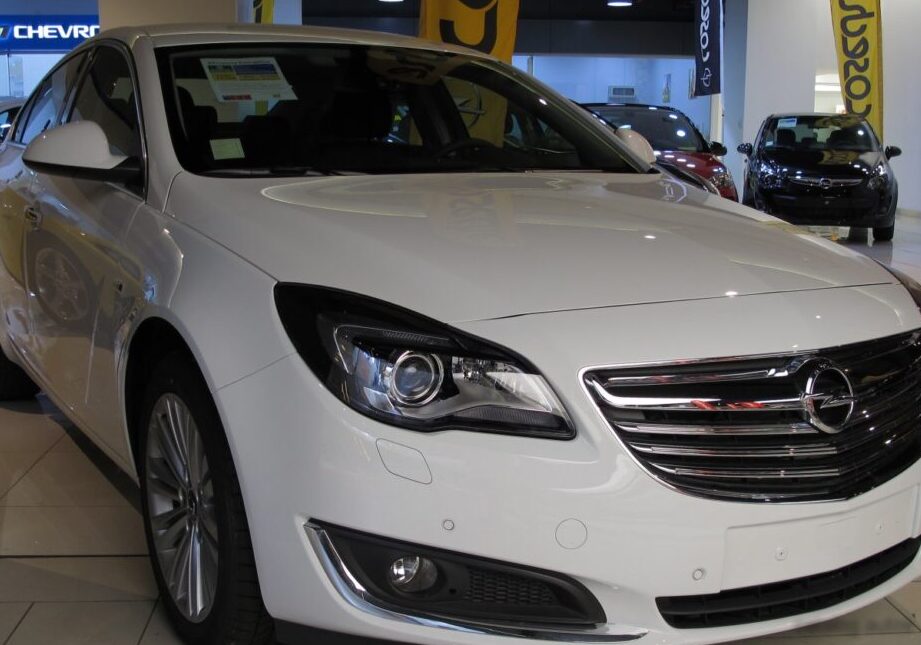
Technical Specifications
| Brand | Opel |
| Model | Insignia |
| Generation | Insignia Hatchback (A, facelift 2013) |
| Type (Engine) | 2.0 CDTI (170 Hp) Automatic |
| Start of production | July, 2015 |
| End of production | January, 2017 |
| Powertrain Architecture | Internal Combustion engine |
| Body type | Hatchback |
| Seats | 5 |
| Doors | 5 |
| Fuel consumption (urban) | 7.8-7.6 l/100 km (30.2 – 30.9 US mpg) |
| Fuel consumption (extra urban) | 4.2-4.1 l/100 km (56 – 57.4 US mpg) |
| Fuel consumption (combined) | 5.6-5.4 l/100 km (42 – 43.6 US mpg) |
| CO2 emissions | 147-143 g/km |
| Fuel Type | Diesel |
| Acceleration 0 – 100 km/h | 9.4 sec |
| Acceleration 0 – 62 mph | 9.4 sec |
| Acceleration 0 – 60 mph | 8.9 sec |
| Maximum speed | 220 km/h (136.7 mph) |
| Emission standard | Euro 6 |
| Weight-to-power ratio | 9.3 kg/Hp, 107 Hp/tonne |
| Weight-to-torque ratio | 4 kg/Nm, 251.7 Nm/tonne |
| Power | 170 Hp @ 3750 rpm |
| Torque | 400 Nm @ 1750-2500 rpm (295.02 lb.-ft. @ 1750-2500 rpm) |
| Engine layout | Front, Transverse |
| Engine Model/Code | B20DTH |
| Engine displacement | 1956 cm3 (119.36 cu. in.) |
| Number of cylinders | 4 |
| Engine configuration | Inline |
| Cylinder Bore | 83 mm (3.27 in.) |
| Piston Stroke | 90.4 mm (3.56 in.) |
| Compression ratio | 16:1 |
| Fuel injection system | Diesel Commonrail |
| Engine aspiration | Turbocharger, Intercooler |
| Engine oil capacity | 5.3 l (5.6 US qt | 4.66 UK qt) |
| Coolant | 7 l (7.4 US qt | 6.16 UK qt) |
| Kerb Weight | 1589 kg (3503.15 lbs.) |
| Max. weight | 2180 kg (4806.08 lbs.) |
| Max load | 591 kg (1302.93 lbs.) |
| Trunk (boot) space – minimum | 530 l (18.72 cu. ft.) |
| Trunk (boot) space – maximum | 1470 l (51.91 cu. ft.) |
| Fuel tank capacity | 70 l (18.49 US gal | 15.4 UK gal) |
| Max. roof load | 100 kg (220.46 lbs.) |
| Permitted trailer load with brakes (12%) | 1800 kg (3968.32 lbs.) |
| Permitted trailer load without brakes | 750 kg (1653.47 lbs.) |
| Length | 4842 mm (190.63 in.) |
| Width | 1856 mm (73.07 in.) |
| Width including mirrors | 2084 mm (82.05 in.) |
| Height | 1498 mm (58.98 in.) |
| Wheelbase | 2737 mm (107.76 in.) |
| Front track | 1587 mm (62.48 in.) |
| Rear (Back) track | 1590 mm (62.6 in.) |
| Minimum turning circle | 11.40 m (37.4 ft.) |
| Drivetrain Architecture | Front wheel drive |
| Number of gears and type of gearbox | 6 gears, automatic transmission |
| Front brakes | Ventilated discs |
| Rear brakes | Disc |
The Opel Insignia A, launched in 2008 and facelifted in 2013, was Opel’s flagship model, designed to compete with established players like the Ford Mondeo and Volkswagen Passat. The 2.0 CDTI Automatic variant, introduced in 2015, offered a compelling package for buyers prioritizing fuel economy and ease of driving. Positioned as a mid-range option, it sat below the more powerful 2.0 BiTurbo models and above the lower-spec 1.6-liter diesel versions. The facelift brought updated styling, improved interior materials, and enhanced technology, solidifying the Insignia’s position as a modern and competitive family car.
Powertrain & Engine Architecture
At the heart of the Insignia 2.0 CDTI Automatic lies the B20DTH engine, a 1956cc inline-four cylinder diesel. This engine utilizes a common rail direct injection system, delivering fuel at extremely high pressure for optimized combustion. The B20DTH is a turbocharged engine, employing a variable geometry turbocharger (VGT) and intercooler to boost power and torque. The engine’s 16:1 compression ratio contributes to its efficiency. Paired with this engine is a six-speed automatic transmission, providing smooth and convenient gear changes. This transmission isn’t known for being particularly sporty, but it prioritizes comfort and fuel efficiency. The automatic transmission was a popular choice for buyers who preferred not to deal with a manual gearbox, especially in urban driving conditions.
Driving Characteristics
The 170 horsepower and 400 Nm (295 lb-ft) of torque produced by the 2.0 CDTI engine provide adequate performance for everyday driving. Acceleration from 0-60 mph takes around 8.9 seconds, and the car has a top speed of 136.7 mph. While not a sports car, the Insignia 2.0 CDTI Automatic offers sufficient power for overtaking and highway cruising. The automatic transmission’s gear ratios are tuned for fuel economy, meaning it doesn’t always provide the most responsive acceleration. Compared to the manual version of the same engine, the automatic feels slightly less engaging, but it offers a more relaxed driving experience. The higher-output BiTurbo models offered significantly more performance, but at the cost of fuel economy and increased complexity.
Equipment & Trim Levels
The Insignia 2.0 CDTI Automatic typically came well-equipped, even in base trim. Standard features included air conditioning, electric windows, a touchscreen infotainment system, Bluetooth connectivity, and alloy wheels. Higher trim levels, such as the Cosmo and Elite, added features like leather upholstery, heated seats, a sunroof, and advanced safety systems like adaptive cruise control and lane departure warning. Optional extras included a navigation system, premium sound system, and parking sensors. The interior design was generally considered modern and comfortable, with a focus on practicality and ergonomics.
Chassis & Braking
The Insignia A featured a MacPherson strut front suspension and a multi-link rear suspension, providing a comfortable and controlled ride. The 2.0 CDTI Automatic models typically had a slightly softer suspension setup compared to the more performance-oriented BiTurbo versions. Braking duties were handled by ventilated discs at the front and solid discs at the rear. ABS (Anti-lock Braking System) was standard. The steering was electrically assisted, providing a light and easy driving experience. The weight distribution was reasonably balanced, contributing to the car’s stability and handling.
Market Reception & Comparison
The Opel Insignia 2.0 CDTI Automatic was generally well-received by critics. It was praised for its comfortable ride, spacious interior, and fuel efficiency. However, some reviewers noted that the automatic transmission could feel sluggish at times, and the handling wasn’t as sharp as some of its rivals. Compared to the 1.6 CDTI models, the 2.0 CDTI offered noticeably more power and refinement. Against the more powerful BiTurbo versions, it represented a more sensible and affordable option for many buyers. Fuel economy was a strong point, with combined figures ranging from 42 to 43.6 US mpg.
Legacy
The Opel Insignia A, including the 2.0 CDTI Automatic variant, proved to be a reliable and durable vehicle. The B20DTH engine is generally considered to be a robust unit, although regular maintenance is essential. Common issues include diesel particulate filter (DPF) problems, particularly on cars that are primarily driven on short journeys. In the used car market, the Insignia 2.0 CDTI Automatic remains a popular choice for buyers seeking a spacious, comfortable, and fuel-efficient family car. Its relatively affordable price and proven reliability make it a compelling alternative to newer models.