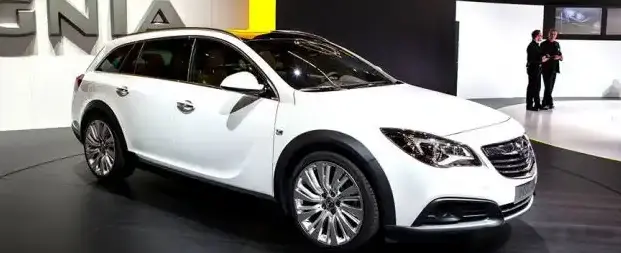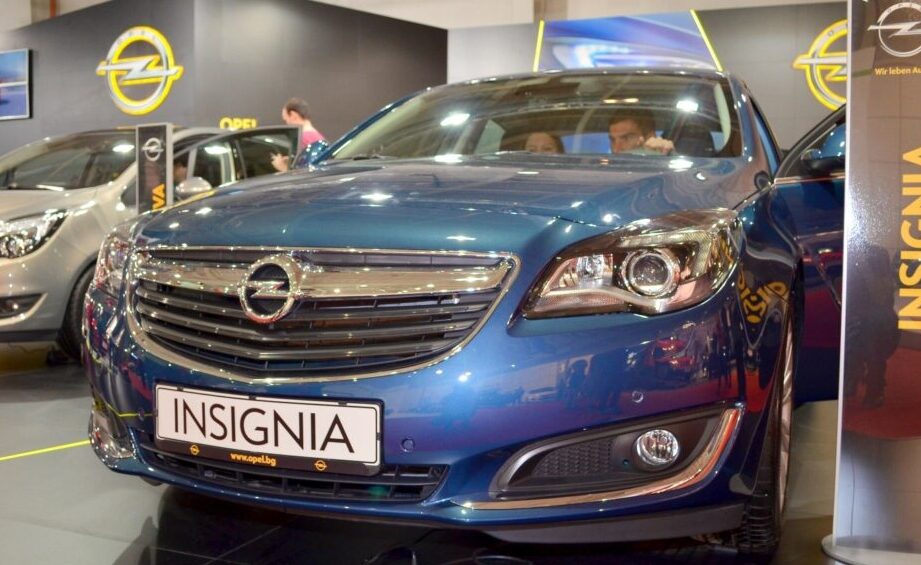
The Opel Insignia Sedan (A, facelift 2013) 1.6 Turbo Ecotec Automatic represents a mid-cycle refresh of Opel’s flagship D-segment sedan. Introduced in July 2013 and continuing through January 2017, this variant aimed to balance fuel efficiency with respectable performance within the Insignia lineup. Positioned as a mainstream offering, it slotted between the base 1.4L turbocharged engine and the more powerful 2.0L variants, both in terms of price and performance. The facelift brought revised styling, updated technology, and refinements to the powertrain options, including this 1.6L turbocharged gasoline engine paired with a six-speed automatic transmission. It was primarily marketed in Europe, where the Insignia competed with rivals like the Ford Mondeo, Volkswagen Passat, and Peugeot 508.
Technical Specifications
| Brand | Opel |
| Model | Insignia |
| Generation | Insignia Sedan (A, facelift 2013) |
| Type (Engine) | 1.6 (170 Hp) Turbo Ecotec Automatic |
| Start of production | July, 2013 |
| End of production | January, 2017 |
| Powertrain Architecture | Internal Combustion engine |
| Body type | Sedan |
| Seats | 5 |
| Doors | 4 |
| Fuel consumption (urban) | 9.1 l/100 km (25.8 US mpg, 31 UK mpg, 11 km/l) |
| Fuel consumption (extra urban) | 5.2 l/100 km (45.2 US mpg, 54.3 UK mpg, 19.2 km/l) |
| Fuel consumption (combined) | 6.6 l/100 km (35.6 US mpg, 42.8 UK mpg, 15.2 km/l) |
| CO2 emissions | 155 g/km |
| Fuel Type | Petrol (Gasoline) |
| Acceleration 0 – 100 km/h | 9.9 sec |
| Acceleration 0 – 62 mph | 9.9 sec |
| Acceleration 0 – 60 mph | 9.4 sec |
| Maximum speed | 210 km/h (130.49 mph) |
| Emission standard | Euro 5 |
| Power | 170 Hp @ 4250 rpm |
| Power per litre | 106.4 Hp/l |
| Torque | 260 Nm @ 1650-4250 rpm (191.77 lb.-ft. @ 1650-4250 rpm) |
| Engine layout | Front, Transverse |
| Engine Model/Code | A16XHT, B16SHL |
| Engine displacement | 1598 cm3 (97.52 cu. in.) |
| Number of cylinders | 4 |
| Engine configuration | Inline |
| Cylinder Bore | 79 mm (3.11 in.) |
| Piston Stroke | 81.5 mm (3.21 in.) |
| Number of valves per cylinder | 4 |
| Fuel injection system | Multi-port manifold injection |
| Engine aspiration | Turbocharger, Intercooler |
| Engine oil capacity | 5.5 l (5.81 US qt | 4.84 UK qt) |
| Coolant | 5.8 l (6.13 US qt | 5.1 UK qt) |
| Trunk (boot) space – minimum | 500 l (17.66 cu. ft.) |
| Trunk (boot) space – maximum | 1015 l (35.84 cu. ft.) |
| Fuel tank capacity | 70 l (18.49 US gal | 15.4 UK gal) |
| Length | 4842 mm (190.63 in.) |
| Width | 1856 mm (73.07 in.) |
| Width including mirrors | 2084 mm (82.05 in.) |
| Height | 1498 mm (58.98 in.) |
| Wheelbase | 2737 mm (107.76 in.) |
| Front track | 1587 mm (62.48 in.) |
| Rear (Back) track | 1590 mm (62.6 in.) |
| Minimum turning circle | 11.4 m (37.4 ft.) |
| Drivetrain Architecture | The Internal combustion engine (ICE) drives the front wheels of the vehicle. |
| Drive wheel | Front wheel drive |
| Number of gears and type of gearbox | 6 gears, automatic transmission |
| Assisting systems | ABS (Anti-lock braking system) |
| Steering type | Steering rack and pinion |
Powertrain & Engine Architecture
The heart of this Insignia variant is the A16XHT (or B16SHL, depending on the specific market and production date) 1.6-liter inline-four cylinder gasoline engine. This engine is part of Opel’s Ecotec family, known for its focus on efficiency and refinement. It features multi-point fuel injection and a single turbocharger with an intercooler, allowing for a good balance of power and torque. The turbocharger provides boost across a broad rev range, contributing to the engine’s 260 Nm (191.77 lb-ft) of torque available from 1650 to 4250 rpm. The engine’s 170 horsepower peak is reached at 4250 rpm. Paired with this engine is a six-speed automatic transmission, designed to provide smooth shifts and contribute to fuel economy. This transmission isn’t known for particularly sporty or rapid shifts, prioritizing comfort and ease of use over outright performance.
Driving Characteristics
The 1.6L Turbo Ecotec Automatic Insignia delivers a comfortable and refined driving experience. Acceleration from 0-60 mph takes around 9.4 seconds, which is adequate for everyday driving but doesn’t offer particularly brisk performance. The automatic transmission is tuned for fuel efficiency, meaning it will upshift quickly to maintain lower engine speeds. This can sometimes result in the engine feeling slightly strained when overtaking or climbing hills, requiring a downshift to access more power. Compared to the 2.0L Turbo variants, this engine feels noticeably less powerful, but it offers a significant improvement in fuel economy. The manual transmission versions of the 1.6L engine provide a more engaging driving experience, allowing the driver to better control the engine’s power band.
Equipment & Trim Levels
The Insignia Sedan (A, facelift 2013) 1.6 Turbo Ecotec Automatic typically came equipped with a reasonable level of standard features. These included air conditioning, power windows, power mirrors, a CD/MP3 stereo system, and alloy wheels. Higher trim levels, such as the Cosmo or Exclusive, added features like leather upholstery, heated front seats, a sunroof, a navigation system, and advanced safety features like adaptive cruise control and lane departure warning. Interior upholstery was generally cloth on the base models, with leather options available on higher trims. The dashboard layout was modern for its time, with a focus on ergonomics and ease of use.
Chassis & Braking
The Insignia Sedan features a front-wheel-drive layout with independent suspension at the front and a semi-independent torsion beam suspension at the rear. The suspension is tuned for comfort, providing a smooth ride over most road surfaces. Braking duties are handled by disc brakes at the front and typically drum brakes at the rear, although some higher-spec models may have been equipped with rear discs. ABS (Anti-lock Braking System) is standard. The chassis is relatively lightweight, helping to offset the engine’s modest power output and contribute to reasonable handling characteristics. Stabilizer bars are fitted front and rear to reduce body roll during cornering.
Market Reception & Comparison
The Opel Insignia 1.6 Turbo Ecotec Automatic was generally well-received by critics as a practical and comfortable family sedan. It was praised for its fuel efficiency and refined ride quality. However, some reviewers noted that the engine lacked the punch of the larger 2.0L variants. Compared to the 2.0L Turbo, the 1.6L offered better fuel economy (around 6.6 l/100km combined) but slower acceleration. The 2.0L diesel variants (like the 1.9 TDI) offered even better fuel economy and more torque, but at the expense of refinement and potential maintenance costs associated with diesel particulate filters. The 1.6L Automatic appealed to buyers who prioritized comfort, fuel economy, and a lower price point.
Legacy
The 1.6L Turbo Ecotec engine, while not known for being a particularly groundbreaking unit, proved to be reasonably reliable in the Insignia. Common issues are generally related to the turbocharger and fuel system, but these are not widespread. In the used car market, the Insignia 1.6 Turbo Ecotec Automatic represents a relatively affordable option for those seeking a spacious and comfortable family sedan. Its fuel efficiency and reasonable running costs make it an attractive choice for budget-conscious buyers. However, potential buyers should be aware of the engine’s limitations in terms of outright performance and ensure that the vehicle has been properly maintained.