Technical Specifications
| Brand | Opel |
| Model | Insignia |
| Generation | Insignia Sedan (A, facelift 2013) |
| Type (Engine) | 1.6 CDTI (136 Hp) |
| Start of production | July, 2015 |
| End of production | January, 2017 |
| Powertrain Architecture | Internal Combustion engine |
| Body type | Sedan |
| Seats | 5 |
| Doors | 4 |
| Fuel consumption (urban) | 4.7-4.5 l/100 km (50 – 52.3 US mpg) |
| Fuel consumption (extra urban) | 3.5-3.3 l/100 km (67.2 – 71.3 US mpg) |
| Fuel consumption (combined) | 3.9-3.8 l/100 km (60.3 – 61.9 US mpg) |
| CO2 emissions | 104-99 g/km |
| Fuel Type | Diesel |
| Acceleration 0 – 100 km/h | 10.9 sec |
| Acceleration 0 – 62 mph | 10.9 sec |
| Acceleration 0 – 60 mph | 10.4 sec |
| Maximum speed | 210 km/h (130.49 mph) |
| Emission standard | Euro 6 |
| Weight-to-power ratio | 11 kg/Hp, 90.9 Hp/tonne |
| Weight-to-torque ratio | 4.7 kg/Nm, 213.9 Nm/tonne |
| Power | 136 Hp @ 3500-4000 rpm |
| Power per litre | 85.1 Hp/l |
| Torque | 320 Nm @ 2000-2250 rpm (236.02 lb.-ft. @ 2000-2250 rpm) |
| Engine layout | Front, Transverse |
| Engine Model/Code | B16DTH |
| Engine displacement | 1598 cm3 (97.52 cu. in.) |
| Number of cylinders | 4 |
| Engine configuration | Inline |
| Cylinder Bore | 79.7 mm (3.14 in.) |
| Piston Stroke | 80.1 mm (3.15 in.) |
| Compression ratio | 16:1 |
| Number of valves per cylinder | 4 |
| Fuel injection system | Diesel Commonrail |
| Engine aspiration | Turbocharger, Intercooler |
| Engine oil capacity | 5 l (5.28 US qt | 4.4 UK qt) |
| Coolant | 8.3 l (8.77 US qt | 7.3 UK qt) |
| Kerb Weight | 1496 kg (3298.12 lbs.) |
| Max. weight | 2110 kg (4651.75 lbs.) |
| Max load | 614 kg (1353.64 lbs.) |
| Trunk (boot) space – minimum | 500 l (17.66 cu. ft.) |
| Trunk (boot) space – maximum | 1015 l (35.84 cu. ft.) |
| Fuel tank capacity | 70 l (18.49 US gal | 15.4 UK gal) |
| Max. roof load | 100 kg (220.46 lbs.) |
| Permitted trailer load with brakes (12%) | 1800 kg (3968.32 lbs.) |
| Permitted trailer load without brakes | 750 kg (1653.47 lbs.) |
| Length | 4842 mm (190.63 in.) |
| Width | 1856 mm (73.07 in.) |
| Width including mirrors | 2084 mm (82.05 in.) |
| Height | 1498 mm (58.98 in.) |
| Wheelbase | 2737 mm (107.76 in.) |
| Front track | 1587 mm (62.48 in.) |
| Rear (Back) track | 1590 mm (62.6 in.) |
| Minimum turning circle | 11.40 m (37.4 ft.) |
| Drivetrain Architecture | The Internal combustion engine (ICE) drives the front wheels of the vehicle. |
| Drive wheel | Front wheel drive |
| Number of gears and type of gearbox | 6 gears, manual transmission |
| Front brakes | Ventilated discs |
| Rear brakes | Disc |
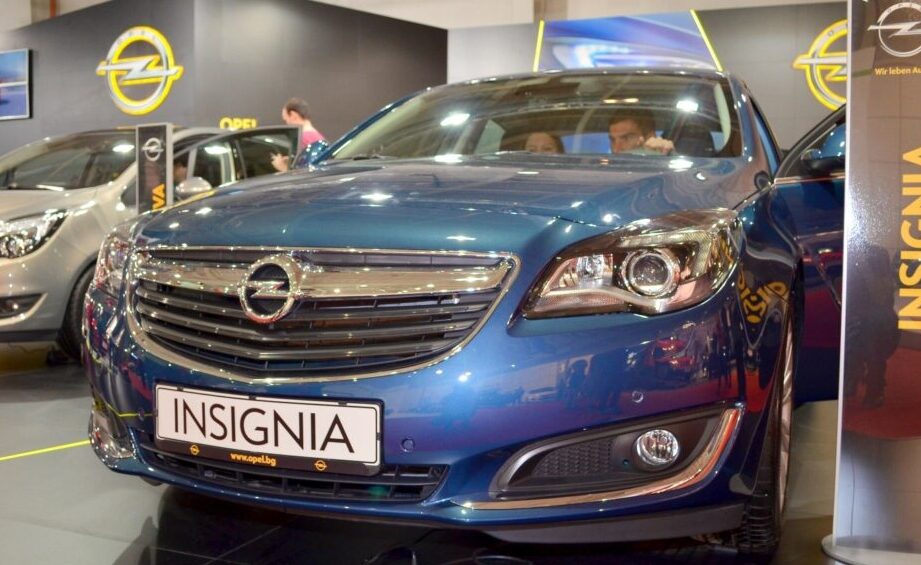
The Opel Insignia Sedan (A, facelift 2013) 1.6 CDTI, producing 136 horsepower, was a significant variant in Opel’s mid-size sedan lineup. Introduced in July 2015 and remaining in production until January 2017, this model represented a step towards fuel efficiency and lower emissions within the Insignia range. It occupied a middle ground in the lineup, offering a balance between performance and economy, appealing to drivers seeking a comfortable and practical family sedan. The facelifted Insignia (A) built upon the original model launched in 2008, incorporating styling updates and revised engine options, all based around the GM’s Epsilon II platform.
Powertrain & Engine Architecture
The heart of the Insignia 1.6 CDTI was the B16DTH engine, a 1.6-liter inline-four cylinder diesel. This engine was part of Opel’s ‘Whisper Diesel’ family, known for its relatively quiet operation and fuel efficiency. It featured a turbocharger with intercooling to boost power output, and a common-rail direct fuel injection system operating at very high pressures to optimize combustion. The engine produced 136 horsepower at 3500-4000 rpm and a respectable 320 Nm (236 lb-ft) of torque between 2000-2250 rpm. This torque band provided good low-end responsiveness, making it suitable for everyday driving. The engine also incorporated a diesel particulate filter (DPF) to meet stringent Euro 6 emission standards. The 6-speed manual transmission was the standard offering, providing a balance between fuel economy and driver control.
Driving Characteristics
The 1.6 CDTI with the manual transmission offered a comfortable and refined driving experience. While not a performance-oriented variant, the engine provided adequate power for most driving situations. Acceleration from 0-60 mph took around 10.4 seconds, and top speed was rated at 130.49 mph. The gear ratios were tuned for fuel efficiency, with taller gearing in higher gears to reduce engine speed at cruising speeds. Compared to the more powerful 2.0 CDTI variants, the 1.6 CDTI felt less urgent in its acceleration, but it offered significantly better fuel economy. The manual transmission allowed for greater driver engagement, but the relatively long throws could feel a bit dated compared to more modern gearboxes.
Equipment & Trim Levels
The Insignia 1.6 CDTI typically came with a reasonable level of standard equipment. This included air conditioning, electric front windows, a basic audio system with USB connectivity, and stability control. Higher trim levels, such as ‘Sport’ or ‘Exclusive’, added features like alloy wheels, upgraded infotainment systems with touchscreen displays, leather upholstery, heated seats, and parking sensors. Optional extras included a panoramic sunroof, adaptive cruise control, and a premium sound system. Interior upholstery was typically cloth on the base models, with leather options available on higher trims. The dashboard layout was functional and well-designed, with clear instrumentation and intuitive controls.
Chassis & Braking
The Insignia Sedan featured a MacPherson strut front suspension and a multi-link rear suspension, providing a comfortable ride and good handling characteristics. The suspension was tuned to prioritize comfort over outright sportiness. The 1.6 CDTI variant typically came with ventilated front disc brakes and solid rear disc brakes. Anti-lock Braking System (ABS) was standard, providing enhanced braking performance and stability. The electric power steering offered light and precise steering feel, making it easy to maneuver in urban environments.
Market Reception & Comparison
The Opel Insignia 1.6 CDTI was generally well-received by critics for its fuel efficiency and comfortable ride. It was seen as a practical and affordable option for families and commuters. Compared to the more powerful 2.0 CDTI variants, the 1.6 CDTI offered significantly better fuel economy, making it an attractive option for those prioritizing running costs. However, some critics noted that the engine lacked the punch of the larger diesel engines, and the manual transmission felt a bit dated. In terms of reliability, the Insignia 1.6 CDTI proved to be generally reliable, although some owners reported issues with the DPF system, a common problem with modern diesel engines.
Legacy
The Opel Insignia 1.6 CDTI remains a relatively common sight on used car lots today. Its fuel efficiency and practicality continue to appeal to buyers looking for an affordable and reliable family sedan. The B16DTH engine, while not without its quirks, has proven to be a durable and long-lasting unit when properly maintained. The Insignia, in general, helped establish Opel as a competitor in the mid-size sedan segment, and the 1.6 CDTI variant played a key role in broadening its appeal to a wider range of buyers.