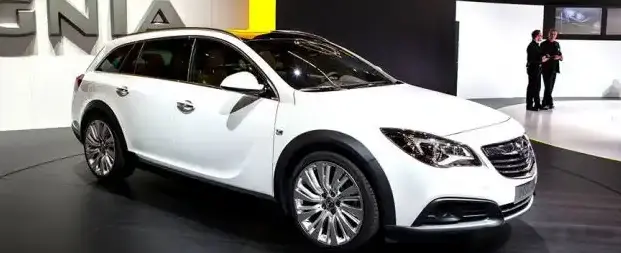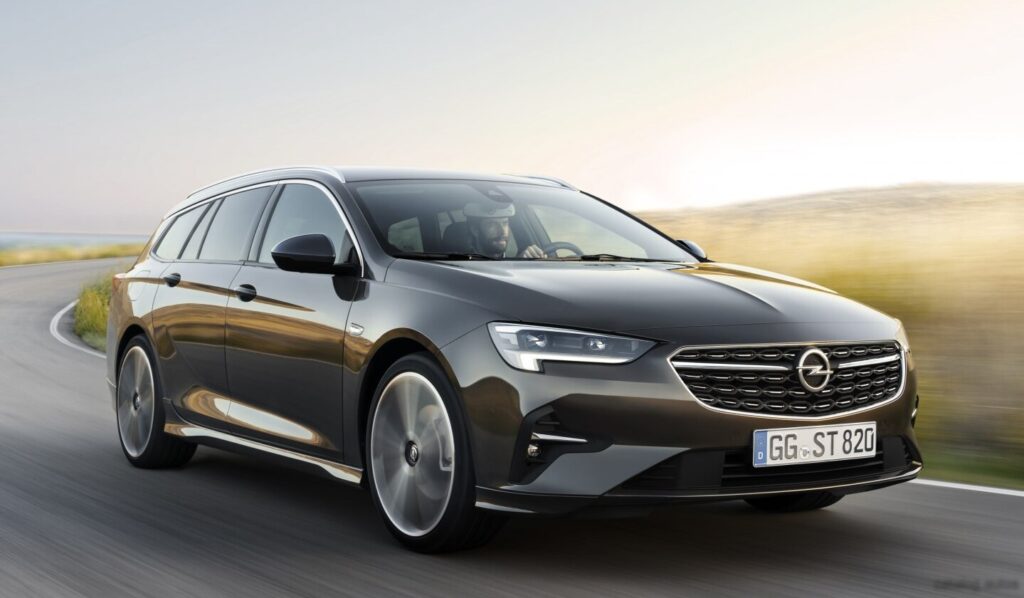
The Opel Insignia Sports Tourer (B), particularly the facelifted version introduced in March 2020, represented a significant evolution of Opel’s mid-size family car. This variant, equipped with a 2.0-liter turbocharged diesel engine producing 174 horsepower and paired with an eight-speed automatic transmission, occupied a key position in the Insignia lineup, offering a balance between fuel efficiency, performance, and comfort. It was designed to appeal to buyers seeking a practical and refined estate car for long-distance travel and everyday use, primarily targeting the European market. The Insignia Sports Tourer competed directly with models like the Volkswagen Passat Variant, Ford Mondeo Estate, and Peugeot 508 SW.
Technical Specifications
| Brand | Opel |
| Model | Insignia |
| Generation | Insignia Sports Tourer (B, facelift 2020) |
| Type (Engine) | 2.0d (174 Hp) Automatic |
| Start of production | March, 2020 |
| Powertrain Architecture | Internal Combustion engine |
| Body type | Station wagon (estate) |
| Seats | 5 |
| Doors | 5 |
| Fuel consumption (urban) | 6.3 l/100 km (37.3 US mpg, 44.8 UK mpg, 15.9 km/l) |
| Fuel consumption (extra urban) | 4.3 l/100 km (54.7 US mpg, 65.7 UK mpg, 23.3 km/l) |
| Fuel consumption (combined) | 5.1 l/100 km (46.1 US mpg, 55.4 UK mpg, 19.6 km/l) |
| CO2 emissions | 133 g/km |
| Fuel Type | Diesel |
| Acceleration 0 – 100 km/h | 9 sec |
| Acceleration 0 – 62 mph | 9 sec |
| Acceleration 0 – 60 mph | 8.6 sec |
| Maximum speed | 220 km/h (136.7 mph) |
| Emission standard | Euro 6d |
| Power | 174 Hp @ 3500 rpm |
| Power per litre | 89 Hp/l |
| Torque | 380 Nm @ 1500-2750 rpm (280.27 lb.-ft. @ 1500-2750 rpm) |
| Engine layout | Front, Transverse |
| Engine Model/Code | F20DVH |
| Engine displacement | 1955 cm3 (119.3 cu. in.) |
| Number of cylinders | 4 |
| Engine configuration | Inline |
| Compression ratio | 15.5:1 |
| Number of valves per cylinder | 4 |
| Fuel injection system | Diesel Commonrail |
| Engine aspiration | Turbocharger, Intercooler |
| Engine oil capacity | 5 l (5.28 US qt | 4.4 UK qt) |
| Trunk (boot) space – minimum | 560 l (19.78 cu. ft.) |
| Trunk (boot) space – maximum | 1665 l (58.8 cu. ft.) |
| Fuel tank capacity | 62 l (16.38 US gal | 13.64 UK gal) |
| AdBlue tank | 15 l (3.96 US gal | 3.3 UK gal) |
| Length | 4986 mm (196.3 in.) |
| Width | 1863 mm (73.35 in.) |
| Width with mirrors folded | 1941 mm (76.42 in.) |
| Width including mirrors | 2093 mm (82.4 in.) |
| Height | 1500 mm (59.06 in.) |
| Wheelbase | 2829 mm (111.38 in.) |
| Front track | 1607 mm (63.27 in.) |
| Rear track | 1610 mm (63.39 in.) |
| Front overhang | 990 mm (38.98 in.) |
| Rear overhang | 1167 mm (45.94 in.) |
| Minimum turning circle | 11.74 m (38.52 ft.) |
| Drivetrain Architecture | Front wheel drive |
| Number of gears | 8 |
| Gearbox type | Automatic transmission |
| Tire size | 215/55 R17; 245/45 R18; 245/35 R20 |
| Wheel rims size | 7.5J x 17; 8.5J x 18; 8.5J x 20 |
INTRODUCTION
The 2020 Opel Insignia Sports Tourer 2.0d Automatic represented a refinement of the second-generation Insignia (introduced in 2017). The facelift brought updated styling, enhanced technology, and improvements to the engine range. Positioned as a mid-range offering within the Sports Tourer lineup, this variant aimed to provide a compelling blend of practicality, efficiency, and driving comfort. It slotted in below the more powerful bi-turbo diesel models and above the lower-powered petrol options, appealing to drivers prioritizing fuel economy and relaxed cruising.
Powertrain & Engine Architecture
At the heart of this Insignia variant lies the F20DVH, a 2.0-liter inline-four cylinder diesel engine. This engine is part of Opel’s modern diesel family, featuring a cast iron block and aluminum cylinder head. It utilizes a common rail direct injection system, delivering fuel at extremely high pressures for optimized combustion. A turbocharger with an intercooler further enhances performance, providing increased air intake to the engine. The engine produces 174 horsepower at 3500 rpm and a substantial 380 Nm (280 lb-ft) of torque between 1500 and 2750 rpm. This broad torque curve contributes to strong acceleration and effortless cruising. The engine also incorporates a particulate filter to reduce emissions, meeting stringent Euro 6d standards. The eight-speed automatic transmission, sourced from Aisin, is a key component of this powertrain. It offers smooth and responsive gear changes, contributing to both fuel efficiency and driving comfort. The transmission is electronically controlled and features adaptive shift patterns, adjusting to driving style and conditions.
Driving Characteristics
The 2.0d Automatic Insignia Sports Tourer delivers a composed and refined driving experience. The 174 hp engine, while not overtly sporty, provides ample power for everyday driving and overtaking maneuvers. Acceleration from 0-60 mph takes approximately 8.6 seconds, and the car feels stable and planted at highway speeds. The eight-speed automatic transmission plays a crucial role in maximizing efficiency and minimizing engine noise. Gear changes are generally seamless, and the transmission is quick to downshift when needed. Compared to the manual transmission versions, the automatic offers greater convenience, particularly in urban traffic. However, it may feel slightly less engaging for drivers who prefer more control. Compared to the higher-output bi-turbo diesel models, this variant offers a more relaxed and fuel-efficient driving experience, sacrificing some outright performance. The suspension is tuned for comfort, absorbing bumps and imperfections in the road effectively.
Equipment & Trim Levels
The Insignia Sports Tourer 2.0d Automatic typically came well-equipped, even in base trim levels. Standard features often included dual-zone climate control, a touchscreen infotainment system with Apple CarPlay and Android Auto compatibility, and a suite of safety features such as automatic emergency braking, lane departure warning, and traffic sign recognition. Higher trim levels added features like leather upholstery, heated front seats, a panoramic sunroof, and adaptive cruise control. The interior design was modern and functional, with a focus on ergonomics and user-friendliness. The Sports Tourer’s spacious cabin provided ample room for passengers and luggage. The rear seats could be folded down to create a large, flat cargo area, maximizing practicality.
Chassis & Braking
The Insignia Sports Tourer features a front-wheel-drive layout with a MacPherson strut front suspension and a multi-link rear suspension. This setup provides a good balance between ride comfort and handling. The steering is electrically assisted and offers a reasonable level of feedback. Braking duties are handled by disc brakes on all four wheels, with ABS (Anti-lock Braking System) and electronic stability control as standard features. The braking system is generally effective, providing confident stopping power. The suspension tuning is geared towards comfort, but the car remains relatively stable and predictable in corners.
Market Reception & Comparison
The Opel Insignia Sports Tourer 2.0d Automatic was generally well-received by automotive critics. It was praised for its spacious interior, comfortable ride, and fuel efficiency. The automatic transmission was also noted for its smoothness and responsiveness. However, some critics found the styling to be somewhat conservative and the driving experience to be less engaging than some of its rivals. Compared to the Volkswagen Passat Variant, the Insignia offered a more affordable price point and a slightly more spacious interior. Compared to the Ford Mondeo Estate, the Insignia provided a more refined driving experience and a more modern interior. Fuel economy figures of around 5.1 l/100 km (46.1 US mpg) were competitive within its class.
Legacy
The Opel Insignia Sports Tourer 2.0d Automatic has proven to be a reliable and durable vehicle. The 2.0-liter diesel engine is known for its longevity, and the eight-speed automatic transmission has also demonstrated good reliability. On the used car market, these models represent a good value proposition, offering a lot of space, comfort, and features for the price. However, potential buyers should be aware of the potential for diesel particulate filter (DPF) issues, particularly if the vehicle has been primarily used for short trips. Regular servicing and maintenance are essential to ensure the long-term reliability of this powertrain.