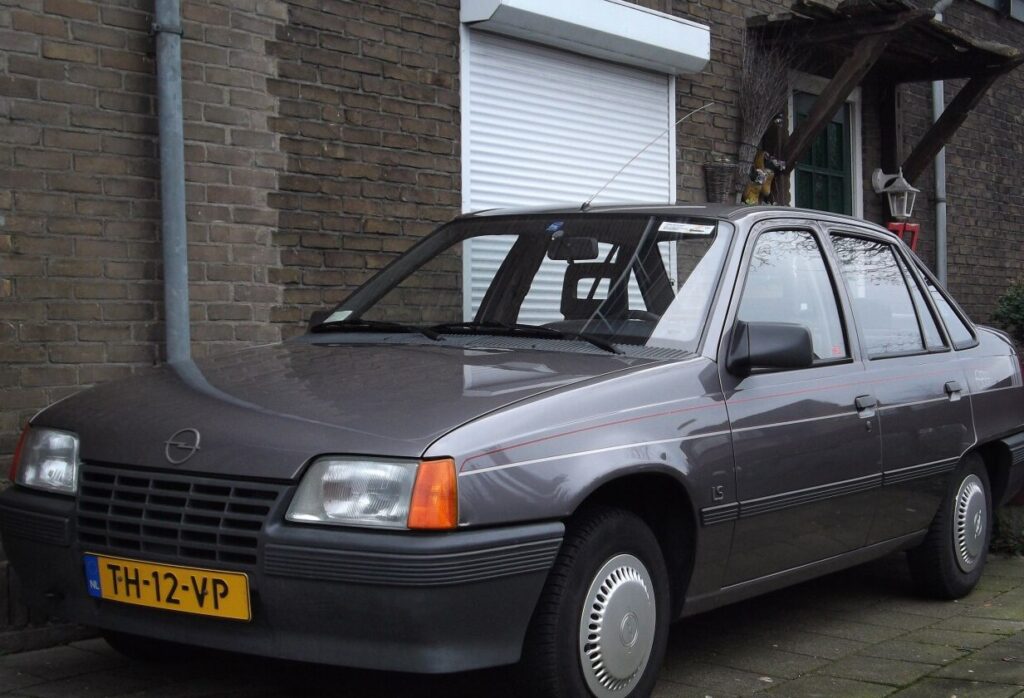
The Opel Kadett E 1.2 S, produced between 1984 and 1986, represented the entry-level offering within the broader Kadett E range. Positioned as an affordable and economical family sedan, it served as a crucial model for Opel in the European market, particularly in Germany. The Kadett E, built on the GM T-platform (internally known as the 1HX0/A3 platform), aimed to modernize Opel’s compact car lineup and compete with rivals like the Volkswagen Golf and Ford Escort. The 1.2 S variant, with its modest 54 horsepower, was designed for buyers prioritizing fuel efficiency and low running costs over outright performance.
Technical Specifications
| Brand | Opel |
| Model | Kadett |
| Generation | Kadett E |
| Type (Engine) | 1.2 S (54 Hp) |
| Start of production | 1984 |
| End of production | 1986 |
| Powertrain Architecture | Internal Combustion engine |
| Body type | Sedan |
| Seats | 5 |
| Doors | 4 |
| Fuel consumption (combined) | 6.7 l/100 km |
| Fuel consumption (US mpg) | 35.1 |
| Fuel consumption (UK mpg) | 42.2 |
| Fuel consumption (km/l) | 14.9 |
| Fuel Type | Petrol (Gasoline) |
| Acceleration 0 – 100 km/h | 17 sec |
| Acceleration 0 – 62 mph | 17 sec |
| Acceleration 0 – 60 mph | 16.2 sec |
| Maximum speed | 155 km/h (96.31 mph) |
| Weight-to-power ratio | 16.1 kg/Hp |
| Weight-to-torque ratio | 10.3 kg/Nm |
| Power | 54 Hp @ 5600 rpm |
| Power per litre | 45.2 Hp/l |
| Torque | 84 Nm @ 3600 rpm (61.96 lb.-ft. @ 3600 rpm) |
| Engine layout | Front, Transverse |
| Engine Model/Code | 12SC, 12ST |
| Engine displacement | 1196 cm3 (72.98 cu. in.) |
| Number of cylinders | 4 |
| Engine configuration | Inline |
| Cylinder Bore | 79 mm (3.11 in.) |
| Piston Stroke | 61 mm (2.4 in.) |
| Compression ratio | 7.8:1 |
| Number of valves per cylinder | 2 |
| Fuel injection system | Carburettor |
| Engine aspiration | Naturally aspirated |
| Engine oil capacity | 2.75 l (2.91 US qt | 2.42 UK qt) |
| Coolant capacity | 5.7 l (6.02 US qt | 5.02 UK qt) |
| Kerb Weight | 868 kg (1913.61 lbs.) |
| Max. weight | 1365 kg (3009.31 lbs.) |
| Max load | 497 kg (1095.7 lbs.) |
| Trunk (boot) space – minimum | 550 l (19.42 cu. ft.) |
| Trunk (boot) space – maximum | 890 l (31.43 cu. ft.) |
| Fuel tank capacity | 52 l (13.74 US gal | 11.44 UK gal) |
| Length | 4218 mm (166.06 in.) |
| Width | 1658 mm (65.28 in.) |
| Height | 1400 mm (55.12 in.) |
| Wheelbase | 2520 mm (99.21 in.) |
| Front track | 1400 mm (55.12 in.) |
| Rear track | 1406 mm (55.35 in.) |
| Minimum turning circle | 10.5 m (34.45 ft.) |
| Drivetrain | Front wheel drive |
| Number of gears | 5 |
| Gearbox type | Manual transmission |
| Front brakes | Disc |
| Rear brakes | Drum |
Powertrain & Engine Architecture
The Kadett E 1.2 S was powered by the 12SC or 12ST engine, a 1.2-liter (1196 cc) inline-four cylinder engine. This engine featured a relatively simple design, utilizing a single overhead camshaft (SOHC) and two valves per cylinder. Fuel delivery was managed by a single carburetor, a common feature for entry-level cars of the era, prioritizing cost-effectiveness over sophisticated fuel injection. The engine produced 54 horsepower at 5600 rpm and 84 Nm (62 lb-ft) of torque at 3600 rpm. The engine’s design emphasized durability and ease of maintenance, rather than high performance. The transmission was a standard five-speed manual gearbox, chosen to maximize fuel economy and provide adequate control for the engine’s power output.
Driving Characteristics
The driving experience in the Kadett E 1.2 S was characterized by its modest performance. Acceleration was slow, taking approximately 17 seconds to reach 62 mph (100 km/h). The engine felt strained at higher speeds, and overtaking required careful planning. The five-speed manual transmission helped to keep the engine within its optimal power band, but the overall experience was geared towards economical motoring rather than spirited driving. Compared to the more powerful Kadett E variants, such as the 1.6 or the later GSi models, the 1.2 S felt significantly underpowered. However, its lighter weight and simpler mechanicals contributed to a nimble feel in city driving.
Equipment & Trim Levels
The 1.2 S trim level was the base model in the Kadett E lineup. Standard equipment was relatively basic, including cloth upholstery, vinyl floor covering, and simple steel wheels with hubcaps. The dashboard featured a straightforward layout with basic instrumentation. Optional extras included a radio, upgraded upholstery, and a sunroof. The interior was designed for practicality and durability, with a focus on providing comfortable seating for five passengers. The exterior styling was functional, with minimal chrome trim and a focus on aerodynamic efficiency.
Chassis & Braking
The Kadett E 1.2 S utilized a MacPherson strut front suspension and a torsion beam rear suspension. This setup provided a reasonable balance between ride comfort and handling. The front brakes were disc brakes, while the rear brakes were drum brakes – a cost-saving measure common in entry-level models. The steering was a rack-and-pinion system, providing adequate precision for everyday driving. The suspension was tuned for comfort, resulting in a relatively soft ride quality. Stabilizer bars were typically omitted on the base 1.2 S model to further reduce costs.
Market Reception & Comparison
The Kadett E 1.2 S was generally well-received as an affordable and reliable family car. Critics praised its fuel efficiency and low running costs, but noted its lack of performance. Compared to other Kadett E variants, the 1.2 S offered the lowest price point, making it accessible to a wider range of buyers. The 1.6-liter Kadett E offered significantly more power and performance, but at a higher price. The 1.3-liter diesel version provided even better fuel economy, but with considerably less power. The 1.2 S appealed to buyers who prioritized economy and practicality over driving excitement.
Legacy
The Opel Kadett E 1.2 S, while not a performance icon, remains a popular choice among classic car enthusiasts and those seeking an affordable and reliable vintage vehicle. The engine, while simple, is known for its durability and ease of maintenance. Parts availability is generally good, and the car’s straightforward design makes it relatively easy to repair. Today, the Kadett E 1.2 S represents a nostalgic reminder of a simpler era in automotive history, offering a glimpse into the affordable family cars that dominated European roads in the 1980s. Well-maintained examples are increasingly sought after by collectors and enthusiasts, and continue to provide a practical and enjoyable driving experience.