Technical Specifications
| Brand | Opel |
| Model | Kadett |
| Generation | Kadett E |
| Type (Engine) | 1.4i (60 Hp) |
| Start of production | 1990 |
| End of production | 1991 |
| Powertrain Architecture | Internal Combustion engine |
| Body type | Sedan |
| Seats | 5 |
| Doors | 4 |
| Fuel consumption (urban) | 8.6 l/100 km (27.4 US mpg, 32.8 UK mpg, 11.6 km/l) |
| Fuel consumption (extra urban) | 5.1 l/100 km (46.1 US mpg, 55.4 UK mpg, 19.6 km/l) |
| Fuel consumption (combined) | 6.5 l/100 km (36.2 US mpg, 43.5 UK mpg, 15.4 km/l) |
| Fuel Type | Petrol (Gasoline) |
| Acceleration 0 – 100 km/h | 15 sec |
| Acceleration 0 – 62 mph | 15 sec |
| Acceleration 0 – 60 mph | 14.3 sec |
| Maximum speed | 160 km/h (99.42 mph) |
| Weight-to-power ratio | 14.6 kg/Hp, 68.6 Hp/tonne |
| Weight-to-torque ratio | 8.5 kg/Nm, 117.7 Nm/tonne |
| Power | 60 Hp @ 5600 rpm |
| Power per litre | 43.2 Hp/l |
| Torque | 103 Nm (75.97 lb.-ft.) |
| Engine layout | Front, Transverse |
| Engine Model/Code | C14NZ |
| Engine displacement | 1389 cm3 (84.76 cu. in.) |
| Number of cylinders | 4 |
| Engine configuration | Inline |
| Cylinder Bore | 77.6 mm (3.06 in.) |
| Piston Stroke | 73.4 mm (2.89 in.) |
| Compression ratio | 9.4:1 |
| Number of valves per cylinder | 2 |
| Fuel injection system | Multi-port manifold injection |
| Engine aspiration | Naturally aspirated engine |
| Valvetrain | SOHC |
| Engine oil capacity | 3 l (3.17 US qt | 2.64 UK qt) |
| Coolant | 6.2 l (6.55 US qt | 5.46 UK qt) |
| Kerb Weight | 875 kg (1929.04 lbs.) |
| Max. weight | 1380 kg (3042.38 lbs.) |
| Max load | 505 kg (1113.33 lbs.) |
| Trunk (boot) space – minimum | 550 l (19.42 cu. ft.) |
| Trunk (boot) space – maximum | 890 l (31.43 cu. ft.) |
| Fuel tank capacity | 52 l (13.74 US gal | 11.44 UK gal) |
| Length | 4218 mm (166.06 in.) |
| Width | 1658 mm (65.28 in.) |
| Height | 1400 mm (55.12 in.) |
| Wheelbase | 2520 mm (99.21 in.) |
| Front track | 1400 mm (55.12 in.) |
| Rear (Back) track | 1406 mm (55.35 in.) |
| Minimum turning circle | 15 m (49.21 ft.) |
| Drivetrain Architecture | The Internal combustion engine (ICE) drives the front wheels of the vehicle. |
| Drive wheel | Front wheel drive |
| Number of gears and type of gearbox | 5 gears, manual transmission |
| Front brakes | Ventilated discs |
| Rear brakes | Drum |
| Steering type | Steering rack and pinion |
| Tires size | 175/70 R13 |
| Wheel rims size | 13 |
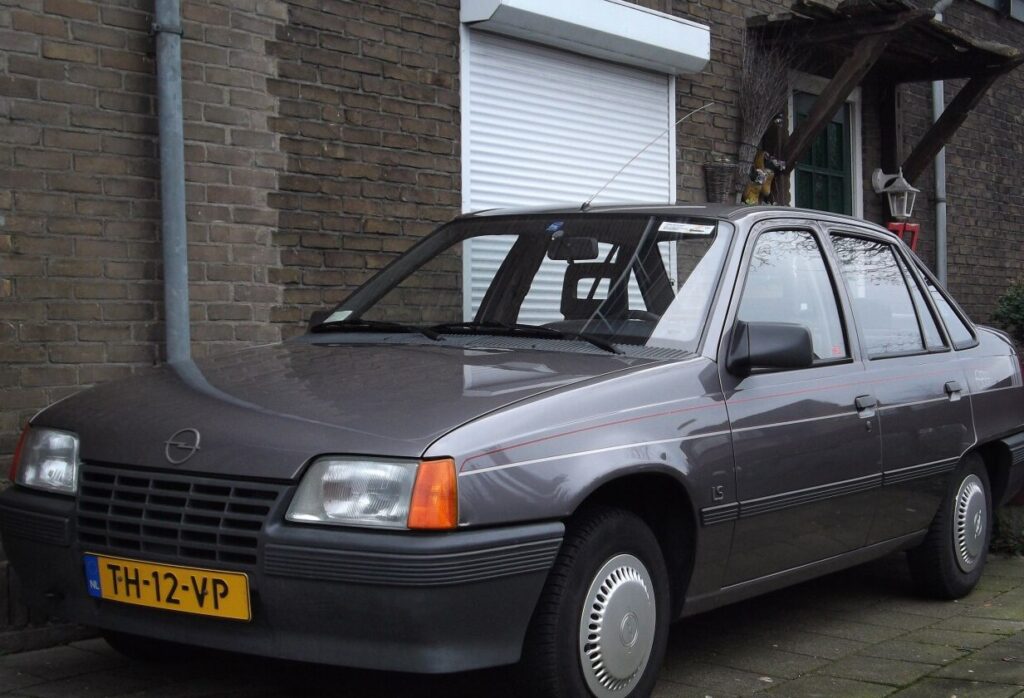
The Opel Kadett E 1.4i, produced from 1990 to 1991, served as the entry-level model within the Kadett E range. Built on the GM T-platform (internally designated 1HX0/A3), the Kadett E represented a substantial improvement over the preceding Kadett D in terms of design, build quality, and available technology. This 1.4i variant was specifically targeted at buyers prioritizing affordability and practicality, making it a popular choice for first-time car owners and those needing a dependable daily commuter. It was primarily sold in European markets, offering a budget-friendly option in the competitive compact car segment.
Powertrain & Engine Architecture
The Kadett E 1.4i’s engine was the C14NZ, a 1.4-liter (1389 cc) inline-four cylinder gasoline engine. This engine employed a single overhead camshaft (SOHC) valvetrain with two valves per cylinder. A key upgrade from earlier Kadett models was the adoption of a multi-port fuel injection system, enhancing fuel efficiency and providing smoother engine operation. The C14NZ was valued for its inherent simplicity and robustness, although it wasn’t designed for high performance. It generated 60 horsepower at 5600 rpm and 76 lb-ft of torque. While a five-speed manual transmission was the standard pairing, a three-speed automatic transmission was offered as an option, though it was less frequently selected. The automatic transmission, while convenient, noticeably reduced acceleration and increased fuel consumption.
Driving Characteristics
The 1.4i Kadett E, especially when equipped with the manual transmission, provided a reasonably pleasant driving experience for its class. However, the modest 60 horsepower output resulted in unhurried acceleration. Reaching 60 mph took approximately 14.3 seconds, and the top speed was around 99 mph. The automatic transmission version further diminished performance, exhibiting slower acceleration and a less responsive feel. The manual transmission’s gear ratios were optimized to extract the most from the engine’s limited power, providing adequate acceleration for typical driving scenarios. The Kadett E’s suspension, while basic, delivered a comfortable ride, effectively absorbing road imperfections. Steering was light and precise, making it easy to maneuver in city traffic.
Equipment & Trim Levels
The Kadett E 1.4i generally came with a fairly basic standard equipment list. Typical features included cloth upholstery, a straightforward dashboard layout, and manual windows and door locks. Power steering was often an optional extra. Higher trim levels, such as the “Formel” or “City,” added enhancements like upgraded interior trim, a more sophisticated stereo system, and occasionally features like central locking. The 1.4i was positioned as the base model, and buyers desiring more luxury or performance typically opted for the 1.6-liter or 2.0-liter Kadett E variants.
Chassis & Braking
The Kadett E utilized a front-wheel-drive layout with a MacPherson strut front suspension and a twist-beam rear suspension. 1.4i models typically featured ventilated disc brakes on the front wheels and drum brakes on the rear. The braking system was adequate for the car’s weight and performance, but lacked the stopping power of the larger-engined Kadett E models equipped with rear disc brakes. Stabilizer bars were often offered as optional equipment, and their inclusion significantly improved handling and reduced body roll.
Market Reception & Comparison
The Kadett E 1.4i was generally well-received as an affordable and practical family car. Reviewers praised its fuel efficiency and reliability, but acknowledged its lack of significant performance. Compared to the more powerful 1.6-liter and 2.0-liter Kadett E models, the 1.4i offered considerably less power and acceleration. However, it was more economical to operate and maintain. The 1.4i also competed with other small family cars of the era, such as the Ford Escort, Volkswagen Golf, and Peugeot 205. In terms of fuel economy, the 1.4i Kadett E was competitive with its rivals, achieving around 36 mpg on the combined cycle.
Legacy
The Opel Kadett E 1.4i, while not the most performance-oriented version of the Kadett E, remains a popular choice among classic car enthusiasts and those seeking a reliable and affordable vintage vehicle. The C14NZ engine is known for its durability, and many examples are still in service today. However, sourcing parts can sometimes be challenging, and rust can be a concern, particularly in vehicles that haven’t been properly maintained. The Kadett E 1.4i represents a noteworthy milestone in Opel’s history, signifying a period of improved quality and technology. It continues to be appreciated for its simplicity, practicality, and affordability.