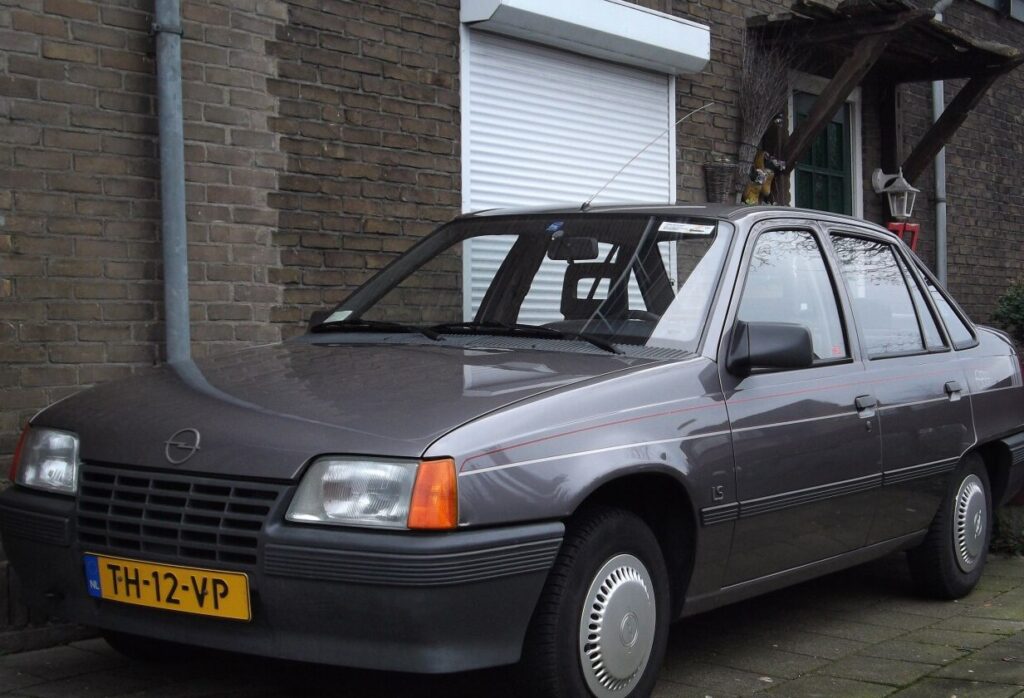
The Opel Kadett E 1.6 D, producing 55 horsepower, was a mainstay of the Kadett E range from 1984 to 1989. Positioned as the entry-level diesel variant, it offered economical transportation for a broad segment of the European market. The Kadett E, built on the GM T-platform (internally designated as the 1HX0/A3), represented a significant step forward for Opel in terms of design, build quality, and technology. This particular diesel model aimed to provide fuel efficiency and durability, appealing to buyers prioritizing practicality over outright performance. While not a performance leader, the 1.6 D played a crucial role in establishing the Kadett E as one of Opel’s most successful models.
Technical Specifications
| Brand | Opel |
| Model | Kadett |
| Generation | Kadett E |
| Type (Engine) | 1.6 D (55 Hp) |
| Start of production | 1984 |
| End of production | 1989 |
| Powertrain Architecture | Internal Combustion engine |
| Body type | Sedan |
| Seats | 5 |
| Doors | 4 |
| Fuel Type | Diesel |
| Acceleration 0 – 100 km/h | 19 sec |
| Acceleration 0 – 62 mph | 19 sec |
| Acceleration 0 – 60 mph | 18.1 sec |
| Maximum speed | 150 km/h (93.21 mph) |
| Weight-to-power ratio | 17.4 kg/Hp, 57.6 Hp/tonne |
| Weight-to-torque ratio | 9.9 kg/Nm, 100.5 Nm/tonne |
| Power | 55 Hp @ 4600 rpm |
| Power per litre | 34.4 Hp/l |
| Torque | 96 Nm @ 2400 rpm (70.81 lb.-ft. @ 2400 rpm) |
| Engine layout | Front, Transverse |
| Engine Model/Code | 16D |
| Engine displacement | 1598 cm3 (97.52 cu. in.) |
| Number of cylinders | 4 |
| Engine configuration | Inline |
| Cylinder Bore | 80 mm (3.15 in.) |
| Piston Stroke | 79.5 mm (3.13 in.) |
| Compression ratio | 23:1 |
| Number of valves per cylinder | 2 |
| Engine aspiration | Naturally aspirated engine |
| Valvetrain | SOHC |
| Engine oil capacity | 5 l (5.28 US qt | 4.4 UK qt) |
| Coolant | 7.5 l (7.93 US qt | 6.6 UK qt) |
| Kerb Weight | 955 kg (2105.41 lbs.) |
| Max. weight | 1445 kg (3185.68 lbs.) |
| Max load | 490 kg (1080.27 lbs.) |
| Trunk (boot) space – minimum | 550 l (19.42 cu. ft.) |
| Trunk (boot) space – maximum | 890 l (31.43 cu. ft.) |
| Fuel tank capacity | 52 l (13.74 US gal | 11.44 UK gal) |
| Length | 4218 mm (166.06 in.) |
| Width | 1658 mm (65.28 in.) |
| Height | 1400 mm (55.12 in.) |
| Wheelbase | 2520 mm (99.21 in.) |
| Front track | 1406 mm (55.35 in.) |
| Rear (Back) track | 1406 mm (55.35 in.) |
| Minimum turning circle | 10.5 m (34.45 ft.) |
| Drivetrain Architecture | The Internal combustion engine (ICE) drives the front wheels of the vehicle. |
| Drive wheel | Front wheel drive |
| Number of gears | 4 gears, manual transmission |
| Front brakes | Disc |
| Rear brakes | Drum |
Powertrain & Engine Architecture
The heart of the Kadett E 1.6 D was the 16D engine, a naturally aspirated, inline-four cylinder diesel. This engine, a common sight in European Opels and Vauxhalls of the era, was known for its robustness and fuel efficiency, rather than its performance. It featured a single overhead camshaft (SOHC) valvetrain operating two valves per cylinder. The engine utilized a Bosch mechanical fuel injection system, a common setup for diesels of the time, providing reliable fuel delivery. The 16D’s relatively low compression ratio of 23:1 contributed to its durability, but also limited its power output. The engine was transversely mounted in the front of the vehicle, driving the front wheels. The four-speed manual transmission was the standard offering, chosen for its simplicity and cost-effectiveness.
Driving Characteristics
The Kadett E 1.6 D was not designed for spirited driving. With only 55 horsepower, acceleration was leisurely, taking approximately 19 seconds to reach 62 mph. The engine’s torque peak of 96 Nm (70.81 lb-ft) at 2400 rpm provided adequate pulling power for everyday driving, but overtaking required careful planning. The four-speed manual transmission had relatively widely spaced gear ratios, prioritizing fuel economy over rapid acceleration. Compared to the more powerful gasoline variants of the Kadett E, such as the 1.6 or 2.0-liter models, the 1.6 D felt significantly slower. However, compared to other diesel options available at the time, it offered a reasonable balance of performance and economy.
Equipment & Trim Levels
The 1.6 D Kadett E typically came with a basic level of equipment. Standard features included cloth upholstery, a simple dashboard layout, and manual windows and door locks. Power steering and central locking were generally not standard, but could be added as optional extras. The interior was functional and durable, designed to withstand the rigors of daily use. Higher trim levels, such as the ‘Formel’ or ‘City’, offered additional features like upgraded upholstery, a more comprehensive instrument cluster, and optional alloy wheels. However, the 1.6 D was generally positioned as the entry-level model, so these upgrades were less common.
Chassis & Braking
The Kadett E featured a MacPherson strut front suspension and a twist-beam rear suspension. This setup provided a comfortable ride, although handling was not particularly sporty. The 1.6 D models typically had drum brakes on the rear wheels and disc brakes on the front, a common configuration for vehicles in this price range. The braking system was adequate for normal driving conditions, but lacked the stopping power of more advanced systems found on higher-end vehicles. Stabilizer bars were often omitted on the base 1.6 D trim to keep costs down, further impacting handling performance.
Market Reception & Comparison
The Kadett E 1.6 D was well-received in the European market as an affordable and economical family car. Critics praised its fuel efficiency and durability, but noted its lack of performance. Compared to the gasoline-powered Kadett E models, the 1.6 D offered significantly better fuel economy, making it a popular choice for drivers covering long distances. However, the gasoline models provided a more engaging driving experience. The 1.6 D also competed with other diesel-powered compact cars, such as the Volkswagen Golf Diesel and the Ford Escort Diesel, offering a similar blend of practicality and economy.
Legacy
The Opel Kadett E 1.6 D, while not a particularly exciting vehicle, proved to be a reliable and durable workhorse. The 16D engine, despite its modest power output, was known for its longevity and relatively low maintenance costs. Today, the Kadett E 1.6 D is a relatively affordable classic car, appealing to enthusiasts looking for a simple and economical vintage vehicle. While finding well-maintained examples can be challenging, the Kadett E 1.6 D remains a testament to Opel’s commitment to providing practical and reliable transportation for the masses. Its enduring popularity in the used car market speaks to its inherent durability and the fond memories it evokes for many European drivers.