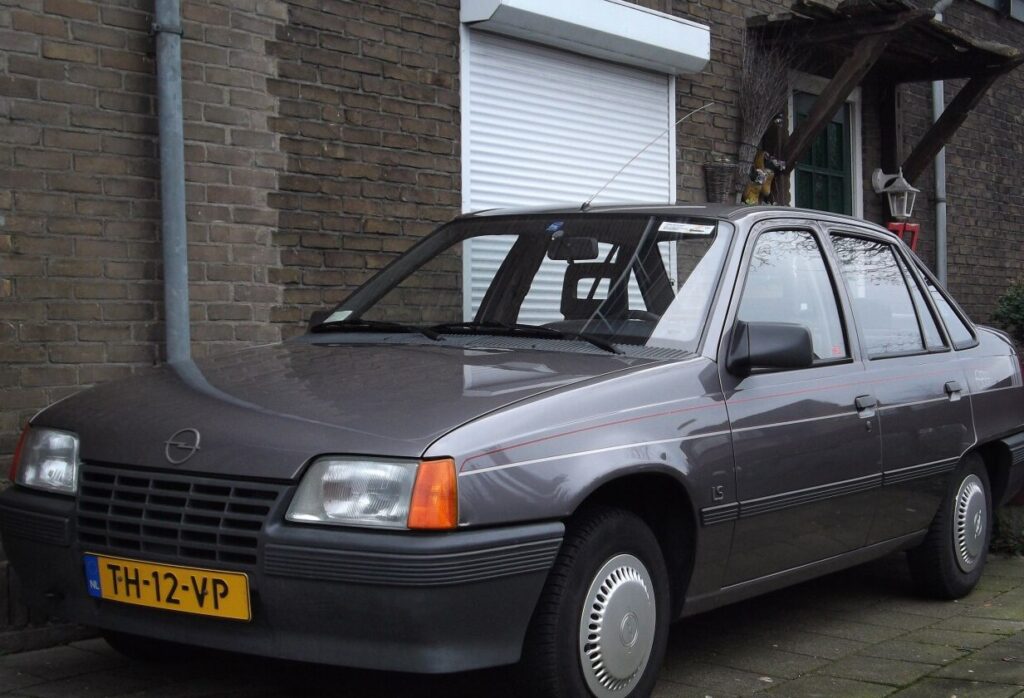
The Opel Kadett E 1.6i CAT, produced from 1986 to 1987, represented a significant step in the evolution of Opel’s popular compact car. Positioned as a mid-range offering within the Kadett E lineup – which spanned from the base 1.3L models to the more potent 1.6S and later, the GSI – the 1.6i CAT aimed to balance affordability with a reasonable level of performance and refinement. It was a key model for Opel during a period of increasing competition in the European small family car segment, built on the 1HX0/A3 platform shared with other General Motors products like the Vauxhall Astra. The “CAT” designation indicated the inclusion of a catalytic converter, reflecting growing environmental regulations in Europe at the time.
Technical Specifications
| Brand | Opel |
| Model | Kadett |
| Generation | Kadett E |
| Type (Engine) | 1.6i CAT (75 Hp) |
| Start of production | 1986 |
| End of production | 1987 |
| Powertrain Architecture | Internal Combustion engine |
| Body type | Sedan |
| Seats | 5 |
| Doors | 4 |
| Fuel consumption (urban) | 8.5 l/100 km (27.7 US mpg) |
| Fuel consumption (extra urban) | 5.6 l/100 km (42 US mpg) |
| Fuel consumption (combined) | 7.2 l/100 km (32.7 US mpg) |
| Fuel Type | Petrol (Gasoline) |
| Acceleration 0 – 100 km/h | 13 sec |
| Acceleration 0 – 62 mph | 13 sec |
| Acceleration 0 – 60 mph | 12.4 sec |
| Maximum speed | 170 km/h (105.63 mph) |
| Weight-to-power ratio | 12.3 kg/Hp |
| Weight-to-torque ratio | 7.6 kg/Nm |
| Power | 75 Hp @ 5200 rpm |
| Power per litre | 46.9 Hp/l |
| Torque | 121 Nm @ 3400 rpm (89.25 lb.-ft. @ 3400 rpm) |
| Engine layout | Front, Transverse |
| Engine Model/Code | C16LZ |
| Engine displacement | 1598 cm3 (97.52 cu. in.) |
| Number of cylinders | 4 |
| Engine configuration | Inline |
| Cylinder Bore | 80 mm (3.15 in.) |
| Piston Stroke | 79.5 mm (3.13 in.) |
| Compression ratio | 8.6:1 |
| Number of valves per cylinder | 2 |
| Fuel injection system | Multi-port manifold injection |
| Engine aspiration | Naturally aspirated engine |
| Valvetrain | SOHC |
| Engine oil capacity | 3.5 l (3.7 US qt | 3.08 UK qt) |
| Coolant capacity | 6.4 l (6.76 US qt | 5.63 UK qt) |
| Kerb Weight | 920 kg (2028.25 lbs.) |
| Max. weight | 1405 kg (3097.49 lbs.) |
| Max load | 485 kg (1069.24 lbs.) |
| Trunk (boot) space – minimum | 550 l (19.42 cu. ft.) |
| Trunk (boot) space – maximum | 890 l (31.43 cu. ft.) |
| Fuel tank capacity | 52 l (13.74 US gal | 11.44 UK gal) |
| Length | 4218 mm (166.06 in.) |
| Width | 1658 mm (65.28 in.) |
| Height | 1400 mm (55.12 in.) |
| Wheelbase | 2520 mm (99.21 in.) |
| Front track | 1406 mm (55.35 in.) |
| Rear track | 1406 mm (55.35 in.) |
| Minimum turning circle | 10.5 m (34.45 ft.) |
| Drivetrain Architecture | Front wheel drive |
| Number of gears | 5 |
| Gearbox type | Manual transmission |
| Front suspension | Independent type McPherson |
| Front brakes | Disc |
| Rear brakes | Drum |
| Steering type | Steering rack and pinion |
| Tires size | 175/65 R14; 175/70 R13 |
| Wheel rims size | 14; 13 |
INTRODUCTION
The Kadett E 1.6i CAT, launched in 1986 and continuing through 1987, was a crucial variant in the Kadett E range. Opel aimed to provide a balance between economy and performance with this model, targeting buyers who wanted more than the base engine offered but weren’t seeking the sportier characteristics of the 1.6S or the later GSI. The Kadett E itself was a significant redesign for Opel, moving towards more aerodynamic styling and offering improved interior space and comfort compared to its predecessor, the Kadett D. The 1.6i CAT benefitted from the inclusion of a catalytic converter, a feature increasingly demanded by European regulations and environmentally conscious consumers.
Powertrain & Engine Architecture
At the heart of the Kadett E 1.6i CAT lay the C16LZ engine, a 1.6-liter inline-four cylinder gasoline engine. This engine featured a single overhead camshaft (SOHC) valvetrain operating two valves per cylinder. The C16LZ utilized Bosch multi-port fuel injection, a significant advancement over earlier carbureted Opel engines, contributing to improved fuel efficiency and smoother power delivery. The catalytic converter, integral to the “CAT” designation, reduced harmful emissions. The engine produced 75 horsepower at 5200 rpm and 121 Nm (89.25 lb-ft) of torque at 3400 rpm. This power was delivered through a five-speed manual transmission, the standard configuration for this variant. While an automatic transmission was available on some Kadett E models, it wasn’t typically paired with the 1.6i CAT, making the manual the predominant choice.
Driving Characteristics
The Kadett E 1.6i CAT offered a reasonably sprightly driving experience for its time. Acceleration from 0 to 60 mph took around 12.4 seconds, and it had a top speed of 170 km/h (105.63 mph). Compared to the base 1.3L Kadett, the 1.6i CAT provided noticeably more power, making overtaking and hill climbing less of a struggle. However, it wasn’t as quick or engaging as the 1.6S, which featured a higher compression ratio and slightly more power. The five-speed manual transmission allowed drivers to keep the engine in its optimal power band, while the gear ratios were geared towards fuel efficiency rather than outright performance. The steering was light and precise, making it easy to maneuver in urban environments, but lacked the feedback desired by more enthusiastic drivers.
Equipment & Trim Levels
The 1.6i CAT typically came with a fairly basic level of equipment, reflecting its position as a mid-range model. Standard features included cloth upholstery, a basic instrument cluster, and manual windows and door locks. Power steering was often an optional extra, as was a sunroof. The interior was functional and durable, though not particularly luxurious. Optional extras could include upgraded audio systems and different wheel covers. The trim level was generally consistent across the 1.6i CAT models, with limited customization options available.
Chassis & Braking
The Kadett E 1.6i CAT utilized a McPherson strut independent suspension at the front, providing a comfortable ride and decent handling. The rear suspension employed a torsion beam setup, which was cost-effective but less sophisticated than a fully independent system. Braking was handled by disc brakes at the front and drum brakes at the rear. The braking system was adequate for everyday driving, but lacked the stopping power of more advanced setups. The Kadett E’s chassis was relatively lightweight, contributing to its fuel efficiency and agility.
Market Reception & Comparison
The Kadett E 1.6i CAT was generally well-received by automotive critics as a practical and reliable family car. It offered a good balance of performance, fuel economy, and affordability. Compared to the base 1.3L models, the 1.6i CAT was considered a worthwhile upgrade for those who needed more power. However, it faced competition from other popular small family cars, such as the Volkswagen Golf, Ford Escort, and Peugeot 205. The 1.6i CAT’s fuel economy was competitive for its time, averaging around 32.7 US mpg in combined driving. Reliability was generally good, although some owners reported issues with the fuel injection system and the catalytic converter.
Legacy
The Opel Kadett E 1.6i CAT remains a relatively common sight on European roads today, testament to its durability and reliability. The C16LZ engine is known for its robustness, and parts availability is generally good. While not a particularly sought-after model by collectors, the 1.6i CAT represents a solid and dependable example of 1980s automotive engineering. In the used car market, these Kadetts are typically affordable and offer a practical and economical mode of transportation. The 1.6i CAT’s legacy lies in its role as a dependable and accessible family car that helped establish the Kadett E as a popular choice in its segment.