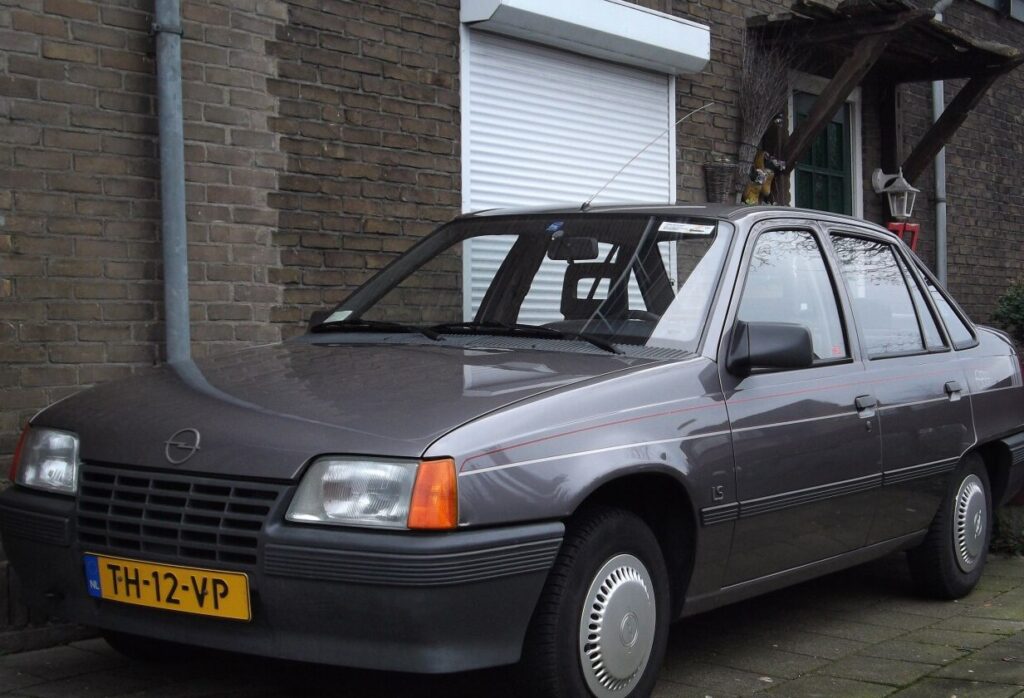
The Opel Kadett E 1.8i (90 hp) was a mainstay of the Kadett E range, produced between 1985 and 1991. Positioned as a mid-range offering, it bridged the gap between the more economical base models and the higher-performance variants. The Kadett E, built on the GM T-platform (internally known as the 1HX0/A3 platform), represented a significant leap forward for Opel in terms of design, technology, and build quality. This generation aimed to compete directly with rivals like the Volkswagen Golf and Ford Escort, and the 1.8i variant offered a balance of performance and affordability that appealed to a broad segment of the European car market.
Technical Specifications
| Brand | Opel |
| Model | Kadett |
| Generation | Kadett E |
| Type (Engine) | 1.8i (90 Hp) |
| Start of production | 1985 |
| End of production | 1991 |
| Powertrain Architecture | Internal Combustion engine |
| Body type | Sedan |
| Seats | 5 |
| Doors | 4 |
| Fuel Type | Petrol (Gasoline) |
| Acceleration 0 – 100 km/h | 11.5 sec |
| Acceleration 0 – 62 mph | 11.5 sec |
| Acceleration 0 – 60 mph | 10.9 sec |
| Maximum speed | 180 km/h (111.85 mph) |
| Weight-to-power ratio | 10.6 kg/Hp, 94.2 Hp/tonne |
| Weight-to-torque ratio | 6.6 kg/Nm, 151.8 Nm/tonne |
| Power | 90 Hp @ 5400 rpm |
| Power per litre | 50.1 Hp/l |
| Torque | 145 Nm @ 2800 rpm (106.95 lb.-ft. @ 2800 rpm) |
| Engine layout | Front, Transverse |
| Engine Model/Code | C18NT, C18NZ |
| Engine displacement | 1796 cm3 (109.6 cu. in.) |
| Number of cylinders | 4 |
| Engine configuration | Inline |
| Cylinder Bore | 84.8 mm (3.34 in.) |
| Piston Stroke | 79.5 mm (3.13 in.) |
| Compression ratio | 9.2:1 |
| Number of valves per cylinder | 2 |
| Fuel injection system | Multi-port manifold injection |
| Engine aspiration | Naturally aspirated engine |
| Engine oil capacity | 4 l (4.23 US qt | 3.52 UK qt) |
| Coolant | 6.5 l (6.87 US qt | 5.72 UK qt) |
| Kerb Weight | 955 kg (2105.41 lbs.) |
| Max. weight | 1435 kg (3163.63 lbs.) |
| Max load | 480 kg (1058.22 lbs.) |
| Trunk (boot) space – minimum | 550 l (19.42 cu. ft.) |
| Trunk (boot) space – maximum | 890 l (31.43 cu. ft.) |
| Fuel tank capacity | 52 l (13.74 US gal | 11.44 UK gal) |
| Length | 4218 mm (166.06 in.) |
| Width | 1658 mm (65.28 in.) |
| Height | 1400 mm (55.12 in.) |
| Wheelbase | 2520 mm (99.21 in.) |
| Front track | 1400 mm (55.12 in.) |
| Rear (Back) track | 1406 mm (55.35 in.) |
| Minimum turning circle | 10.5 m (34.45 ft.) |
Powertrain & Engine Architecture
The heart of the Kadett E 1.8i was the C18NT or C18NZ engine, an inline four-cylinder unit displacing 1796cc. These engines featured a cast iron block and an aluminum cylinder head, a common configuration for Opel at the time. Both engine codes were very similar, with the C18NT being slightly more common. The engine utilized a Bosch Motronic fuel injection system, a multi-port system that improved fuel efficiency and reduced emissions compared to earlier carbureted designs. The valvetrain employed a single overhead camshaft (SOHC) operating two valves per cylinder. The 1.8-liter engine produced 90 horsepower at 5400 rpm and 145 Nm (107 lb-ft) of torque at 2800 rpm. The Kadett E 1.8i was typically paired with a four-speed automatic transmission, although a five-speed manual was also available. The automatic transmission, while providing convenience, was not known for its sportiness and was geared towards comfortable cruising.
Driving Characteristics
The 1.8i automatic Kadett E offered a comfortable, if not particularly exhilarating, driving experience. Acceleration from 0-60 mph took around 10.9 seconds, making it competitive with other cars in its class, but noticeably slower than the manual transmission or the more powerful 2.0-liter versions. The automatic transmission’s gear ratios were optimized for fuel economy rather than performance, resulting in a somewhat sluggish response during overtaking maneuvers. However, the engine provided adequate power for everyday driving, and the smooth operation of the automatic transmission made it a popular choice for drivers prioritizing ease of use. The suspension, tuned for comfort, absorbed bumps well, but didn’t offer the sharp handling of sportier rivals.
Equipment & Trim Levels
The Kadett E 1.8i typically came equipped with features considered standard for the time, including power steering, central locking, and a basic stereo system. Interior upholstery was usually cloth, with options for upgraded materials available. Trim levels varied depending on the market, but generally included features like electric windows, a sunroof, and alloy wheels as optional extras. The dashboard layout was functional and straightforward, with clearly labeled controls. Higher trim levels often included features like a trip computer and upgraded sound systems.
Chassis & Braking
The Kadett E utilized a MacPherson strut front suspension and a torsion beam rear suspension. This setup provided a good balance of comfort and handling for a car in its class. Braking was typically accomplished with disc brakes on the front wheels and drum brakes on the rear. The braking system was adequate for normal driving conditions, but lacked the stopping power of more advanced systems found on higher-end vehicles. Stabilizer bars were fitted to both the front and rear axles to reduce body roll during cornering.
Market Reception & Comparison
The Kadett E 1.8i automatic was generally well-received by automotive critics as a practical and affordable family car. It was praised for its comfortable ride, spacious interior, and relatively low running costs. However, the automatic transmission was often criticized for its lack of responsiveness and its impact on fuel economy compared to the manual version. Compared to the 1.6-liter base models, the 1.8i offered a noticeable performance improvement. Against the more powerful 2.0-liter Kadett E, it represented a more economical option, albeit with a significant performance deficit. The Kadett E 1.8i competed directly with cars like the Volkswagen Golf, Ford Escort, and Fiat Escort, offering a compelling alternative in terms of value and practicality.
Legacy
The Opel Kadett E 1.8i, while not a performance icon, remains a popular choice among classic car enthusiasts and collectors. The C18NT and C18NZ engines are known for their reliability and relatively simple maintenance requirements. Parts availability is generally good, making it a relatively easy car to keep on the road. Today, well-maintained examples of the Kadett E 1.8i are increasingly sought after, representing a nostalgic reminder of a bygone era of automotive design and engineering. The automatic transmission, while not the most desirable configuration for driving enthusiasts, continues to offer a comfortable and convenient driving experience for those seeking a classic car with a relaxed demeanor.