Technical Specifications
| Brand | Opel |
| Model | Kadett |
| Generation | Kadett E |
| Type (Engine) | 2.0i (115 Hp) |
| Start of production | 1986 |
| End of production | 1989 |
| Powertrain Architecture | Internal Combustion engine |
| Body type | Sedan |
| Seats | 5 |
| Doors | 4 |
| Fuel Type | Petrol (Gasoline) |
| Acceleration 0 – 100 km/h | 9 sec |
| Acceleration 0 – 62 mph | 9 sec |
| Acceleration 0 – 60 mph | 8.6 sec |
| Maximum speed | 195 km/h (121.17 mph) |
| Weight-to-power ratio | 8.6 kg/Hp, 116.8 Hp/tonne |
| Weight-to-torque ratio | 5.8 kg/Nm, 172.6 Nm/tonne |
| Power | 115 Hp @ 5400 rpm |
| Power per litre | 57.6 Hp/l |
| Torque | 170 Nm @ 3000 rpm (125.39 lb.-ft. @ 3000 rpm) |
| Engine layout | Front, Transverse |
| Engine Model/Code | 20NE |
| Engine displacement | 1998 cm3 (121.93 cu. in.) |
| Number of cylinders | 4 |
| Engine configuration | Inline |
| Cylinder Bore | 86 mm (3.39 in.) |
| Piston Stroke | 86 mm (3.39 in.) |
| Compression ratio | 9.2:1 |
| Number of valves per cylinder | 2 |
| Fuel injection system | Multi-port manifold injection |
| Engine aspiration | Naturally aspirated engine |
| Valvetrain | SOHC |
| Engine oil capacity | 4 l (4.23 US qt | 3.52 UK qt) |
| Coolant | 6.9 l (7.29 US qt | 6.07 UK qt) |
| Kerb Weight | 985 kg (2171.55 lbs.) |
| Max. weight | 1450 kg (3196.7 lbs.) |
| Max load | 465 kg (1025.15 lbs.) |
| Trunk (boot) space – minimum | 550 l (19.42 cu. ft.) |
| Trunk (boot) space – maximum | 890 l (31.43 cu. ft.) |
| Fuel tank capacity | 52 l (13.74 US gal | 11.44 UK gal) |
| Length | 4218 mm (166.06 in.) |
| Width | 1658 mm (65.28 in.) |
| Height | 1400 mm (55.12 in.) |
| Wheelbase | 2520 mm (99.21 in.) |
| Front track | 1400 mm (55.12 in.) |
| Rear (Back) track | 1406 mm (55.35 in.) |
| Minimum turning circle | 10.5 m (34.45 ft.) |
| Drivetrain Architecture | The Internal combustion engine (ICE) drives the front wheels of the vehicle. |
| Drive wheel | Front wheel drive |
| Number of gears and type of gearbox | 5 gears, manual transmission |
| Front brakes | Ventilated discs |
| Rear brakes | Drum |
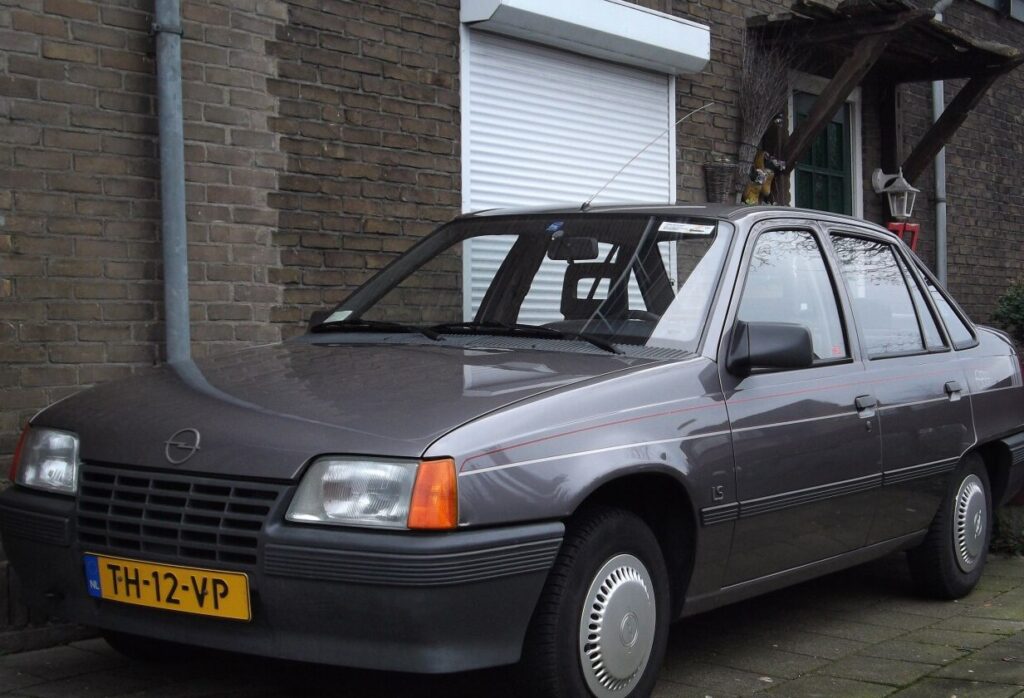
The Opel Kadett E 2.0i, produced between 1986 and 1989, represented a notable step up in performance and refinement within the Kadett E range. Positioned as a mid-range offering, it bridged the gap between the more economical base models and the sportier, often GSi-designated trims. The Kadett E itself was a crucial model for Opel (and its Vauxhall counterpart in the UK), serving as the company’s entry-level offering in the competitive European compact car segment. It was built on the GM T-platform, known internally as the 1HX0/A3 platform, and shared many components with other GM vehicles of the era, including the Astra. The 2.0i variant aimed to provide a balance of respectable power and everyday usability, appealing to buyers who desired a more engaging driving experience without sacrificing practicality.
Powertrain & Engine Architecture
The heart of the Kadett E 2.0i was the 20NE engine, a 1998cc inline-four cylinder unit. This engine was a naturally aspirated design featuring a single overhead camshaft (SOHC) valvetrain operating two valves per cylinder. The 20NE utilized Bosch multi-port fuel injection, a significant advancement over earlier carbureted Opel engines, contributing to improved fuel efficiency and smoother power delivery. The engine’s 9.2:1 compression ratio was a compromise between performance and the fuel quality available in European markets. Crucially, the 2.0i was exclusively offered with a five-speed manual transmission, providing drivers with full control over the engine’s power band. This transmission was known for its relatively light and precise shift action, a characteristic appreciated by enthusiasts.
Driving Characteristics
The 115 horsepower and 170 Nm (125 lb-ft) of torque provided by the 2.0i engine delivered a noticeable improvement in performance compared to the smaller-displacement Kadett E models. Acceleration from 0 to 60 mph took approximately 8.6 seconds, and the car could reach a top speed of around 121 mph. While not a sports car, the 2.0i offered a responsive and enjoyable driving experience. The five-speed manual transmission allowed drivers to keep the engine in its optimal power range, providing good acceleration in most situations. The gear ratios were well-matched for both city driving and highway cruising. Compared to the later, more powerful GSi versions, the 2.0i felt less urgent, but it offered a more relaxed and fuel-efficient driving experience. The GSi’s larger engine and sport-tuned suspension provided a more aggressive feel, but at the expense of everyday comfort and fuel economy.
Equipment & Trim Levels
The Kadett E 2.0i typically came equipped with a reasonable level of standard features for its time. This included cloth upholstery, a basic stereo system, and manual windows and door locks. Power steering was often an optional extra, as was air conditioning. The interior design was functional and straightforward, prioritizing practicality over luxury. The dashboard layout was typical of European cars of the 1980s, with clearly marked gauges and easy-to-reach controls. Optional extras could include upgraded stereo systems, alloy wheels, and a sunroof. The 2.0i trim generally sat above the base models in terms of equipment, but below the more comprehensively equipped GSi variants. The GSi often included features like electric windows, central locking, and a more sophisticated interior trim.
Chassis & Braking
The Kadett E utilized a MacPherson strut front suspension and a torsion beam rear suspension. This setup provided a good balance of ride comfort and handling. The front suspension featured an anti-roll bar, helping to reduce body roll during cornering. Braking duties were handled by ventilated disc brakes at the front and drum brakes at the rear. While adequate for everyday driving, the rear drum brakes were a point of criticism compared to the all-disc setups found on some of the higher-performance Kadett E models, particularly the GSi. The steering was rack-and-pinion, providing precise and responsive steering feel. The suspension tuning was geared towards comfort, making it a pleasant car for long journeys.
Market Reception & Comparison
The Kadett E 2.0i was generally well-received by automotive critics as a competent and practical family car. It was praised for its comfortable ride, decent performance, and relatively low running costs. However, some critics noted that the interior was somewhat basic and lacked the refinement of some of its rivals. Compared to other 2.0-liter compact cars of the era, such as the Volkswagen Golf and Ford Escort, the Kadett E 2.0i offered a competitive level of performance and fuel economy. The 2.0i provided a good compromise between the more economical 1.3 and 1.6-liter models and the sportier GSi variants. The GSi, with its larger engine and upgraded suspension, offered significantly more performance but at a higher price point and with increased running costs. The Kadett E 2.0i appealed to buyers who wanted a bit more pep without the added expense of the GSi.
Legacy
The Opel Kadett E 2.0i, while not a particularly rare or collectible model today, remains a popular choice among classic car enthusiasts. The 20NE engine is known for its reliability and durability, provided it is properly maintained. Parts availability is generally good, as many components were shared with other GM vehicles. The Kadett E 2.0i represents a significant milestone in Opel’s history, marking a period of modernization and improvement in build quality. In the used car market, well-maintained examples of the 2.0i can still provide a comfortable and enjoyable driving experience, offering a nostalgic glimpse into the automotive landscape of the late 1980s. Finding a rust-free example is often the biggest challenge for potential buyers today, as age and exposure to the elements have taken their toll on many examples.