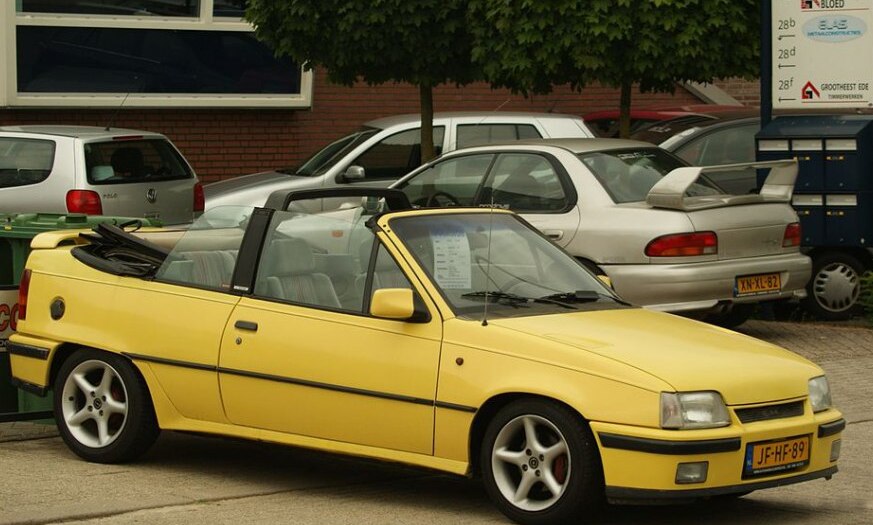
The Opel Kadett E Cabrio 1.3 S, produced between 1987 and 1993, represented an affordable entry point into the world of open-top motoring for European buyers. Positioned as the base-level engine and transmission option for the Cabriolet variant of the Kadett E, it offered a balance of practicality and style. The Kadett E itself was a significant model for Opel, representing a move towards more modern design and engineering compared to its predecessor, the Kadett D. The Cabriolet, introduced later in the E’s lifecycle, aimed to capitalize on the growing popularity of convertibles, particularly amongst younger drivers. This specific 1.3 S trim served as the most accessible version, appealing to those seeking a stylish and economical vehicle.
Technical Specifications
| Brand | Opel |
| Model | Kadett |
| Generation | Kadett E Cabrio |
| Type (Engine) | 1.3 S (75 Hp) |
| Start of production | 1987 |
| End of production | 1993 |
| Powertrain Architecture | Internal Combustion engine |
| Body type | Cabriolet |
| Seats | 5 |
| Doors | 2 |
| Fuel Type | Petrol (Gasoline) |
| Weight-to-power ratio | 12.4 kg/Hp, 80.6 Hp/tonne |
| Weight-to-torque ratio | 9.2 kg/Nm, 108.6 Nm/tonne |
| Power | 75 Hp @ 5800 rpm |
| Power per litre | 57.8 Hp/l |
| Torque | 101 Nm @ 4200 rpm (74.49 lb.-ft. @ 4200 rpm) |
| Engine layout | Front, Transverse |
| Engine Model/Code | 13S, 13SC |
| Engine displacement | 1297 cm3 (79.15 cu. in.) |
| Number of cylinders | 4 |
| Engine configuration | Inline |
| Cylinder Bore | 75 mm (2.95 in.) |
| Piston Stroke | 73.4 mm (2.89 in.) |
| Compression ratio | 9.2:1 |
| Number of valves per cylinder | 2 |
| Fuel injection system | Carburettor |
| Engine aspiration | Naturally aspirated engine |
| Valvetrain | SOHC |
| Engine oil capacity | 3 l (3.17 US qt | 2.64 UK qt) |
| Coolant | 7 l (7.4 US qt | 6.16 UK qt) |
| Kerb Weight | 930 kg (2050.3 lbs) |
| Max. weight | 1365 kg (3009.31 lbs) |
| Max load | 435 kg (959.01 lbs) |
| Trunk (boot) space – minimum | 290 l (10.24 cu. ft.) |
| Trunk (boot) space – maximum | 620 l (21.9 cu. ft.) |
| Fuel tank capacity | 52 l (13.74 US gal | 11.44 UK gal) |
| Length | 3998 mm (157.4 in.) |
| Width | 1663 mm (65.47 in.) |
| Height | 1385 mm (54.53 in.) |
| Wheelbase | 2520 mm (99.21 in.) |
| Front track | 1400 mm (55.12 in.) |
| Rear (Back) track | 1406 mm (55.35 in.) |
| Minimum turning circle (turning diameter) | 10.5 m (34.45 ft.) |
| Drivetrain Architecture | The Internal combustion engine (ICE) drives the front wheels of the vehicle. |
| Drive wheel | Front wheel drive |
| Number of gears and type of gearbox | 5 gears, manual transmission |
| Front brakes | Disc |
| Rear brakes | Drum |
| Tires size | 175/70 R13 |
| Wheel rims size | 13 |
Powertrain & Engine Architecture
The heart of the Kadett E Cabrio 1.3 S was the 13S or 13SC engine, a 1.3-liter inline-four cylinder unit. This engine, while not known for its outright performance, was valued for its reliability and fuel efficiency. It featured a single overhead camshaft (SOHC) valvetrain operating two valves per cylinder. Crucially, this engine utilized a carburetor for fuel delivery, a relatively simple and cost-effective system for the time, but less precise than fuel injection. The carburetor setup contributed to the engine’s ease of maintenance, but also limited its potential for power output and emissions control. The engine produced 75 horsepower at 5800 rpm and 101 Nm (74.49 lb-ft) of torque at 4200 rpm. The engine was transversely mounted, driving the front wheels. The standard transmission was a five-speed manual, although a three-speed automatic was available as an option, significantly impacting the driving experience.
Driving Characteristics
The 1.3 S engine, paired with the five-speed manual transmission, provided adequate, though not exhilarating, performance. Acceleration was modest, and overtaking required careful planning. The automatic transmission option, while offering convenience, further reduced performance, resulting in slower acceleration and a less engaging driving experience. The gear ratios were geared towards economy rather than outright speed. The car felt nimble enough due to its relatively light weight, but the engine lacked the punch of the larger 1.6 or 2.0-liter engines offered in other Kadett E models. The steering was light and responsive, making it easy to maneuver in urban environments.
Equipment & Trim Levels
The Kadett E Cabrio 1.3 S was generally equipped with basic, but functional, features. Standard equipment typically included cloth upholstery, a basic instrument cluster, and manual windows and door locks. Optional extras included power steering, upgraded audio systems, and different wheel trims. The interior was relatively spartan, reflecting the car’s position as an entry-level model. The convertible top was manually operated, adding to the sense of driver involvement. The trim level was designed to appeal to buyers prioritizing affordability and style over luxury.
Chassis & Braking
The Kadett E Cabriolet utilized a MacPherson strut front suspension and a torsion beam rear suspension. This setup provided a reasonable balance of ride comfort and handling. The front brakes were disc brakes, offering better stopping power than the drum brakes fitted to the rear wheels. The braking system was adequate for the car’s performance, but lacked the sophistication of more advanced systems found in higher-end vehicles. Stabilizer bars were fitted to both the front and rear axles to reduce body roll during cornering.
Market Reception & Comparison
The Kadett E Cabrio 1.3 S was generally well-received as an affordable and stylish convertible. Critics praised its value for money and its relatively low running costs. However, the engine’s lack of power was often cited as a drawback. Compared to the 1.6-liter and 2.0-liter Kadett E Cabriolet models, the 1.3 S offered significantly less performance. The 1.6-liter provided a noticeable improvement in acceleration and overall drivability, while the 2.0-liter offered a more sporty driving experience. The 1.3 S was also often compared to other small convertibles of the time, such as the Peugeot 205 Cabriolet and the Fiat Punto Cabriolet. In terms of fuel economy, the 1.3 S was generally competitive with its rivals.
Legacy
The Opel Kadett E Cabrio 1.3 S remains a popular choice among classic car enthusiasts, particularly those seeking an affordable and reliable entry into the world of classic convertibles. The 13S engine, while not particularly powerful, is known for its durability and ease of maintenance. Parts availability is generally good, although some specific trim pieces can be difficult to find. Today, these cars are often seen as a nostalgic reminder of a simpler era of motoring. The automatic transmission versions, while less desirable to driving enthusiasts, offer a more accessible option for those less comfortable with a manual gearbox. The Kadett E Cabrio 1.3 S represents a significant piece of Opel’s history and continues to be enjoyed by car enthusiasts around the world.