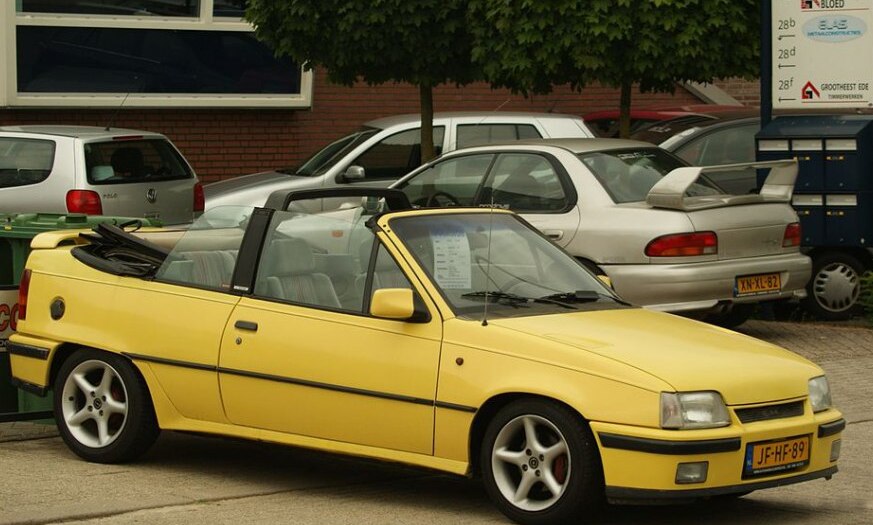
The Opel Kadett E Cabrio 1.6i (75 hp) Automatic, produced between 1986 and 1993, represented a more accessible entry point into the Kadett E Cabriolet range. Positioned as a comfortable and stylish open-top option, it catered to buyers prioritizing ease of use over outright performance. This variant was built upon the Kadett E platform (1HX0/A3), a significant step forward for Opel in terms of build quality and modern design. The 1.6i Automatic offered a blend of practicality and open-air enjoyment, making it a popular choice in European markets.
Technical Specifications
| Brand | Opel |
| Model | Kadett |
| Generation | Kadett E Cabrio |
| Type (Engine) | 1.6i (75 Hp) Automatic |
| Start of production | 1986 |
| End of production | 1993 |
| Powertrain Architecture | Internal Combustion engine |
| Body type | Cabriolet |
| Seats | 5 |
| Doors | 2 |
| Fuel Type | Petrol (Gasoline) |
| Maximum speed | 162 km/h (100.66 mph) |
| Weight-to-power ratio | 13.4 kg/Hp, 74.6 Hp/tonne |
| Weight-to-torque ratio | 8.1 kg/Nm, 123.4 Nm/tonne |
| Power | 75 Hp @ 5200 rpm |
| Power per litre | 46.9 Hp/l |
| Torque | 124 Nm @ 3400 rpm (91.46 lb.-ft. @ 3400 rpm) |
| Engine layout | Front, Transverse |
| Engine Model/Code | E16NZ, C16NZ |
| Engine displacement | 1598 cm3 (97.52 cu. in.) |
| Number of cylinders | 4 |
| Engine configuration | Inline |
| Cylinder Bore | 80 mm (3.15 in.) |
| Piston Stroke | 79.5 mm (3.13 in.) |
| Compression ratio | 9.2:1 |
| Number of valves per cylinder | 2 |
| Fuel injection system | Multi-port manifold injection |
| Engine aspiration | Naturally aspirated engine |
| Valvetrain | SOHC |
| Engine oil capacity | 3.5 l (3.7 US qt | 3.08 UK qt) |
| Coolant | 6.4 l (6.76 US qt | 5.63 UK qt) |
| Kerb Weight | 1005 kg (2215.65 lbs) |
| Max. weight | 1405 kg (3097.49 lbs) |
| Max load | 400 kg (881.85 lbs) |
| Trunk (boot) space – minimum | 290 l (10.24 cu. ft.) |
| Trunk (boot) space – maximum | 620 l (21.9 cu. ft.) |
| Fuel tank capacity | 52 l (13.74 US gal | 11.44 UK gal) |
| Length | 3998 mm (157.4 in.) |
| Width | 1663 mm (65.47 in.) |
| Height | 1385 mm (54.53 in.) |
| Wheelbase | 2520 mm (99.21 in.) |
| Front track | 1400 mm (55.12 in.) |
| Rear (Back) track | 1406 mm (55.35 in.) |
| Minimum turning circle | 10.5 m (34.45 ft.) |
| Drivetrain Architecture | The Internal combustion engine (ICE) drives the front wheels of the vehicle. |
| Drive wheel | Front wheel drive |
| Number of gears and type of gearbox | 3 gears, automatic transmission |
| Front brakes | Disc |
| Rear brakes | Drum |
| Tires size | 175/70 R13 |
| Wheel rims size | 13 |
Powertrain & Engine Architecture
The Kadett E Cabrio 1.6i Automatic was powered by the Opel E16NZ or C16NZ engine, a 1.6-liter inline-four cylinder unit. This engine featured a single overhead camshaft (SOHC) valvetrain and multi-port fuel injection. The E16NZ was generally found in later models, offering slightly improved emissions control. The engine produced 75 horsepower at 5200 rpm and 124 Nm (91.46 lb-ft) of torque at 3400 rpm. The automatic transmission was a three-speed unit, designed for smooth operation and ease of driving. While not a performance-oriented transmission, it suited the engine’s characteristics and the target audience’s needs. The engine’s relatively simple design contributed to its reliability, but also limited its potential for significant power gains.
Driving Characteristics
The 1.6i Automatic Kadett E Cabrio offered a relaxed driving experience. Acceleration was adequate for everyday driving, but it wasn’t particularly quick. The three-speed automatic transmission meant that gear changes were noticeable, and the engine could feel strained when climbing hills or overtaking. Compared to the five-speed manual versions, the automatic suffered a noticeable performance deficit. The gear ratios were optimized for fuel economy and comfort rather than outright speed. The front-wheel-drive configuration provided predictable handling, but the car wasn’t designed for aggressive cornering. The soft suspension, typical of convertibles, prioritized ride comfort over sharp handling.
Equipment & Trim Levels
The Kadett E Cabrio 1.6i Automatic typically came with a reasonable level of standard equipment. This included power steering, central locking, and a basic stereo system. Interior upholstery was usually cloth, with options for upgraded materials available. Dashboard configuration was relatively simple, with clearly laid-out controls. Optional extras included electric windows, a sunroof (in addition to the convertible top), and alloy wheels. The trim level often dictated the quality of the interior materials and the availability of certain features. The automatic transmission was often bundled with comfort-oriented options, making it a popular choice for buyers seeking a well-equipped and easy-to-drive convertible.
Chassis & Braking
The Kadett E Cabrio featured a MacPherson strut front suspension and a torsion beam rear suspension. The front brakes were disc brakes, providing adequate stopping power, while the rear brakes were drum brakes, a cost-saving measure common in this class of vehicle. The suspension was tuned for comfort, resulting in a relatively soft ride. Stabilizer bars were fitted to both the front and rear axles to reduce body roll during cornering. The chassis was reinforced to compensate for the lack of a fixed roof, providing adequate structural rigidity. The 13-inch wheels were fitted with 175/70 R13 tires, offering a balance of grip and ride comfort.
Market Reception & Comparison
The Kadett E Cabrio 1.6i Automatic received mixed reviews. Critics praised its comfortable ride and ease of use, but criticized its lack of performance. Compared to the more powerful 1.8 and 2.0-liter versions, the 1.6i Automatic was significantly slower. However, it offered better fuel economy and lower running costs. The 1.6i Automatic was also more affordable than its higher-powered siblings, making it an attractive option for budget-conscious buyers. Compared to other convertibles on the market at the time, the Kadett E Cabrio offered a good value proposition, combining style, comfort, and affordability.
Legacy
The Opel Kadett E Cabrio 1.6i Automatic has proven to be a relatively reliable vehicle, with many examples still on the road today. The engine is known for its durability, and the automatic transmission, while not particularly sophisticated, is generally dependable. However, like all classic cars, it requires regular maintenance to prevent corrosion and ensure proper operation. In the used car market, the 1.6i Automatic is often the most affordable Kadett E Cabrio variant. It appeals to buyers seeking a classic convertible experience without the high price tag of the more powerful models. Its simplicity and ease of maintenance make it a popular choice for enthusiasts and first-time classic car owners.