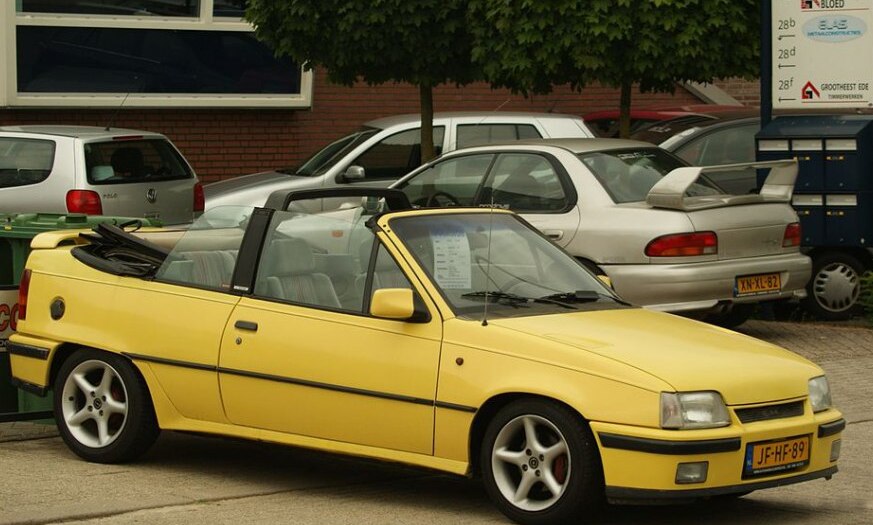
The Opel Kadett E Cabrio 1.6i CAT, produced between 1987 and 1993, represented the final iteration of the popular Kadett E series, and the last open-top Kadett offered by Opel. This variant, equipped with a 1.6-liter inline-four engine producing 75 horsepower, served as an accessible entry point into the Cabriolet market, offering open-air motoring at a relatively affordable price. It was positioned as the base model Cabriolet, below the more powerful 1.8 and 2.0-liter options. The Kadett E Cabrio, built on the T-platform, was a significant departure from previous Kadett generations, offering a more modern design and improved features.
Technical Specifications
| Brand | Opel |
| Model | Kadett |
| Generation | Kadett E Cabrio |
| Type (Engine) | 1.6i CAT (75 Hp) |
| Start of production | 1987 |
| End of production | 1993 |
| Powertrain Architecture | Internal Combustion engine |
| Body type | Cabriolet |
| Seats | 5 |
| Doors | 2 |
| Fuel Type | Petrol (Gasoline) |
| Acceleration 0 – 100 km/h | 13.5 sec |
| Acceleration 0 – 62 mph | 13.5 sec |
| Acceleration 0 – 60 mph | 12.8 sec |
| Maximum speed | 167 km/h (103.77 mph) |
| Weight-to-power ratio | 13.1 kg/Hp, 76.5 Hp/tonne |
| Weight-to-torque ratio | 7.9 kg/Nm, 126.5 Nm/tonne |
| Power | 75 Hp @ 5200 rpm |
| Power per litre | 46.9 Hp/l |
| Torque | 124 Nm @ 3400 rpm (91.46 lb.-ft. @ 3400 rpm) |
| Engine layout | Front, Transverse |
| Engine Model/Code | E16NZ, C16NZ |
| Engine displacement | 1598 cm3 (97.52 cu. in.) |
| Number of cylinders | 4 |
| Engine configuration | Inline |
| Cylinder Bore | 80 mm (3.15 in.) |
| Piston Stroke | 79.5 mm (3.13 in.) |
| Compression ratio | 9.2:1 |
| Number of valves per cylinder | 2 |
| Fuel injection system | Multi-port manifold injection |
| Engine aspiration | Naturally aspirated engine |
| Valvetrain | SOHC |
| Engine oil capacity | 3.5 l (3.7 US qt | 3.08 UK qt) |
| Coolant | 6.4 l (6.76 US qt | 5.63 UK qt) |
| Kerb Weight | 980 kg (2160.53 lbs) |
| Max. weight | 1405 kg (3097.49 lbs) |
| Max load | 425 kg (936.96 lbs) |
| Trunk (boot) space – minimum | 290 l (10.24 cu. ft.) |
| Trunk (boot) space – maximum | 620 l (21.9 cu. ft.) |
| Fuel tank capacity | 52 l (13.74 US gal | 11.44 UK gal) |
| Length | 3998 mm (157.4 in.) |
| Width | 1663 mm (65.47 in.) |
| Height | 1385 mm (54.53 in.) |
| Wheelbase | 2520 mm (99.21 in.) |
| Front track | 1400 mm (55.12 in.) |
| Rear (Back) track | 1406 mm (55.35 in.) |
| Minimum turning circle | 10.5 m (34.45 ft.) |
| Drivetrain Architecture | The Internal combustion engine (ICE) drives the front wheels of the vehicle. |
| Drive wheel | Front wheel drive |
| Number of gears | 5 gears, manual transmission |
| Front brakes | Disc |
| Rear brakes | Drum |
| Tires size | 175/70 R13 |
| Wheel rims size | 13 |
Powertrain & Engine Architecture
The heart of the Kadett E Cabrio 1.6i CAT is the E16NZ or C16NZ engine, a 1.6-liter inline-four cylinder unit. This engine featured a single overhead camshaft (SOHC) valvetrain operating two valves per cylinder. The “CAT” designation indicates the presence of a catalytic converter, a feature increasingly common in European vehicles during the late 1980s and early 1990s to meet stricter emissions regulations. Fuel delivery was handled by a multi-port fuel injection system, providing a more precise and efficient fuel mixture compared to earlier carbureted designs. The engine’s relatively modest output of 75 horsepower at 5200 rpm and 124 Nm (91.46 lb-ft) of torque at 3400 rpm was typical for this displacement and era. The engine was transversely mounted, driving the front wheels. The five-speed manual transmission was the standard offering, providing adequate gear ratios for everyday driving.
Driving Characteristics
The 1.6i CAT Cabriolet offered a comfortable, if not particularly sporty, driving experience. Acceleration was leisurely, taking around 13.5 seconds to reach 100 km/h (62 mph). The engine felt somewhat strained at higher speeds, and overtaking required careful planning. Compared to the 1.8 and 2.0-liter versions, the 1.6i lacked the punch for more spirited driving. However, the lower power output also contributed to better fuel economy. The five-speed manual transmission was well-matched to the engine’s characteristics, allowing drivers to keep the engine in its optimal power band. The steering was light and precise, making the car easy to maneuver in urban environments. The Cabriolet’s suspension provided a reasonably comfortable ride, although it wasn’t as refined as some of its competitors.
Equipment & Trim Levels
The Kadett E Cabrio 1.6i CAT was generally equipped with a basic level of features. Standard equipment typically included cloth upholstery, a basic stereo system, and manual windows and door locks. Power steering was often an optional extra. The interior design was functional and straightforward, reflecting the car’s affordable positioning. Optional extras included upgraded stereo systems, alloy wheels, and a more luxurious interior trim. The Cabriolet’s folding soft top was manually operated, and featured a glass rear window. The dashboard layout was typical of Opel vehicles of the period, with clearly labeled controls and a straightforward instrument cluster.
Chassis & Braking
The Kadett E Cabrio utilized a MacPherson strut front suspension and a torsion beam rear suspension. The front brakes were disc brakes, providing adequate stopping power, while the rear brakes were drum brakes, a cost-saving measure common in this class of vehicle. The suspension was tuned for comfort rather than outright handling performance. Stabilizer bars were fitted to both the front and rear axles to reduce body roll during cornering. The steering system was a rack-and-pinion setup, providing precise and responsive steering feel. The car’s relatively light weight (around 980 kg or 2160 lbs) helped to offset the engine’s modest power output.
Market Reception & Comparison
The Kadett E Cabrio 1.6i CAT was generally well-received by critics as an affordable and stylish open-top car. It offered a good value proposition for buyers seeking a fun and practical convertible. However, some reviewers criticized its lack of power and its relatively basic interior. Compared to the more powerful 1.8 and 2.0-liter versions, the 1.6i CAT offered better fuel economy but significantly less performance. It also provided a more accessible entry point into Cabriolet ownership. Competitors included the Volkswagen Golf Cabriolet, the Peugeot 205 Cabriolet, and the Ford Escort Cabriolet.
Legacy
The Opel Kadett E Cabrio 1.6i CAT remains a popular choice among classic car enthusiasts today. Its relatively simple mechanical design and readily available parts make it a relatively easy car to maintain. While not a high-performance machine, it offers a charming and enjoyable driving experience. The 1.6i CAT engine is generally considered to be reliable, although regular maintenance is essential. The Cabriolet’s soft top can be prone to wear and tear, and may require replacement over time. Today, well-maintained examples of the Kadett E Cabrio 1.6i CAT are becoming increasingly collectible, representing a nostalgic reminder of a bygone era of affordable open-top motoring.