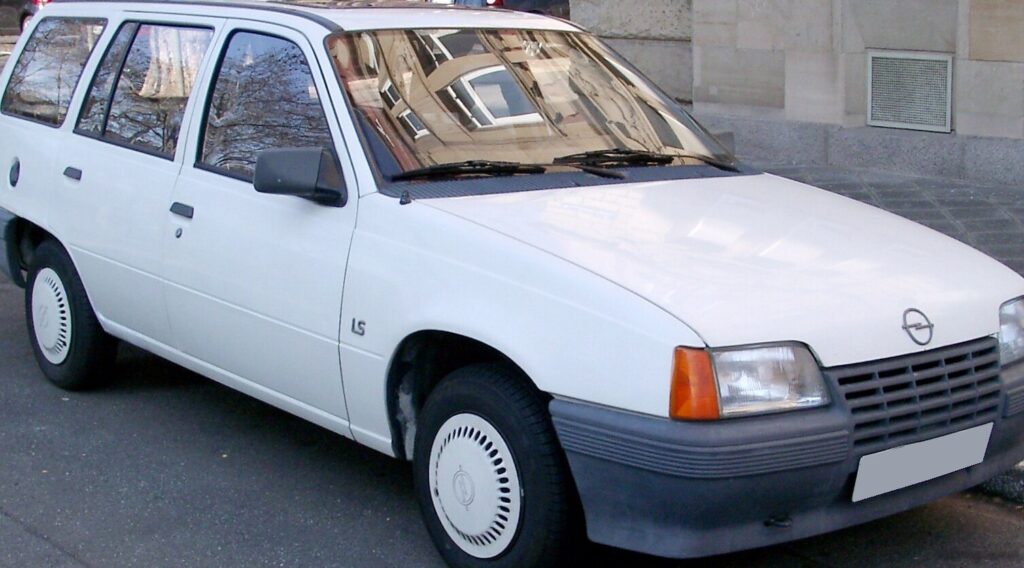
The Opel Kadett E Caravan 1.2, producing 55 horsepower, was a mainstay of the Kadett E range from 1984 to 1986. Positioned as the entry-level variant of the Caravan (estate) body style, it offered affordable family transportation within the broader Kadett E generation (1984-1993), which itself was based on the GM T-platform. This model aimed at buyers prioritizing economy and practicality over outright performance, serving as a workhorse for families and small businesses. While not known for its speed, the 1.2-liter Kadett Caravan provided a reliable and spacious option in a competitive segment.
Technical Specifications
| Brand | Opel |
| Model | Kadett |
| Generation | Kadett E Caravan |
| Type (Engine) | 1.2 (55 Hp) |
| Start of production | 1984 |
| End of production | 1986 |
| Powertrain Architecture | Internal Combustion engine |
| Body type | Station wagon (estate) |
| Seats | 5 |
| Doors | 3-5 |
| Fuel Type | Petrol (Gasoline) |
| Acceleration 0 – 100 km/h | 17.5 sec |
| Acceleration 0 – 62 mph | 17.5 sec |
| Acceleration 0 – 60 mph | 16.6 sec |
| Maximum speed | 150 km/h (93.21 mph) |
| Weight-to-power ratio | 16.2 kg/Hp, 61.8 Hp/tonne |
| Weight-to-torque ratio | 10.6 kg/Nm, 94.4 Nm/tonne |
| Power | 55 Hp @ 5600 rpm |
| Power per litre | 46 Hp/l |
| Torque | 84 Nm @ 3600 rpm (61.96 lb.-ft. @ 3600 rpm) |
| Engine layout | Front, Transverse |
| Engine Model/Code | 12SC, 12ST |
| Engine displacement | 1196 cm3 (72.98 cu. in.) |
| Number of cylinders | 4 |
| Engine configuration | Inline |
| Cylinder Bore | 79 mm (3.11 in.) |
| Piston Stroke | 61 mm (2.4 in.) |
| Compression ratio | 9:1 |
| Number of valves per cylinder | 2 |
| Fuel injection system | Carburettor |
| Engine aspiration | Naturally aspirated engine |
| Valvetrain | OHV |
| Engine oil capacity | 2.75 l (2.91 US qt | 2.42 UK qt) |
| Coolant | 5.7 l (6.02 US qt | 5.02 UK qt) |
| Kerb Weight | 890 kg (1962.11 lbs) |
| Max. weight | 1420 kg (3130.56 lbs) |
| Max load | 530 kg (1168.45 lbs) |
| Trunk (boot) space – minimum | 565 l (19.95 cu. ft.) |
| Trunk (boot) space – maximum | 1800 l (63.57 cu. ft.) |
| Fuel tank capacity | 50 l (13.21 US gal | 11 UK gal) |
| Length | 4228 mm (166.46 in.) |
| Width | 1666 mm (65.59 in.) |
| Height | 1430 mm (56.3 in.) |
| Wheelbase | 2520 mm (99.21 in.) |
| Front track | 1400 mm (55.12 in.) |
| Rear (Back) track | 1406 mm (55.35 in.) |
| Minimum turning circle | 10.5 m (34.45 ft.) |
| Drivetrain Architecture | The Internal combustion engine (ICE) drives the front wheels of the vehicle. |
| Drive wheel | Front wheel drive |
| Number of gears | 4 gears, manual transmission |
| Front brakes | Disc |
| Rear brakes | Drum |
Powertrain & Engine Architecture
The heart of the Kadett E Caravan 1.2 was the 1196cc inline-four cylinder engine, designated as either 12SC or 12ST depending on minor variations. This engine featured a relatively simple overhead valve (OHV) valvetrain with two valves per cylinder. Fuel delivery was handled by a single carburetor, a common setup for economy-focused vehicles of the era. The engine’s modest 55 horsepower at 5600 rpm and 62 lb-ft of torque at 3600 rpm were sufficient for everyday driving, but didn’t offer significant performance reserves. The engine was transversely mounted, driving the front wheels through a four-speed manual transmission. This configuration was typical for European compact cars of the time, maximizing interior space and improving front-wheel drive efficiency.
Driving Characteristics
The 1.2-liter Kadett Caravan was not a sporty vehicle. Acceleration was leisurely, taking around 17.5 seconds to reach 62 mph. The four-speed manual transmission was geared for economy, with relatively tall ratios. This meant that the engine needed to be revved to maintain speed, especially when carrying a load or climbing hills. Compared to the more powerful 1.6-liter or even the later 1.4-liter versions, the 1.2 felt noticeably underpowered. However, the light weight of the vehicle (around 1962 lbs) helped to mitigate some of the performance deficit. The steering was light and easy, making it maneuverable in urban environments, but lacked the precision of more performance-oriented models.
Equipment & Trim Levels
The 1.2-liter Kadett Caravan was typically offered with a basic level of equipment. Standard features included cloth upholstery, a simple dashboard layout, and manual windows and door locks. The interior was functional and durable, prioritizing practicality over luxury. Optional extras, such as a radio, upgraded upholstery, and a sunroof, were available, but were not commonly specified on the base model. The trim level was generally considered the entry point to the Kadett E Caravan range, appealing to buyers on a tight budget.
Chassis & Braking
The Kadett E Caravan featured a MacPherson strut front suspension and a twist-beam rear suspension. This setup provided a reasonable balance between ride comfort and handling. The front brakes were disc brakes, while the rear brakes were drum brakes – a cost-saving measure common on base models. The steering was a rack-and-pinion system, providing light and responsive steering. Stabilizer bars were often omitted on the base 1.2 model, further contributing to the softer ride quality.
Market Reception & Comparison
The Kadett E Caravan 1.2 was generally well-received as an affordable and practical family car. Critics acknowledged its fuel efficiency and spacious interior, but noted its lack of performance. Compared to the 1.6-liter versions, the 1.2 offered significantly lower running costs but at the expense of driving enjoyment. The 1.6-liter models were favored by those who needed more power for highway driving or carrying heavy loads. The 1.2’s reliability was generally good, although the carburetor required periodic maintenance. Fuel economy was a strong point, making it an attractive option for budget-conscious buyers.
Legacy
The Opel Kadett E Caravan 1.2, while not a performance icon, remains a fondly remembered vehicle for many European drivers. Its simplicity and reliability have made it a popular choice among classic car enthusiasts. Today, well-maintained examples are becoming increasingly rare, and are sought after by collectors. The 12SC/12ST engine, while not particularly powerful, is known for its durability and relatively straightforward maintenance. The Kadett E Caravan 1.2 represents a practical and affordable era of automotive design, offering a glimpse into the everyday transportation needs of families in the 1980s.