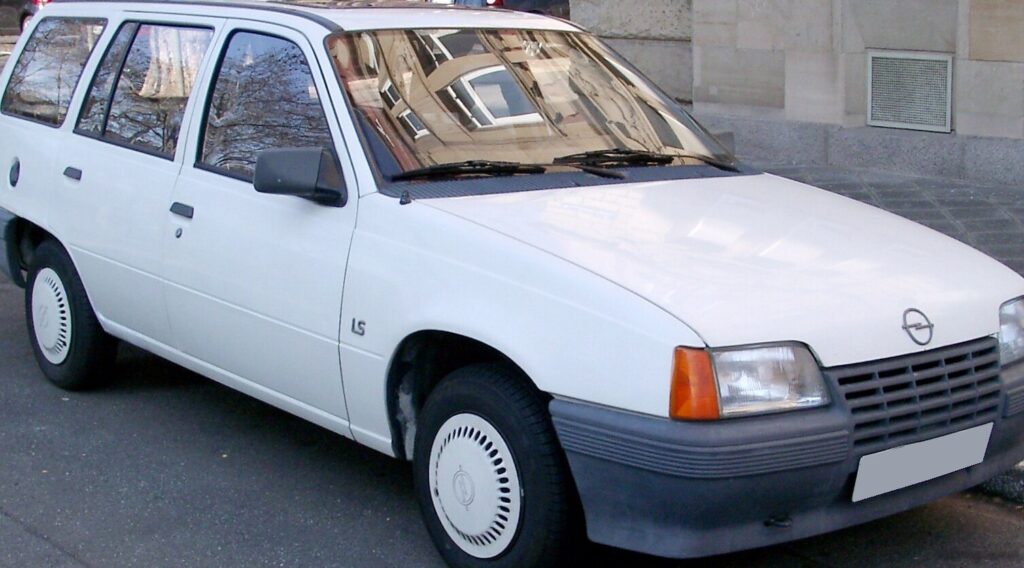
The Opel Kadett E Caravan 1.3 N, produced between 1984 and 1987, represented the entry-level offering within the broader Kadett E Caravan range. Positioned as an affordable and practical family vehicle, it served as a crucial model for Opel in the European market, particularly for buyers prioritizing economy and space. The Kadett E, launched in 1986 as a replacement for the Kadett D, was built on the GM T-platform (internally known as the 1HX0/A3 platform), shared with other models like the Vauxhall Astra and Isuzu Gemini. The Caravan body style, a station wagon or estate, added significant cargo capacity, making it a popular choice for families and those needing a versatile vehicle.
Technical Specifications
| Brand | Opel |
| Model | Kadett |
| Generation | Kadett E Caravan |
| Type (Engine) | 1.3 N (60 Hp) |
| Start of production | 1984 |
| End of production | 1987 |
| Powertrain Architecture | Internal Combustion engine |
| Body type | Station wagon (estate) |
| Seats | 5 |
| Doors | 3-5 |
| Fuel Type | Petrol (Gasoline) |
| Acceleration 0 – 100 km/h | 16 sec |
| Acceleration 0 – 62 mph | 16 sec |
| Acceleration 0 – 60 mph | 15.2 sec |
| Maximum speed | 155 km/h (96.31 mph) |
| Weight-to-power ratio | 15.1 kg/Hp, 66.3 Hp/tonne |
| Weight-to-torque ratio | 9.6 kg/Nm, 103.9 Nm/tonne |
| Power | 60 Hp @ 5800 rpm |
| Power per litre | 46.3 Hp/l |
| Torque | 94 Nm @ 3400-3800 rpm (69.33 lb.-ft. @ 3400-3800 rpm) |
| Engine layout | Front, Transverse |
| Engine Model/Code | 13N |
| Engine displacement | 1297 cm3 (79.15 cu. in.) |
| Number of cylinders | 4 |
| Engine configuration | Inline |
| Cylinder Bore | 75 mm (2.95 in.) |
| Piston Stroke | 73.4 mm (2.89 in.) |
| Compression ratio | 8.2:1 |
| Number of valves per cylinder | 2 |
| Fuel injection system | Carburettor |
| Engine aspiration | Naturally aspirated engine |
| Valvetrain | SOHC |
| Engine oil capacity | 3 l (3.17 US qt | 2.64 UK qt) |
| Coolant | 7 l (7.4 US qt | 6.16 UK qt) |
| Kerb Weight | 905 kg (1995.18 lbs) |
| Max. weight | 1420 kg (3130.56 lbs) |
| Max load | 515 kg (1135.38 lbs) |
| Trunk (boot) space – minimum | 565 l (19.95 cu. ft.) |
| Trunk (boot) space – maximum | 1800 l (63.57 cu. ft.) |
| Fuel tank capacity | 50 l (13.21 US gal | 11 UK gal) |
| Length | 4228 mm (166.46 in.) |
| Width | 1666 mm (65.59 in.) |
| Height | 1430 mm (56.3 in.) |
| Wheelbase | 2520 mm (99.21 in.) |
| Front track | 1400 mm (55.12 in.) |
| Rear (Back) track | 1406 mm (55.35 in.) |
| Minimum turning circle | 10.5 m (34.45 ft.) |
| Drivetrain Architecture | The Internal combustion engine (ICE) drives the front wheels of the vehicle. |
| Drive wheel | Front wheel drive |
| Number of gears and type of gearbox | 4 gears, manual transmission |
| Front brakes | Disc |
| Rear brakes | Drum |
Powertrain & Engine Architecture
The Kadett E Caravan 1.3 N was powered by the 13N engine, a 1.3-liter (1297 cc) inline-four cylinder gasoline engine. This engine was a relatively simple design, utilizing a single overhead camshaft (SOHC) valvetrain with two valves per cylinder. Fuel delivery was managed by a carburetor, a common feature for entry-level vehicles of this era, prioritizing cost-effectiveness over the more advanced fuel injection systems found in higher-spec models. The 13N engine produced 60 horsepower at 5800 rpm and 94 Nm (69.33 lb-ft) of torque between 3400 and 3800 rpm. The engine was transversely mounted in the front of the vehicle, driving the front wheels. The standard transmission was a four-speed manual gearbox, designed for durability and ease of use. An optional three-speed automatic transmission was available, though it was less common due to its impact on fuel economy and performance.
Driving Characteristics
The 1.3 N engine, paired with the four-speed manual transmission, provided adequate, but not exhilarating, performance. Acceleration from 0 to 60 mph took approximately 15.2 seconds, and the top speed was around 96 mph. The engine felt somewhat strained at higher speeds, and overtaking required careful planning. The automatic transmission further reduced performance, increasing the 0-60 mph time. However, the engine’s torque delivery was relatively smooth, making it suitable for everyday driving. The front-wheel-drive configuration provided reasonable handling, although it lacked the sophistication of more modern systems. The Kadett E Caravan 1.3 N was primarily designed for practicality and fuel efficiency, rather than sporty driving dynamics.
Equipment & Trim Levels
The Kadett E Caravan 1.3 N typically came with a basic level of equipment. Standard features included cloth upholstery, a simple dashboard layout, and manual windows and door locks. Power steering and central locking were generally not standard, but could be added as optional extras. The interior was functional and durable, prioritizing practicality over luxury. Optional extras included a radio, upgraded seat fabrics, and a sunroof. The trim level was generally considered the base model, appealing to buyers seeking the most affordable option within the Kadett E Caravan range.
Chassis & Braking
The Kadett E Caravan featured a MacPherson strut front suspension and a twist-beam rear suspension. This setup provided a comfortable ride, although it wasn’t particularly sporty. The front brakes were disc brakes, offering adequate stopping power, while the rear brakes were drum brakes, a cost-saving measure common in this segment. Stabilizer bars were often omitted on the base 1.3 N model, further contributing to a softer, less responsive handling experience. The suspension was tuned for comfort and load-carrying capacity, reflecting the Caravan’s role as a family vehicle.
Market Reception & Comparison
The Kadett E Caravan 1.3 N was generally well-received as an affordable and practical family car. Critics praised its spacious interior, large cargo area, and fuel efficiency. However, the engine’s lack of power was a common criticism. Compared to other Kadett E variants, such as the 1.6-liter and 2.0-liter models, the 1.3 N offered significantly less performance. The 1.6-liter engine provided a noticeable improvement in acceleration and overall drivability, while the 2.0-liter models offered even more power. The 1.9-liter diesel (TDI) versions were favored by those prioritizing fuel economy over performance. The 1.3 N’s main advantage was its lower purchase price and relatively simple mechanical design, making it a popular choice for budget-conscious buyers.
Legacy
The Opel Kadett E Caravan 1.3 N, while not a performance icon, remains a fondly remembered vehicle for many European drivers. Its simple, robust engine and durable construction contributed to its longevity. Today, well-maintained examples are becoming increasingly sought after by classic car enthusiasts. The 13N engine is known for its reliability, although it can be prone to wear and tear if not properly maintained. Parts availability is generally good, although some specific components may be difficult to find. The Kadett E Caravan 1.3 N represents a significant chapter in Opel’s history, embodying the brand’s commitment to providing affordable and practical transportation for families.