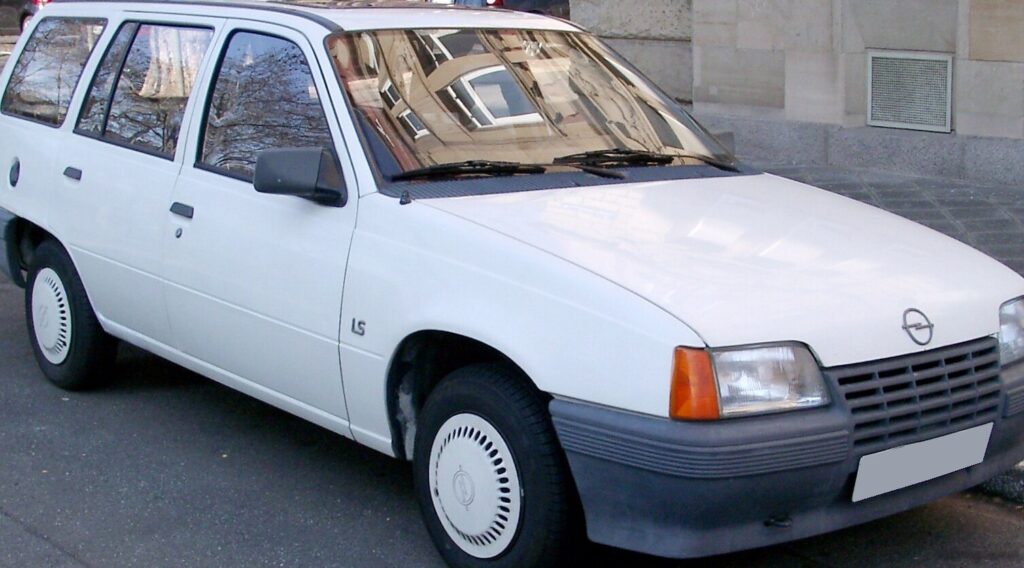
The Opel Kadett E Caravan 1.4 S, produced from 1990 to 1991, represented a practical and affordable option within the broader Kadett E range. Positioned as a mid-range trim level for the Caravan (estate) body style, it offered a balance between economy and usability for families. The Kadett E, launched in 1986, was a significant model for Opel, built on the GM T-platform (internally known as the 1HX0/A3 platform) and shared with other European GM brands like Vauxhall. The Caravan variant, in particular, was popular in Europe for its spaciousness and versatility, catering to buyers needing a practical vehicle for work and leisure.
Technical Specifications
| Brand | Opel |
| Model | Kadett |
| Generation | Kadett E Caravan |
| Type (Engine) | 1.4 S (75 Hp) |
| Start of production | 1990 |
| End of production | 1991 |
| Powertrain Architecture | Internal Combustion engine |
| Body type | Station wagon (estate) |
| Seats | 5 |
| Doors | 5 |
| Fuel Type | Petrol (Gasoline) |
| Maximum speed | 165 km/h (102.53 mph) |
| Weight-to-power ratio | 12.6 kg/Hp, 79.4 Hp/tonne |
| Weight-to-torque ratio | 8.7 kg/Nm, 114.4 Nm/tonne |
| Power | 75 Hp @ 5600 rpm |
| Power per litre | 54 Hp/l |
| Torque | 108 Nm @ 3000 rpm (79.66 lb.-ft. @ 3000 rpm) |
| Engine layout | Front, Transverse |
| Engine Model/Code | 14NV |
| Engine displacement | 1389 cm3 (84.76 cu. in.) |
| Number of cylinders | 4 |
| Engine configuration | Inline |
| Cylinder Bore | 77.6 mm (3.06 in.) |
| Piston Stroke | 73.4 mm (2.89 in.) |
| Compression ratio | 9.4:1 |
| Number of valves per cylinder | 2 |
| Fuel injection system | Carburettor |
| Engine aspiration | Naturally aspirated engine |
| Valvetrain | SOHC |
| Engine oil capacity | 3 l (3.17 US qt | 2.64 UK qt) |
| Coolant | 6.2 l (6.55 US qt | 5.46 UK qt) |
| Kerb Weight | 944 kg (2081.16 lbs.) |
| Max. weight | 1435 kg (3163.63 lbs.) |
| Max load | 491 kg (1082.47 lbs.) |
| Trunk (boot) space – minimum | 565 l (19.95 cu. ft.) |
| Trunk (boot) space – maximum | 1800 l (63.57 cu. ft.) |
| Fuel tank capacity | 50 l (13.21 US gal | 11 UK gal) |
| Length | 4228 mm (166.46 in.) |
| Width | 1666 mm (65.59 in.) |
| Height | 1430 mm (56.3 in.) |
| Wheelbase | 2520 mm (99.21 in.) |
| Front track | 1400 mm (55.12 in.) |
| Rear (Back) track | 1406 mm (55.35 in.) |
| Minimum turning circle (turning diameter) | 10.5 m (34.45 ft.) |
| Drivetrain Architecture | The Internal combustion engine (ICE) drives the front wheels of the vehicle. |
| Drive wheel | Front wheel drive |
| Number of gears and type of gearbox | 5 gears, manual transmission |
| Front suspension | Independent type McPherson |
| Rear suspension | Independent coil spring |
| Front brakes | Disc |
| Rear brakes | Drum |
| Steering type | Steering rack and pinion |
Powertrain & Engine Architecture
The Kadett E Caravan 1.4 S utilized the 14NV engine, a 1.4-liter inline-four cylinder petrol engine. This engine was a relatively simple design, featuring a single overhead camshaft (SOHC) valvetrain with two valves per cylinder. Crucially, this variant employed a carburetor for fuel delivery, a cost-saving measure compared to the fuel injection systems found on higher-spec Kadett models. The carburetor, while less efficient than injection, contributed to the 1.4 S’s affordability. The engine produced 75 horsepower at 5600 rpm and 108 Nm (79.66 lb-ft) of torque at 3000 rpm. The engine was transversely mounted, driving the front wheels. The 14NV engine was known for its durability, but its performance was modest by modern standards.
Driving Characteristics
The 1.4 S, paired with a five-speed manual transmission, offered adequate, but not exhilarating, performance. Acceleration was leisurely, and overtaking required careful planning. The carburetor contributed to a slightly sluggish throttle response compared to fuel-injected counterparts. The five-speed gearbox helped to keep the engine within its optimal power band, but the overall driving experience was geared towards economy and practicality rather than sporty handling. Compared to the more powerful Kadett E variants, such as the 1.6 or 2.0-liter models, the 1.4 S felt noticeably underpowered, especially when fully loaded with passengers and cargo. However, its lighter weight compared to those larger-engined models did offer some compensation in terms of fuel efficiency and maneuverability.
Equipment & Trim Levels
The 1.4 S trim level offered a reasonable level of equipment for its price point. Standard features typically included basic cloth upholstery, a simple dashboard layout, and manual windows and door locks. Power steering was often an optional extra. The Caravan body style, of course, provided a large and versatile cargo area, making it ideal for families or those needing to transport bulky items. Optional extras could include a sunroof, upgraded stereo system, and more comfortable seating. The interior was functional and durable, prioritizing practicality over luxury.
Chassis & Braking
The Kadett E Caravan featured an independent McPherson strut suspension at the front and an independent coil spring suspension at the rear. This setup provided a reasonably comfortable ride, although it wasn’t particularly sporty. The front brakes were disc brakes, offering adequate stopping power, while the rear brakes were drum brakes, a cost-saving measure common in this class of vehicle. The steering was a rack and pinion system, providing precise and responsive handling. Stabilizer bars were typically fitted to improve body roll during cornering.
Market Reception & Comparison
The Kadett E Caravan 1.4 S was generally well-received as an affordable and practical family car. Critics praised its spacious interior, versatility, and fuel efficiency. However, the engine’s modest power output was often cited as a drawback. Compared to other Kadett E variants, the 1.4 S offered the most affordable entry point into the range, making it popular with budget-conscious buyers. The 1.6-liter version offered a noticeable performance improvement, but at a higher price. The diesel variants (like the 1.6D) prioritized fuel economy even further, but sacrificed performance. The 1.4 S struck a balance, appealing to those who needed a practical car without breaking the bank.
Legacy
The Opel Kadett E Caravan 1.4 S, while not a performance icon, remains a fondly remembered vehicle for many European drivers. The 14NV engine, while simple, proved to be relatively reliable, and parts availability remains reasonable even today. In the used car market, these Kadetts are often sought after by enthusiasts looking for a classic and affordable European car. The Caravan body style, in particular, is valued for its practicality and spaciousness. While rust can be an issue with older examples, well-maintained Kadett E Caravans 1.4 S models continue to provide reliable and affordable transportation.