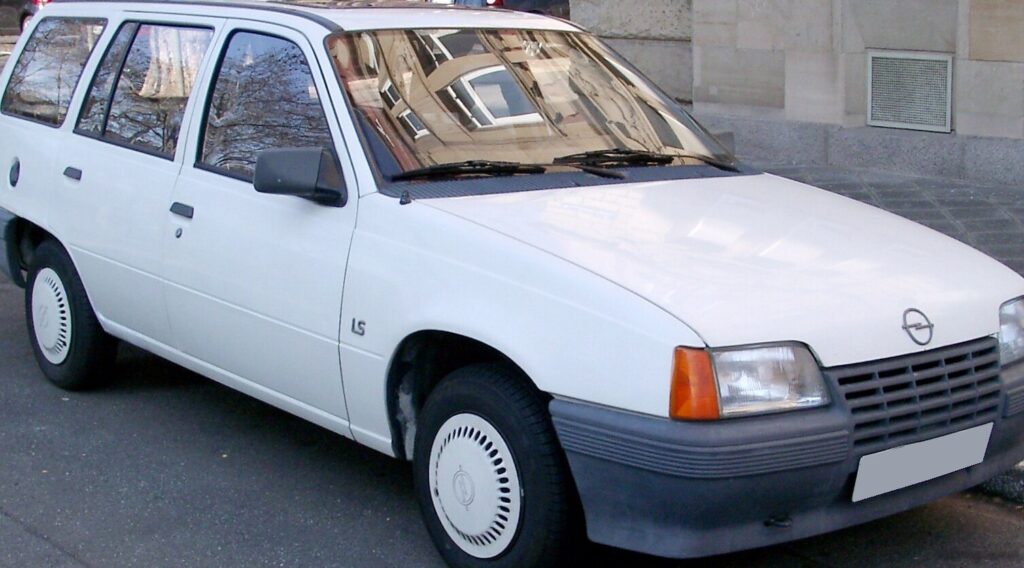
The Opel Kadett E Caravan 1.4i, producing 60 horsepower, was a mainstay of the Kadett E range during its relatively short production run from 1990 to 1991. Positioned as the entry-level variant of the Caravan (estate) body style, it offered practical family transport at an affordable price point. The Kadett E, launched in 1986, represented a significant step forward for Opel, utilizing the GM T-platform (internally known as the 1HX0/A3 platform) which also underpinned models like the Vauxhall Astra, Isuzu Gemini, and Holden Nova. The Caravan body style, introduced alongside the hatchback and sedan, catered to buyers needing increased cargo capacity. This particular 1.4i model was primarily aimed at budget-conscious buyers and those prioritizing fuel economy over outright performance.
Technical Specifications
| Brand | Opel |
| Model | Kadett |
| Generation | Kadett E Caravan |
| Type (Engine) | 1.4i (60 Hp) |
| Start of production | 1990 |
| End of production | 1991 |
| Powertrain Architecture | Internal Combustion engine |
| Body type | Station wagon (estate) |
| Seats | 5 |
| Doors | 5 |
| Fuel Type | Petrol (Gasoline) |
| Acceleration 0 – 100 km/h | 16 sec |
| Acceleration 0 – 62 mph | 16 sec |
| Acceleration 0 – 60 mph | 15.2 sec |
| Maximum speed | 155 km/h (96.31 mph) |
| Weight-to-power ratio | 15.7 kg/Hp, 63.6 Hp/tonne |
| Weight-to-torque ratio | 9.2 kg/Nm, 109.1 Nm/tonne |
| Power | 60 Hp @ 5600 rpm |
| Power per litre | 43.2 Hp/l |
| Torque | 103 Nm @ 2600 rpm (75.97 lb.-ft. @ 2600 rpm) |
| Engine layout | Front, Transverse |
| Engine Model/Code | C14NZ |
| Engine displacement | 1389 cm3 (84.76 cu. in.) |
| Number of cylinders | 4 |
| Engine configuration | Inline |
| Cylinder Bore | 77.6 mm (3.06 in.) |
| Piston Stroke | 73.4 mm (2.89 in.) |
| Compression ratio | 9.4:1 |
| Number of valves per cylinder | 2 |
| Fuel injection system | Multi-port manifold injection |
| Engine aspiration | Naturally aspirated engine |
| Valvetrain | SOHC |
| Engine oil capacity | 3 l (3.17 US qt | 2.64 UK qt) |
| Coolant | 6.2 l (6.55 US qt | 5.46 UK qt) |
| Kerb Weight | 944 kg (2081.16 lbs.) |
| Max. weight | 1435 kg (3163.63 lbs.) |
| Max load | 491 kg (1082.47 lbs.) |
| Trunk (boot) space – minimum | 565 l (19.95 cu. ft.) |
| Trunk (boot) space – maximum | 1800 l (63.57 cu. ft.) |
| Fuel tank capacity | 50 l (13.21 US gal | 11 UK gal) |
| Length | 4228 mm (166.46 in.) |
| Width | 1666 mm (65.59 in.) |
| Height | 1430 mm (56.3 in.) |
| Wheelbase | 2520 mm (99.21 in.) |
| Front track | 1400 mm (55.12 in.) |
| Rear (Back) track | 1406 mm (55.35 in.) |
| Minimum turning circle | 10.5 m (34.45 ft.) |
| Drivetrain Architecture | The Internal combustion engine (ICE) drives the front wheels of the vehicle. |
| Drive wheel | Front wheel drive |
| Number of gears and type of gearbox | 5 gears, manual transmission |
| Front brakes | Disc |
| Rear brakes | Drum |
Powertrain & Engine Architecture
The heart of the Kadett E Caravan 1.4i was the C14NZ engine, a 1.4-liter inline-four cylinder unit. This engine was a relatively simple design, featuring a single overhead camshaft (SOHC) operating two valves per cylinder. Fuel delivery was handled by a multi-port fuel injection system, a step up from the carburetors used in earlier Kadett models. The C14NZ was known for its durability, though it wasn’t a powerhouse. The engine produced 60 horsepower at 5600 rpm and 103 Nm (76 lb-ft) of torque at 2600 rpm. The engine’s design prioritized fuel efficiency and low emissions, aligning with the growing environmental concerns of the early 1990s. The standard transmission was a five-speed manual gearbox, designed to make the most of the engine’s limited power output.
Driving Characteristics
The 1.4i Caravan, with its 60 horsepower, wasn’t designed for spirited driving. Acceleration was modest, taking around 16 seconds to reach 62 mph (100 km/h). The five-speed manual transmission helped to keep the engine in its optimal power band, but overtaking required careful planning. Compared to the more powerful 1.6-liter and 2.0-liter Kadett E variants, the 1.4i felt noticeably slower. However, the lighter engine weight contributed to better handling and a more nimble feel, particularly in urban environments. The gear ratios were spaced to prioritize fuel economy, resulting in a relatively relaxed driving experience at highway speeds.
Equipment & Trim Levels
The Kadett E Caravan 1.4i was typically equipped with basic, but functional, features. Standard equipment included cloth upholstery, a basic instrument cluster, and manual windows and door locks. Power steering was often an optional extra, as was a radio. The interior was designed with practicality in mind, featuring durable materials and a straightforward layout. The Caravan body style itself was the key feature, offering a generous 565 liters of luggage space (expanding to 1800 liters with the rear seats folded down). Trim levels were relatively limited for the 1.4i model, with most cars being fairly spartan in their specification.
Chassis & Braking
The Kadett E Caravan utilized a MacPherson strut front suspension and a twist-beam rear suspension. The front brakes were disc brakes, providing adequate stopping power, while the rear brakes were drum brakes, a cost-saving measure common in entry-level models. Stabilizer bars were often omitted on the base 1.4i model to further reduce costs. The suspension was tuned for comfort rather than outright handling, providing a reasonably smooth ride on most road surfaces. The relatively lightweight construction of the Kadett E helped to mitigate the limitations of the basic suspension setup.
Market Reception & Comparison
The Kadett E Caravan 1.4i was generally well-received as an affordable and practical family car. Critics acknowledged its fuel efficiency and spacious interior, but noted its lack of performance. Compared to the higher-spec Kadett E models, such as the 1.6 and 2.0-liter versions, the 1.4i offered a significantly lower price point, making it accessible to a wider range of buyers. The 1.4i also compared favorably to competitors like the Ford Escort and Vauxhall Astra in terms of value for money. However, the more powerful alternatives offered a more engaging driving experience.
Legacy
The C14NZ engine, while not known for its performance, proved to be a reliable and durable unit. Many Kadett E Caravan 1.4i models remain on the road today, a testament to their build quality and mechanical simplicity. In the used car market, these models are often sought after by those looking for a cheap and cheerful classic car or a project vehicle. Parts availability is generally good, and the relatively simple engine design makes it relatively easy to maintain and repair. The Kadett E Caravan 1.4i represents a practical and affordable option from a bygone era of automotive engineering, offering a glimpse into the family car landscape of the early 1990s.