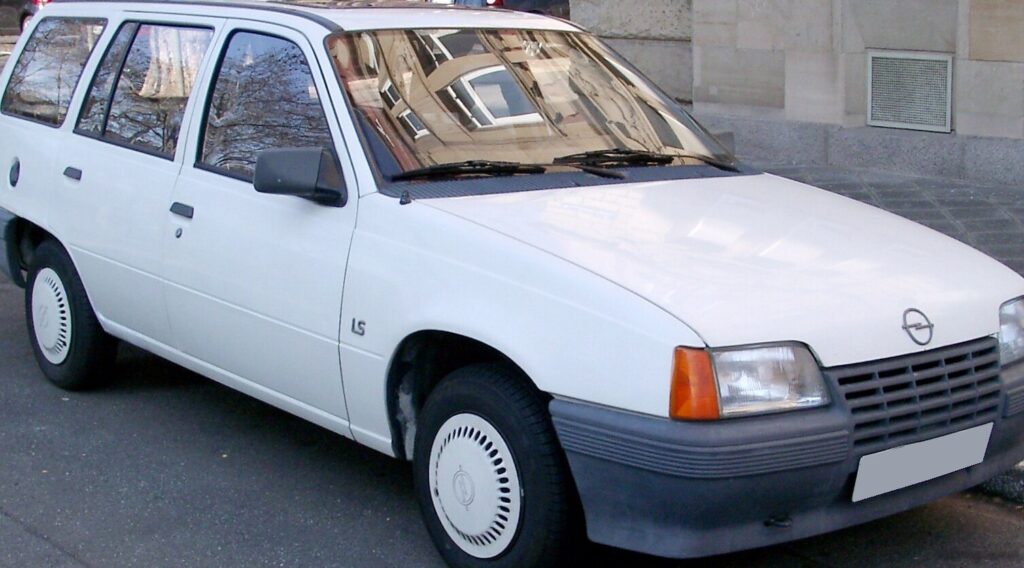
The Opel Kadett E Caravan 1.6, producing 82 horsepower, was a mainstay of the European family car market from 1986 to 1991. Positioned as an affordable and practical option within the Kadett E range, it offered a spacious estate body style combined with a relatively economical engine. This variant represented a core offering for buyers prioritizing utility and value over outright performance. The Kadett E, overall, was a significant model for Opel, representing a move towards more modern design and engineering compared to its predecessors, and was built on the GM T platform (internally known as the 1HX0/A3 platform). The Caravan (estate) body style was particularly popular in Europe, where practicality was highly valued.
Technical Specifications
| Brand | Opel |
| Model | Kadett |
| Generation | Kadett E Caravan |
| Type (Engine) | 1.6 (82 Hp) |
| Start of production | 1986 |
| End of production | 1991 |
| Powertrain Architecture | Internal Combustion engine |
| Body type | Station wagon (estate) |
| Seats | 5 |
| Doors | 3-5 |
| Fuel Type | Petrol (Gasoline) |
| Acceleration 0 – 100 km/h | 13 sec |
| Acceleration 0 – 62 mph | 13 sec |
| Acceleration 0 – 60 mph | 12.4 sec |
| Maximum speed | 170 km/h (105.63 mph) |
| Weight-to-power ratio | 11.2 kg/Hp, 89.1 Hp/tonne |
| Weight-to-torque ratio | 7.1 kg/Nm, 141.3 Nm/tonne |
| Power | 82 Hp @ 5400 rpm |
| Power per litre | 51.3 Hp/l |
| Torque | 130 Nm @ 2600 rpm (95.88 lb.-ft. @ 2600 rpm) |
| Engine layout | Front, Transverse |
| Engine Model/Code | 16SV |
| Engine displacement | 1598 cm3 (97.52 cu. in.) |
| Number of cylinders | 4 |
| Engine configuration | Inline |
| Cylinder Bore | 80 mm (3.15 in.) |
| Piston Stroke | 79.5 mm (3.13 in.) |
| Compression ratio | 10:1 |
| Number of valves per cylinder | 2 |
| Fuel injection system | Carburettor |
| Engine aspiration | Naturally aspirated engine |
| Valvetrain | SOHC |
| Engine oil capacity | 3.5 l (3.7 US qt | 3.08 UK qt) |
| Coolant | 6.4 l (6.76 US qt | 5.63 UK qt) |
| Kerb Weight | 920 kg (2028.25 lbs) |
| Max. weight | 1460 kg (3218.75 lbs) |
| Max load | 540 kg (1190.5 lbs) |
| Trunk (boot) space – minimum | 565 l (19.95 cu. ft.) |
| Trunk (boot) space – maximum | 1800 l (63.57 cu. ft.) |
| Fuel tank capacity | 50 l (13.21 US gal | 11 UK gal) |
| Length | 4228 mm (166.46 in.) |
| Width | 1666 mm (65.59 in.) |
| Height | 1430 mm (56.3 in.) |
| Wheelbase | 2520 mm (99.21 in.) |
| Front track | 1400 mm (55.12 in.) |
| Rear (Back) track | 1406 mm (55.35 in.) |
| Minimum turning circle | 10.5 m (34.45 ft.) |
| Drivetrain Architecture | The Internal combustion engine (ICE) drives the front wheels of the vehicle. |
| Drive wheel | Front wheel drive |
| Number of gears and type of gearbox | 4 gears, manual transmission |
| Front brakes | Disc |
| Rear brakes | Drum |
| Steering type | Steering rack and pinion |
Powertrain & Engine Architecture
The Kadett E Caravan 1.6 utilized the 16SV engine, a 1.6-liter inline-four cylinder engine. This engine was a relatively simple design, featuring a single overhead camshaft (SOHC) and two valves per cylinder. Crucially, this version employed a carburetor for fuel delivery, rather than fuel injection, which was becoming more common in the late 1980s. The carburetor contributed to its lower cost but also resulted in slightly less precise fuel metering and potentially higher emissions compared to injected engines. The 16SV produced 82 horsepower at 5400 rpm and 96 lb-ft of torque at 2600 rpm. The engine was transversely mounted in the front of the vehicle, driving the front wheels. The standard transmission was a four-speed manual gearbox, although a three-speed automatic transmission was also available, albeit less common.
Driving Characteristics
The 1.6-liter engine, paired with the four-speed manual transmission, provided adequate, but not exhilarating, performance. Acceleration from 0 to 60 mph took around 12.4 seconds, and top speed was approximately 106 mph. The engine felt somewhat strained at higher speeds, and overtaking required careful planning. The carburetor contributed to a slightly sluggish throttle response compared to fuel-injected counterparts. The four-speed gearbox offered reasonable spacing, but the lack of a fifth gear meant engine speeds were higher at highway cruising speeds, impacting fuel economy and noise levels. Compared to the more powerful Kadett E variants, such as those with the 2.0-liter engine, the 1.6 felt noticeably slower, but it offered a more relaxed and fuel-efficient driving experience.
Equipment & Trim Levels
The 1.6-liter Kadett E Caravan typically came with a fairly basic level of equipment. Standard features generally included cloth upholstery, a basic instrument cluster, and manual windows and door locks. Power steering was often an optional extra, as was a sunroof. Higher trim levels, such as the “GL” offered additional features like upgraded upholstery, a more comprehensive instrument panel, and potentially alloy wheels. The Caravan’s strength lay in its practicality; the large cargo area was a key selling point. The rear seats could be folded down to create a substantial loading space, making it ideal for families and those needing to transport bulky items.
Chassis & Braking
The Kadett E Caravan featured a MacPherson strut front suspension and a twist-beam rear suspension. This setup provided a comfortable ride, but handling was not particularly sporty. The front brakes were disc brakes, while the rear brakes were drum brakes – a common configuration for this class of vehicle at the time. The steering was a rack-and-pinion system, providing reasonable precision. Stabilizer bars were often fitted to improve body roll control, but their presence varied depending on the trim level.
Market Reception & Comparison
The Kadett E Caravan 1.6 was generally well-received as a practical and affordable family car. Critics praised its spacious interior and large cargo area, but noted that the engine lacked refinement and performance compared to some of its rivals. Compared to other Kadett E variants, such as the 2.0-liter models, the 1.6 offered better fuel economy but significantly less power. Against competitors like the Ford Escort Estate and Volkswagen Golf Estate, the Kadett E Caravan 1.6 offered a competitive price point and a generous amount of space. Reliability was generally good, although the carburetor required periodic adjustment and maintenance.
Legacy
The Opel Kadett E Caravan 1.6, while not a performance icon, remains a fondly remembered vehicle for many European drivers. Its simplicity and practicality have made it a relatively reliable and affordable used car. The 16SV engine, while not particularly sophisticated, is known for its durability. Today, well-maintained examples are sought after by classic car enthusiasts and those looking for a nostalgic driving experience. The Kadett E Caravan, in all its variants, represents a significant chapter in Opel’s history, marking a transition towards more modern automotive design and engineering.