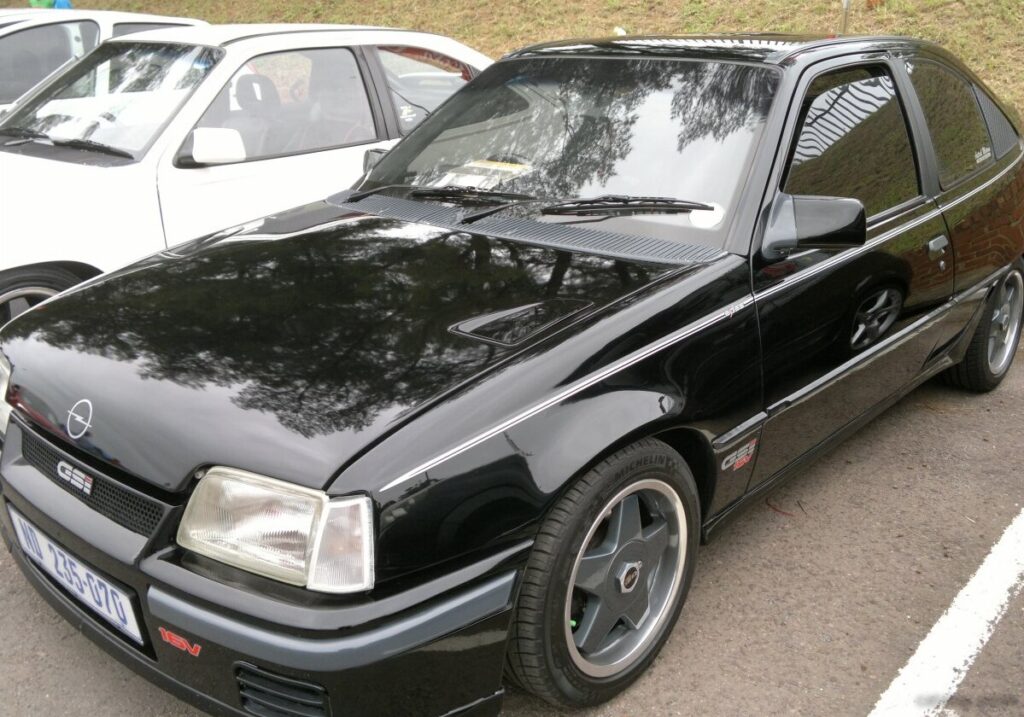
The Opel Kadett E CC 1.2, producing 55 horsepower, was a mainstay of the European small car market from 1984 to 1986. Positioned as the entry-level variant of the Kadett E range, it offered affordable transportation during a period of economic recovery in Europe. The “CC” designation signified the ‘Coupe’ or fastback body style, a three-door hatchback that proved popular with younger drivers and those seeking a practical, economical vehicle. This model played a significant role in establishing the Kadett E as one of Opel’s best-selling cars, competing directly with rivals like the Volkswagen Golf, Ford Escort, and Fiat Uno.
Technical Specifications
| Brand | Opel |
| Model | Kadett |
| Generation | Kadett E CC |
| Type (Engine) | 1.2 (55 Hp) |
| Start of production | 1984 |
| End of production | 1986 |
| Powertrain Architecture | Internal Combustion engine |
| Body type | Hatchback |
| Seats | 5 |
| Doors | 3 |
| Fuel Type | Petrol (Gasoline) |
| Acceleration 0 – 100 km/h | 17 sec |
| Acceleration 0 – 62 mph | 17 sec |
| Acceleration 0 – 60 mph | 16.2 sec |
| Maximum speed | 155 km/h (96.31 mph) |
| Weight-to-power ratio | 15.3 kg/Hp, 65.5 Hp/tonne |
| Weight-to-torque ratio | 10 kg/Nm, 100 Nm/tonne |
| Power | 55 Hp @ 5600 rpm |
| Power per litre | 46 Hp/l |
| Torque | 84 Nm @ 3600 rpm (61.96 lb.-ft. @ 3600 rpm) |
| Engine layout | Front, Transverse |
| Engine Model/Code | 12SC, 12ST |
| Engine displacement | 1196 cm3 (72.98 cu. in.) |
| Number of cylinders | 4 |
| Engine configuration | Inline |
| Cylinder Bore | 79 mm (3.11 in.) |
| Piston Stroke | 61 mm (2.4 in.) |
| Compression ratio | 9:1 |
| Number of valves per cylinder | 2 |
| Fuel injection system | Carburettor |
| Engine aspiration | Naturally aspirated engine |
| Valvetrain | OHV |
| Engine oil capacity | 2.75 l (2.91 US qt | 2.42 UK qt) |
| Coolant | 5.7 l (6.02 US qt | 5.02 UK qt) |
| Kerb Weight | 840 kg (1851.88 lbs.) |
| Max. weight | 1345 kg (2965.22 lbs.) |
| Max load | 505 kg (1113.33 lbs.) |
| Trunk (boot) space – minimum | 485 l (17.13 cu. ft.) |
| Trunk (boot) space – maximum | 1385 l (48.91 cu. ft.) |
| Fuel tank capacity | 52 l (13.74 US gal | 11.44 UK gal) |
| Length | 3998 mm (157.4 in.) |
| Width | 1663 mm (65.47 in.) |
| Height | 1400 mm (55.12 in.) |
| Wheelbase | 2520 mm (99.21 in.) |
| Front track | 1400 mm (55.12 in.) |
| Rear (Back) track | 1406 mm (55.35 in.) |
| Minimum turning circle | 10.5 m (34.45 ft.) |
| Drivetrain Architecture | The Internal combustion engine (ICE) drives the front wheels of the vehicle. |
| Drive wheel | Front wheel drive |
| Number of gears and type of gearbox | 4 gears, manual transmission |
| Front brakes | Disc |
| Rear brakes | Drum |
Powertrain & Engine Architecture
The heart of the Kadett E CC 1.2 was the 1196cc inline-four cylinder engine, designated as either 12SC or 12ST depending on minor variations. This engine featured a relatively simple overhead valve (OHV) valvetrain with two valves per cylinder. Fuel delivery was handled by a single carburetor, a common setup for economy-focused cars of the era. The engine’s modest 55 horsepower at 5600 rpm and 62 lb-ft of torque at 3600 rpm were sufficient for city driving and moderate highway speeds, but it wasn’t designed for spirited performance. The engine was transversely mounted, driving the front wheels through a four-speed manual transmission. This configuration maximized interior space and contributed to the Kadett’s relatively compact footprint.
Driving Characteristics
The 1.2-liter Kadett E CC offered a predictable, if uninspiring, driving experience. Acceleration was leisurely, taking around 17 seconds to reach 62 mph. The four-speed gearbox was geared for economy, meaning higher gears were engaged at lower speeds. This resulted in a quiet ride at cruising speeds, but required frequent downshifts when overtaking or climbing hills. Compared to the more powerful 1.6-liter and later 2.0-liter Kadett variants, the 1.2 felt noticeably underpowered. However, its lighter weight and simpler mechanicals made it more nimble in urban environments. The manual transmission provided a direct connection to the engine, allowing drivers to make the most of the available power.
Equipment & Trim Levels
The 1.2-liter Kadett E CC was typically offered in a basic trim level, focusing on affordability. Standard features included cloth upholstery, a basic instrument cluster, and manually operated windows and door locks. Options were limited but could include a radio, upgraded interior trim, and occasionally, a sunroof. The interior was functional and durable, prioritizing practicality over luxury. The dashboard layout was straightforward, with clearly labeled controls. The three-door hatchback configuration provided reasonable access to the rear seats, although space was somewhat limited.
Chassis & Braking
The Kadett E CC utilized a MacPherson strut front suspension and a torsion beam rear suspension. This setup provided a comfortable ride, although handling was not particularly sporty. The front brakes were disc brakes, offering adequate stopping power, while the rear brakes were drums, a cost-saving measure common in this class of vehicle. The steering was manual, providing a direct feel but requiring more effort at low speeds. The Kadett’s relatively lightweight construction helped to compensate for the modest braking performance.
Market Reception & Comparison
The Kadett E CC 1.2 was well-received as an affordable and reliable small car. Critics praised its fuel economy and practicality, but noted its lack of performance. Compared to the higher-spec Kadett models, the 1.2 offered a significantly lower price point, making it accessible to a wider range of buyers. The 1.6-liter Kadett offered a noticeable performance improvement, but at a higher cost. The 1.2’s simplicity also translated to lower maintenance costs, making it an attractive option for budget-conscious drivers. Fuel economy was a strong point, averaging around 35-40 mpg in real-world driving.
Legacy
The Opel Kadett E CC 1.2, while not a performance icon, remains a fondly remembered car for many European drivers. Its robust engine and simple mechanicals contributed to its long-term reliability. Today, well-maintained examples are becoming increasingly collectible, particularly among enthusiasts of classic Opel vehicles. The 1.2-liter engine, while modest by modern standards, proved to be durable and relatively easy to repair. The Kadett E CC 1.2 represents a significant chapter in Opel’s history, embodying the brand’s commitment to providing affordable and practical transportation to the masses. Finding one in good condition today is a testament to its build quality and enduring appeal.