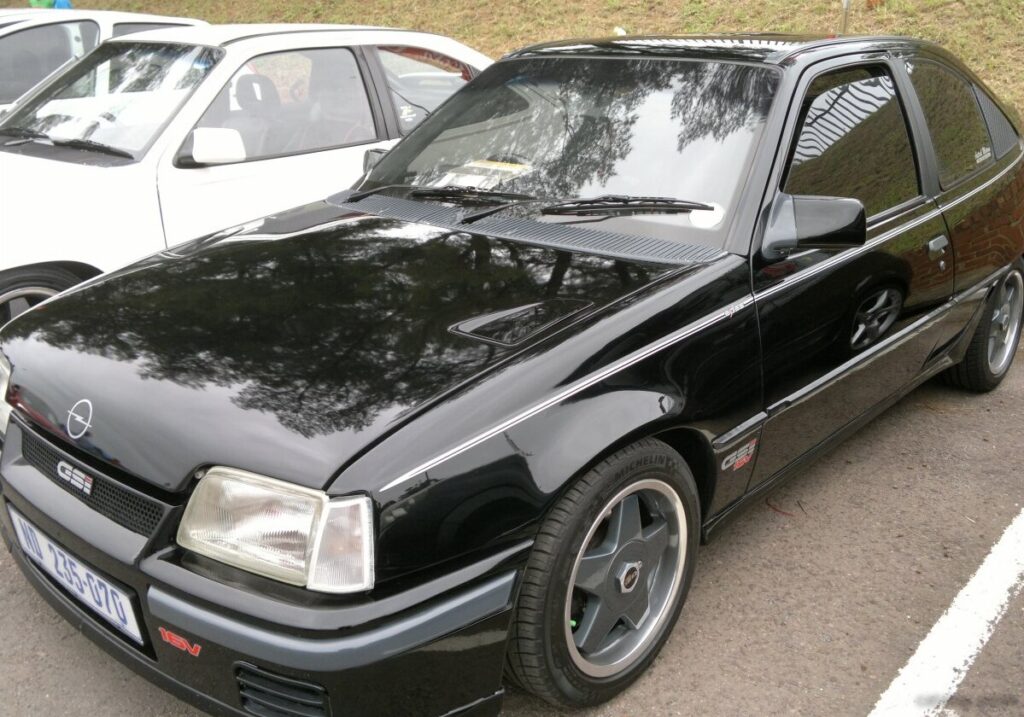
The Opel Kadett E CC 1.3 S, produced between 1984 and 1986, represented an entry-level offering within the broader Kadett E range. This variant, powered by a 1.3-liter engine producing 75 horsepower, was aimed at buyers seeking affordable and economical transportation. The Kadett E, launched in 1984, was a significant model for Opel, representing a move towards more modern design and engineering. It was built on the GM T-platform, shared with other European and North American models like the Vauxhall Astra, Isuzu Gemini, and Buick Skyhawk. The “CC” designation signified the Kadett’s ‘Coupé’ or hatchback body style, which was the most popular configuration. The 1.3 S trim occupied the lower end of the performance spectrum, positioned below the more powerful 1.6-liter and later 2.0-liter variants.
Technical Specifications
| Brand | Opel |
| Model | Kadett |
| Generation | Kadett E CC |
| Type (Engine) | 1.3 S (75 Hp) |
| Start of production | 1984 |
| End of production | 1986 |
| Powertrain Architecture | Internal Combustion engine |
| Body type | Hatchback |
| Seats | 5 |
| Doors | 3-5 |
| Fuel Type | Petrol (Gasoline) |
| Acceleration 0 – 100 km/h | 13 sec |
| Acceleration 0 – 62 mph | 13 sec |
| Acceleration 0 – 60 mph | 12.4 sec |
| Maximum speed | 173 km/h (107.5 mph) |
| Weight-to-power ratio | 11.7 kg/Hp, 85.2 Hp/tonne |
| Weight-to-torque ratio | 8.7 kg/Nm, 114.8 Nm/tonne |
| Power | 75 Hp @ 5800 rpm |
| Power per litre | 57.8 Hp/l |
| Torque | 101 Nm @ 4200 rpm (74.49 lb.-ft. @ 4200 rpm) |
| Engine layout | Front, Transverse |
| Engine Model/Code | 13S |
| Engine displacement | 1297 cm3 (79.15 cu. in.) |
| Number of cylinders | 4 |
| Engine configuration | Inline |
| Cylinder Bore | 75 mm (2.95 in.) |
| Piston Stroke | 73.4 mm (2.89 in.) |
| Compression ratio | 9.2:1 |
| Number of valves per cylinder | 2 |
| Fuel injection system | Carburettor |
| Engine aspiration | Naturally aspirated engine |
| Valvetrain | SOHC |
| Engine oil capacity | 3 l (3.17 US qt | 2.64 UK qt) |
| Coolant | 7 l (7.4 US qt | 6.16 UK qt) |
| Kerb Weight | 880 kg (1940.07 lbs.) |
| Max. weight | 1365 kg (3009.31 lbs.) |
| Max load | 485 kg (1069.24 lbs.) |
| Trunk (boot) space – minimum | 485 l (17.13 cu. ft.) |
| Trunk (boot) space – maximum | 1385 l (48.91 cu. ft.) |
| Fuel tank capacity | 52 l (13.74 US gal | 11.44 UK gal) |
| Length | 3998 mm (157.4 in.) |
| Width | 1663 mm (65.47 in.) |
| Height | 1400 mm (55.12 in.) |
| Wheelbase | 2520 mm (99.21 in.) |
| Front track | 1400 mm (55.12 in.) |
| Rear (Back) track | 1406 mm (55.35 in.) |
| Minimum turning circle | 10.5 m (34.45 ft.) |
| Drivetrain Architecture | The Internal combustion engine (ICE) drives the front wheels of the vehicle. |
| Drive wheel | Front wheel drive |
| Number of gears and type of gearbox | 5 gears, manual transmission |
| Front brakes | Disc |
| Rear brakes | Drum |
Powertrain & Engine Architecture
The heart of the Kadett E 1.3 S was the 13S engine, a 1.3-liter inline-four cylinder unit. This engine featured a single overhead camshaft (SOHC) valvetrain and utilized a carburetor for fuel delivery. While relatively simple in design, the 13S engine was known for its durability and ease of maintenance. The carburetor system, while less efficient than fuel injection, contributed to the engine’s affordability. The engine produced 75 horsepower at 5800 rpm and 101 Nm (74.49 lb-ft) of torque at 4200 rpm. The engine was transversely mounted in the front of the vehicle, driving the front wheels. The standard transmission was a five-speed manual gearbox, although a three-speed automatic transmission was offered as an option, albeit less common in this specific trim.
Driving Characteristics
The 1.3 S, with its 75 horsepower, offered modest performance. Acceleration from 0 to 100 km/h (0-62 mph) took approximately 13 seconds, and top speed was around 173 km/h (107.5 mph). Compared to the 1.6-liter and 2.0-liter Kadett E models, the 1.3 S felt noticeably slower, particularly when fully loaded or climbing hills. The five-speed manual transmission helped to keep the engine in its optimal power band, but the carburetor could sometimes lead to a slight hesitation during acceleration. The automatic transmission, when equipped, further reduced performance and increased fuel consumption. The Kadett E’s handling was generally considered safe and predictable, but not particularly sporty. The suspension was tuned for comfort rather than outright performance.
Equipment & Trim Levels
The Kadett E 1.3 S was typically equipped with basic but functional features. Standard equipment included cloth upholstery, a simple dashboard layout, and manual windows and door locks. Power steering and central locking were often optional extras. The interior was designed with practicality in mind, offering adequate space for five passengers. Trim levels varied depending on the market, but generally, the 1.3 S represented the entry point into the Kadett E range. Optional extras could include a radio, upgraded speakers, and a sunroof.
Chassis & Braking
The Kadett E featured a MacPherson strut front suspension and a twist-beam rear suspension. The front brakes were disc brakes, providing adequate stopping power, while the rear brakes were drum brakes, a cost-saving measure for the entry-level model. The steering was a rack-and-pinion system. The Kadett E’s chassis was relatively lightweight, contributing to its fuel efficiency. Stabilizer bars were often optional, and their presence could improve handling.
Market Reception & Comparison
The Kadett E 1.3 S was well-received as an affordable and reliable family car. Critics praised its fuel economy and practicality, but noted its lack of performance compared to higher-spec models. Compared to the 1.6-liter Kadett E, the 1.3 S offered lower running costs but significantly less power. The 1.6-liter version was often considered a better all-around choice for those willing to spend a little more. The 1.3 S appealed to buyers who prioritized economy and simplicity over performance.
Legacy
The Opel Kadett E 1.3 S, while not the most powerful or exciting variant of the Kadett E, remains a popular choice among classic car enthusiasts and those seeking a reliable and affordable vintage vehicle. The 13S engine is known for its durability, and parts availability is generally good. Today, well-maintained examples of the Kadett E 1.3 S can be found in the used car market, often at relatively low prices. Its simplicity and ease of maintenance make it an attractive option for those looking for a classic car project or a dependable daily driver.